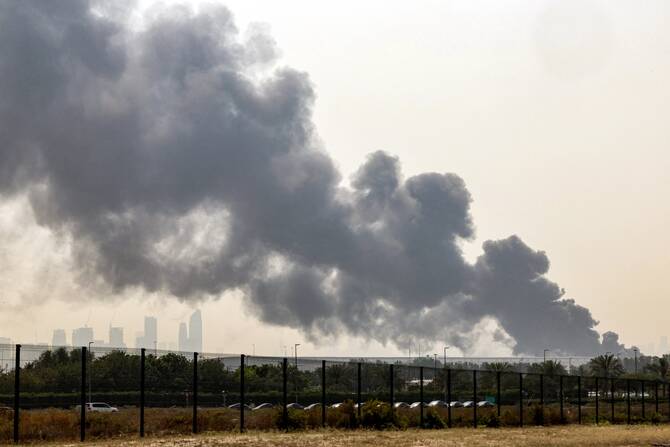
The Gulf’s wartime unity is under threat. Initially, the Gulf Cooperation Council states shared a sense of shock and collectively condemned Iran’s reckless strikes on civilian targets throughout the region. But they refused to join the war and exacerbate the region’s descent into chaos. Five weeks into the conflict, questions abound as to how sustainable that strategy is.
Saudi Foreign Minister Prince Faisal bin Farhan last month publicly warned that the Kingdom’s patience is “not unlimited,” while other Gulf states are allegedly considering military action to open the Strait of Hormuz. Others still are pressing to maintain dialogue with Iran.
This lack of consensus is understandable because the Gulf states have no single, objectively good option. Each of the proposed policies — defense, offense or diplomacy — comes with significant risk. Even if a ceasefire is reached, this will remain true in the next round of fighting. Accordingly, the least-bad choice is not one of the above policies. Instead, the Gulf states should prepare for the future by incorporating all three into their planning.
This lack of consensus is understandable because the Gulf states have no single, objectively good option
Rob Geist Pinfold
Remaining on the defensive indubitably has its drawbacks. As the conflict continues, the Gulf states risk appearing passive, with limited ability to shape events. By absorbing repeated strikes without responding, the GCC risks undermining its deterrence. This means that Tehran has no reason not to attack again. It could also undermine the Gulf states’ military investment. As former US Secretary of State Madeleine Albright once remarked: “What’s the point of having this superb military … if we can’t use it?” A purely defensive posture, then, risks sending the wrong signal: that capacity does not translate into either deterrence or agency.
Yet going on the offensive is no magic bullet. This would risk further drawing the Gulf states deeper into a war they never wanted. Iran could retaliate by targeting critical infrastructure, including desalination plants, or by opening additional fronts. At the strategic level, the risks are even greater. Israel seeks to shift the conflict’s center of gravity away from its own borders and onto Iran. This would provide Israel with strategic depth. Yet it would have the opposite effect for the Gulf states, creating indefinite chaos in their backyard. Further, the US may cajole the GCC into joining its strikes but then step back, leaving them high and dry.
Equally, reverting to the Gulf states’ pre-war preference for dealing with Iran through engagement is neither likely nor desirable. Riyadh and Tehran agreed a detente in 2023, the UAE was Iran’s key trading partner and Qatar maintained open channels to de-escalate tensions. None of this prevented Iran from repeatedly striking each of these Gulf states. Despite claiming to target US bases, Tehran has attacked civilian infrastructure.
The lesson is clear: Iran feels that its behavior carries little cost and it can bluff its way back to dialogue. The GCC must demonstrate that this is not the case. As regime change in Tehran seems increasingly unlikely, the Gulf states should prepare for another round of conflict.
Reverting to the Gulf states’ pre-war preference for dealing with Iran through engagement is neither likely nor desirable
Rob Geist Pinfold
Firstly, the Gulf states should double down on defensive measures. Their record here is strong, given the interception rates in the current conflict. But more could be done. The GCC states should replenish their interceptor stocks in the short-term, while in the longer-term pivoting toward home-grown missile defenses. This would mitigate any threat from supply chain disruption.
The Gulf monarchies also need to invest in target hardening to better insulate critical infrastructure. Similarly, they should prioritize low-cost antidrone technology. This is because, in any future war, an increasingly cash-strapped Iran is likely to rely more heavily on drones, which are cheaper and easier to produce than ballistic missiles.
Second, even if they continue to exercise restraint, the Gulf monarchies should hedge their policy options by preparing a credible military alternative for when diplomacy fails. This should include mine countermeasures vessels and a greater focus on naval forces, given how critical the Strait of Hormuz has been in the current conflict. More investment in naval and air power, channeled through a strengthened and better-integrated Peninsula Shield Force, would significantly enhance its effectiveness as a force multiplier in any future conflict.
Third, however bitter a pill it may be to swallow, geography ensures that the Gulf states have little choice but to coexist with Iran. The GCC’s pre-war engagement strategy rested on the sound deduction that regime collapse or civil war in Iran would bring another failed state to the Gulf’s doorstep. This would harm their reputation for stability and, above all, their economic diversification. The current conflict has only vindicated these fears.
This does not, however, necessitate a return to pre-war detentes and declarations of friendship. Instead, the Gulf states can downgrade their official diplomatic, economic and cultural relations with Iran — no big loss given that their extensive ties in all these sectors did not stop Tehran from attacking — while maintaining elite-level de-escalation channels.
Taken together, these policies would not eliminate the risk of future conflict but they would significantly mitigate it. Iran is currently attacking the GCC states since it seeks to cause maximum regional chaos and economic disruption in order to force the US to stop its attacks. The GCC should therefore reduce its vulnerability through greater resilience and target hardening, while simultaneously raising the costs of aggression by building a more credible and diverse deterrent. Simultaneously, they should maintain diplomatic channels that prioritize de-escalation and containment, rather than the pre-war focus on expansive engagement.
This is not about preserving honor. Instead, it is about ensuring that Iran has less incentive and ability to attack the Gulf states with impunity again. Even if the current conflict ends soon, the Gulf monarchies should hope for the best while preparing for the worst.
BY: Rob Geist Pinfold is a lecturer in Defense Studies (International Security) at King’s College London.
Disclaimer: Views expressed by writers in this section are their own and do not necessarily reflect The Times Union‘ point of view