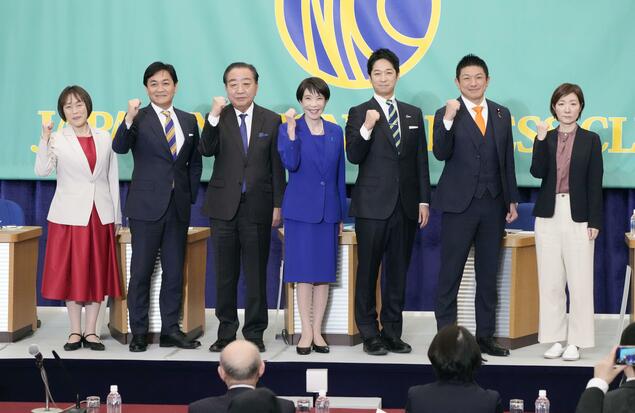
TOKYO – The Liberal Democratic Party seeks to accelerate Prime Minister Sanae Takaichi’s drive to strengthen Japan’s defense capabilities by scoring a landslide victory in Sunday’s general election, hoping to crush those that think the country is going too fast in that direction.
How each party intends to protect Japan from growing threats posed by China and North Korea has been one of the key topics for the election, at a time when the United States is telling other countries to spend more on their own defense.
The recently released U.S. National Defense Strategy document urged allies and partners to increase defense spending to 5 percent of their gross domestic product as it highlighted President Donald Trump’s “America First” and “peace through strength” agenda.
Japan under Takaichi, who took office last October, has brought defense-related spending to its target of 2 percent of GDP in fiscal 2025, two years ahead of the previous schedule.
“If the LDP wins the election by a landslide, Prime Minister Takaichi may harden her already hawkish stance on security issues,” Nihon University political science professor Masahiro Iwasaki said.
He added that what Takaichi is trying to achieve is clearly different from her predecessors and even more aggressive than the late Prime Minister Shinzo Abe’s “proactive” foreign policy.
In explaining why she decided to call the election, Takaichi told a press conference on Jan. 19 she was looking for public mandate and political stability to fearlessly take on bold policies and reforms that could divide the nation.
The LDP’s campaign pledges include the first-ever revision to the postwar pacifist Constitution and a strengthening of intelligence operations.
The latest Kyodo News survey showed Monday the LDP could win 233 or more of the 465 seats on its own, securing a majority and far more than the 198 it held before the House of Representatives was dissolved. The newly formed main opposition Centrist Reform Alliance, meanwhile, is expected to perform poorly.
Among signs of the most severe security environment of the postwar era for Japan, China’s military has been actively conducting assertive air and sea operations across the Indo-Pacific, while North Korea has repeatedly launched ballistic missiles toward the Sea of Japan, including two short-range missiles on Jan. 27.
“Because the quality and quantity of the weapons systems and militaries are growing, it is expected and understandable for Japan to increase its defense spending,” Robert Eldridge, director in charge of North Asia at the Global Risk Mitigation Foundation, said, adding that “Japan has spent so little over the past 70 years.”
“Japan increasingly understands it cannot over-rely on the United States, which has the entire globe to look at,” the award-winning author and scholar said. “As such, Japan needs to do what it can for its own defense as well as the regional balance.”
At present, the United States has more than 50,000 active-duty troops stationed in Japan, the most anywhere in the world outside of the United States, followed by Germany and South Korea, according to U.S. government data.
Last week, Japan and the United States agreed to bolster alliance deterrence and response capabilities when Vice Foreign Minister Takehiro Funakoshi met in Tokyo with Elbridge Colby, the Pentagon’s undersecretary for policy, a key figure in U.S. efforts to push allies and partners to raise defense spending.
Prior to his Japan visit, Colby traveled to South Korea, another critical U.S. security ally, and welcomed Seoul’s decision made last year to raise its annual defense spending to 3.5 percent of GDP.
“There are countries that can reach 5 percent and others that cannot, depending on their fiscal conditions,” Nihon University’s Iwasaki said. “It would be impossible for Japan to reach 5 percent all at once, so it might end up being around 3.5 percent. But given Japan’s current finance situation, even 3.5 percent would not be easy.”
If the election results turn out to be as projected by the media, Takaichi will stay in office and likely meet with Trump in March before the U.S. president goes to China in April for a summit with Xi Jinping.
Political analyst Norio Toyoshima said how the LDP wins the election will mean a lot before the Takaichi-Trump meeting.
“Trump wants to make sure he gets what is promised, so he prefers making deals with strong and stable governments,” Toyoshima said.
During his first presidency, Trump got along with Abe, Takaichi’s mentor, who went on to become Japan’s longest-serving prime minister.
Takaichi hopes her upcoming meeting with Trump, as well as Trump’s with Xi, will help mend Japan-China ties strained over her remarks in November that suggested Japan could act in the event of an attack on Taiwan.
BY: The Times Union