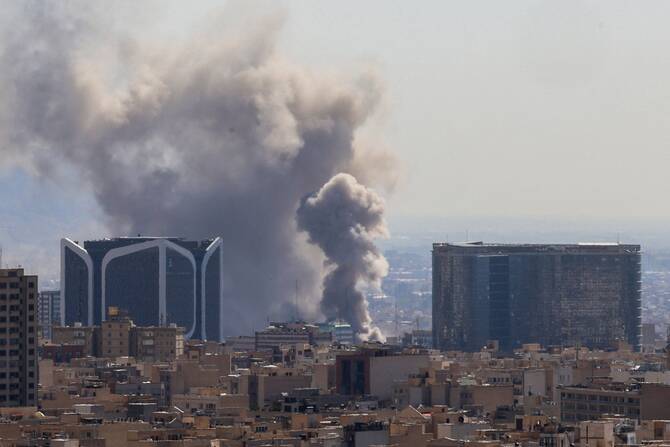
The new war on Iran did not take anyone by surprise. Israeli Prime Minister Benjamin Netanyahu had openly laid the ground for it. While Netanyahu’s previous regional wars were justified under the banner of the “right to self-defense,” he was more explicit this time, invoking both the “preemptive” and “preventive” intentions. It is worth remembering here that, for many years, he tirelessly repeated his claim that Iran was “only a few months away” from producing a nuclear bomb.
In fact, the Israeli right has enjoyed striking confidence in recent years, reinforced by its growing trust in a crucial shift in Washington’s approach to developments in the region.
While the Democrats’ priorities toward the Middle East, during the presidencies of Barack Obama and Joe Biden, were founded on familiar and unconditional strategic support for Israel, they also took a less hostile approach toward Tehran. The justification lay in the existence, or rather the creation, of the phenomenon known as Daesh.
Daesh was a “desired” phenomenon used to inflame Sunni-Shiite sensitivities and perpetuate divisions in the Islamic world. Then the push toward divisive, fragmentary and deadly tensions among the region’s major ethnic groups — above all, Arabs, Persians, Turks, Kurds, Balochis and others. Once this “script” was enacted, the next stage would begin: the partition of existing entities, regardless of their size, alliances or frame of reference.
Iran convinced itself that it could shield its expansionism, its project of exporting the revolution, while keeping its cities safe
Eyad Abu Shakra
The Iranian regime, which is defending its very existence as we speak, is of course the gravitational pole of the Shiite side in this division, facing Daesh and other factions with a similar ideology. It has likely understood the price of its ambitions and appetites for quite some time. It was also well aware of the rules of the game, as well as the weight of the US after it assumed sole leadership of the world.
Many of the regime’s politicians graduated from American universities and deeply understood the organic relationship between the US and Israel. They also knew that this relationship was inextricably tied to Britain, the old colonial power that shaped the “construction” of Middle Eastern entities and drew their borders, and which maintains military bases and political memory that defines its posture and maneuvers.
When the administration of George W. Bush presented Iraq to the Iranian regime on a silver platter in 2003, and when neither that administration nor subsequent ones showed any real concern about Tehran’s expanding influence into Bashar Assad’s Syria and Hezbollah’s Lebanon, the regime was reassured. America would turn a blind eye. Accordingly, it convinced itself that it could shield its expansionism, its project of exporting the revolution, while keeping Iranian cities safe from American and Israeli retaliation.
It assumed it could confront the US and Israel militarily in the cities and countryside of occupied Palestine, Lebanon and Syria if necessary, or even Iraq and Yemen, and spare Iranian territory.
Meanwhile, as Arab polities in the region were being torn apart from within amid disputes, grudges and manufactured hostilities, Tehran steadily built up its combat capabilities and intensified its blatant intervention in the affairs of the Arab world.
The Israeli far right, the expansionist wing included, was preparing to liquidate what remained of the Palestinian cause by erasing Palestine, the Palestinian people and Palestinian memory. The window was opened by the catastrophic aggravation of intra-Palestinian divisions and the deepening split between the Gaza Strip and the West Bank.
In parallel, Netanyahu’s personal scandals multiplied. He sought to evade them by every possible means, exploiting settler groups in the Knesset and forging tactical, deceptive alliances with parliamentary and military figures to buy time and wear down his rivals, thereby maintaining power and evading the sword of judicial accountability.
Israel stands to be the ultimate beneficiary of the Tehran regime’s collapse and the fragmentation of the region’s polities
Eyad Abu Shakra
Over time, as his opponents’ weakness became apparent. As the extremism of the ultra-Orthodox and settler radicals (backed by financial and political support from American biblical and evangelical hard-line circles) grew, Donald Trump returned. His base includes segments of those same circles and he gave Netanyahu free rein to complete his plan … and even go further.
Here, Tehran found itself in an uncomfortable position it had not anticipated, even though the writing had been on the wall before the Oct. 7, 2023, operation in the Gaza envelope. Today, any response on its part will be far too little and too late. It cannot avert change or chaos, either in Iran or across the region.
Israel, as has been said several times, stands to be the ultimate beneficiary of the Tehran regime’s collapse and the fragmentation of the region’s polities.
In other words, if the objectives of the current war are achieved in the coming days, we will not merely be facing a different regional reality; we will also be witnessing a comprehensive reconstruction of the region’s future: its notions, loyalties, economies and societies.
Indeed, I personally expect that Israel, along with its backers, will not be satisfied with reshaping the future alone. I believe they may soon begin revisiting the past.
Yes: revisiting history, rewriting it, erasing elements deemed undesirable, removing existing identities and inventing alternatives. This prospect has become far more likely with Netanyahu preparing for a future war against other regional actors, such as Turkiye and perhaps even Pakistan, after building a new strategic alliance with Narendra Modi’s India.
BY: Writer Eyad Abu Shakra is managing editor of Asharq Al-Awsat, where this article was originally published.
Disclaimer: Views expressed by writers in this section are their own and do not necessarily reflect The Times Union‘ point of view