- Moroccan Security Services Play a Pivotal Role in International Investigations
The U.S. Attorney’s Office for the Eastern District of Virginia has underscored the critical operational support provided by Morocco’s General Directorate of National Security (DGSN) and General Directorate of Territorial Surveillance (DGST) in dismantling complex transnational criminal networks. These efforts were instrumental in two major investigations targeting an international arms trafficking syndicate linked to Latin American cartels and a sophisticated narco-terrorism operation driven by illicit financial flows.
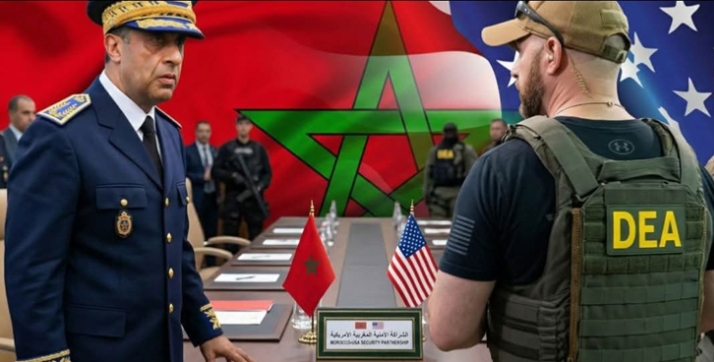
Conducted in close coordination with the U.S. Drug Enforcement Administration (DEA) and multiple African and European partners, the joint operations led to several high-profile arrests and subsequent extraditions to the United States, highlighting the strength of global law enforcement collaboration.Disruption of a Transnational Arms Trafficking Network
In the first case, Bulgarian arms trafficker Peter Dimitrov Mirchev appeared before a U.S. federal court following his extradition from Spain. Kenyan national Elisha Odhiambo Asumo was also extradited—transferred from Morocco on March 11, 2026—and presented before a federal judge shortly thereafter.
According to prosecutors, the defendants conspired to supply military-grade weapons to Mexican drug cartels, notably the Jalisco New Generation Cartel—one of the most violent transnational criminal organizations. The planned arsenal reportedly included machine guns, rocket launchers, grenades, sniper rifles, anti-personnel mines, and anti-aircraft systems.
Investigations revealed that the network intended these weapons to facilitate large-scale cocaine trafficking into the United States. Covert meetings, involving individuals posing as cartel representatives, were allegedly used to negotiate illicit arms deals designed to bypass international regulations.
Use of Forged Documentation and Advanced Weapons Deals
Court filings indicate that Mirchev recruited Asumo to secure falsified end-user certificates to legitimize illegal arms shipments. Authorities allege the conspirators obtained authorization documents for AK-47 imports before exporting 50 automatic rifles from Bulgaria, ultimately intended for cartel use.
Further negotiations reportedly extended to more advanced weaponry, including surface-to-air missiles, anti-aircraft drones, and ZU-23 artillery systems—significantly escalating the threat level posed by the network.
Simultaneous arrests were executed across multiple jurisdictions. Mirchev was apprehended in Madrid, while Moroccan authorities detained Asumo in Casablanca. Another suspect, a Tanzanian national, was arrested in Accra, Ghana, and later extradited to the United States.
Coordinated International Efforts Ensure Successful Arrests
The investigation, initiated in September 2022, involved extensive coordination through the DEA’s Bilateral Investigations Unit. Authorities emphasized Morocco’s decisive contribution, particularly in the arrest and extradition of the Kenyan suspect.
Prosecutors also linked the Bulgarian arms dealer to past transactions associated with Viktor Bout, a convicted international arms trafficker. Each defendant now faces a mandatory minimum sentence of ten years, with the possibility of life imprisonment pending judicial review.cond Case Uncovers Narco-Terrorism Financing Network
In a separate but equally significant case, U.S. prosecutors announced the conviction of Antoine Kassis, a Lebanese-Syrian dual national, on charges of narco-terrorism conspiracy and providing material support to a foreign terrorist organization.
Authorities allege that Kassis orchestrated an arms-for-cocaine exchange, leveraging high-level political connections to facilitate the movement of weapons from military stockpiles in return for large quantities of narcotics.
Complex Financial Operations and Global Drug Distribution
Evidence presented in court demonstrated that Kassis coordinated the trafficking of hundreds of kilograms of cocaine, intending to distribute it across the Middle East while relying on international accomplices to launder proceeds.
Investigators revealed that nearly $100 million was moved through the network in under eighteen months. A controlled financial transfer operation conducted in August 2024—under DEA supervision—proved crucial in exposing the scale and sophistication of the operation.
Morocco’s Continued Contribution to Global Security
The investigation spanned multiple regions, with DEA offices in Rabat, Nairobi, Accra, Madrid, and Bogotá contributing to the effort. Moroccan authorities, particularly the DGSN, were recognized for providing significant intelligence and operational assistance alongside partners from Ghana, Kenya, and Colombia.
Federal prosecutors highlighted that both cases exemplify the effectiveness of sustained international cooperation, involving the DEA’s Special Operations Division and the U.S. Department of Justice’s Bureau of International Affairs.
Kassis is scheduled to be sentenced on July 2, 2026, and faces a mandatory minimum of 20 years in prison, with the possibility of life imprisonment.
Strengthening Global Law Enforcement Partnerships
These cases collectively demonstrate the growing importance of cross-border collaboration in combating organized crime, arms trafficking, and terrorism financing. Morocco’s proactive engagement and strategic cooperation with international partners continue to reinforce global security frameworks and contribute to the disruption of high-risk criminal networks.
BY: The Times Union