- Despite constitutional flaws, judges may opt not to strike down entire measure, especially as some surmise its extreme language aims to provoke a fight with the court for political gain
A highly controversial law passed by the Knesset last month mandates the death penalty as the default sentence for West Bank Palestinians convicted of carrying out deadly terror attacks in the West Bank.
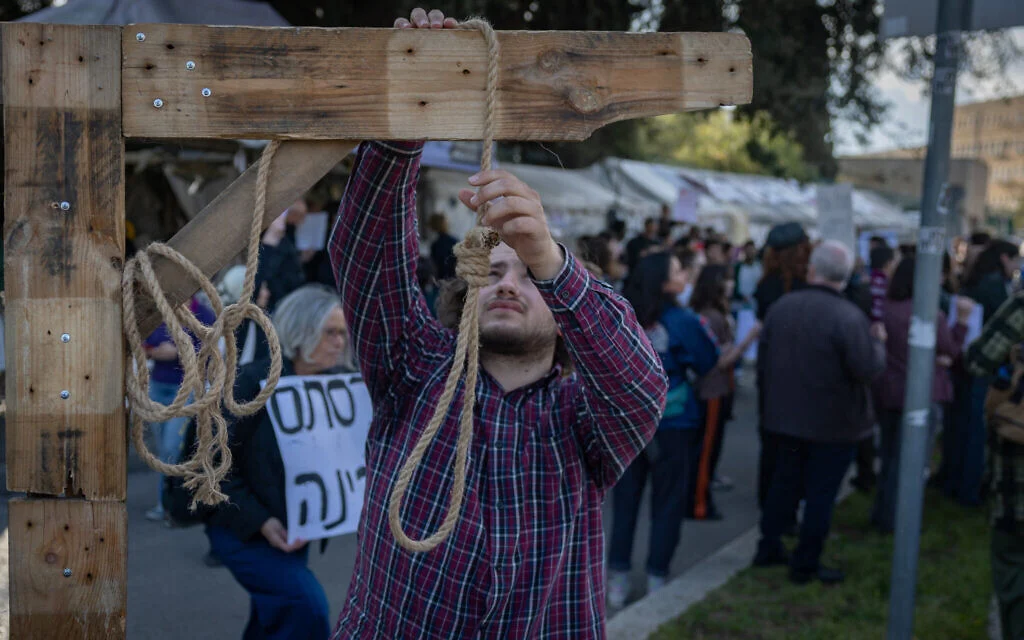
Israel’s legal code already contains the death penalty, though it is so rarely invoked that it has only ever been implemented a single time, against Nazi war criminal Adolf Eichmann (Meir Tobianski was executed as a traitor after a drumhead court martial in 1948, and exonerated a year later). In contrast, the new measure ensures the regular exercise of capital punishment, stripping judges of broad discretion in sentencing, neutering the appeals process and removing several procedural safeguards.
Legal scholars say the law, promoted by far-right National Security Minister Itamar Ben Gvir’s Otzma Yehudit party, contains serious constitutional defects, including violating the right to life, and is discriminatory in that it applies almost exclusively to Palestinians. In addition, experts argue, there is no proof that it would achieve its stated goal of deterring terrorism.
“I think it’s quite clear that the law is unconstitutional, especially due to the discriminatory element,” said Prof. Yaniv Roznai, a constitutional law expert at Reichman University.
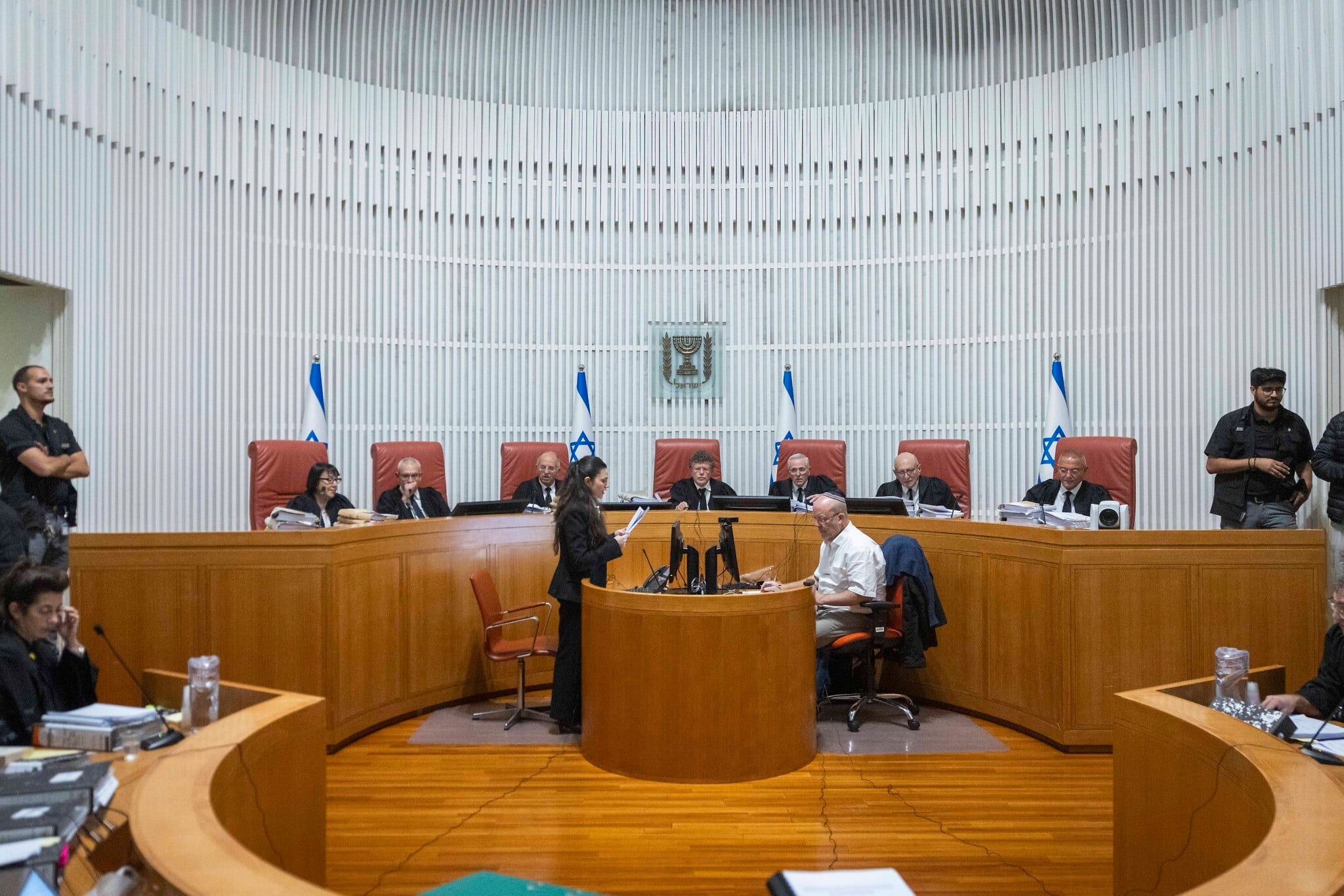
While the law is being challenged in the High Court, legal experts say it is far from certain that the bench will strike it down in its entirety, given its traditionally cautious approach to intervening in national security matters and the extraordinary political and wartime context in which the legislation was passed. Parts of the measure, however, may still be annulled by the court.
At the same time, there are some who believe the law may be aimed from the start at provoking a politically advantageous fight with the court, with election season approaching.

Knesset National Security Committee meeting discussing his ‘death penalty for
terrorists’ bill in Jerusalem, March 24, 2026.
Following the passage of the law just before the Knesset went on recess at the end of March, several opposition parties, along with several human rights organizations, announced they would petition the High Court to nullify it. Judges said there were no grounds to issue a temporary injunction freezing the legislation, but have instructed the state to submit a response to the petitions by May 24.
The petitioners, including Democrats MK Gilad Kariv and MKs from the Arab-majority Hadash-Ta’al party, and the Rabbis for Human Rights organization, are nonetheless “very confident” that the High Court will strike down the law, sources with knowledge of the matter told The Times of Israel.
“In principle, we’re opposed to the death penalty, but there are also so many legal issues that were ignored,” said Rabbi Avi Dabush, who leads Rabbis for Human Rights.
Both critics and supporters of the law note that it contains language that effectively enshrines capital punishment for Palestinians alone, explicitly excluding citizens or residents of Israel. It applies specifically to terrorism cases tried in military courts, the default venue for cases involving Palestinian suspects, rather than the civilian courts used to prosecute Israelis, including in the West Bank.
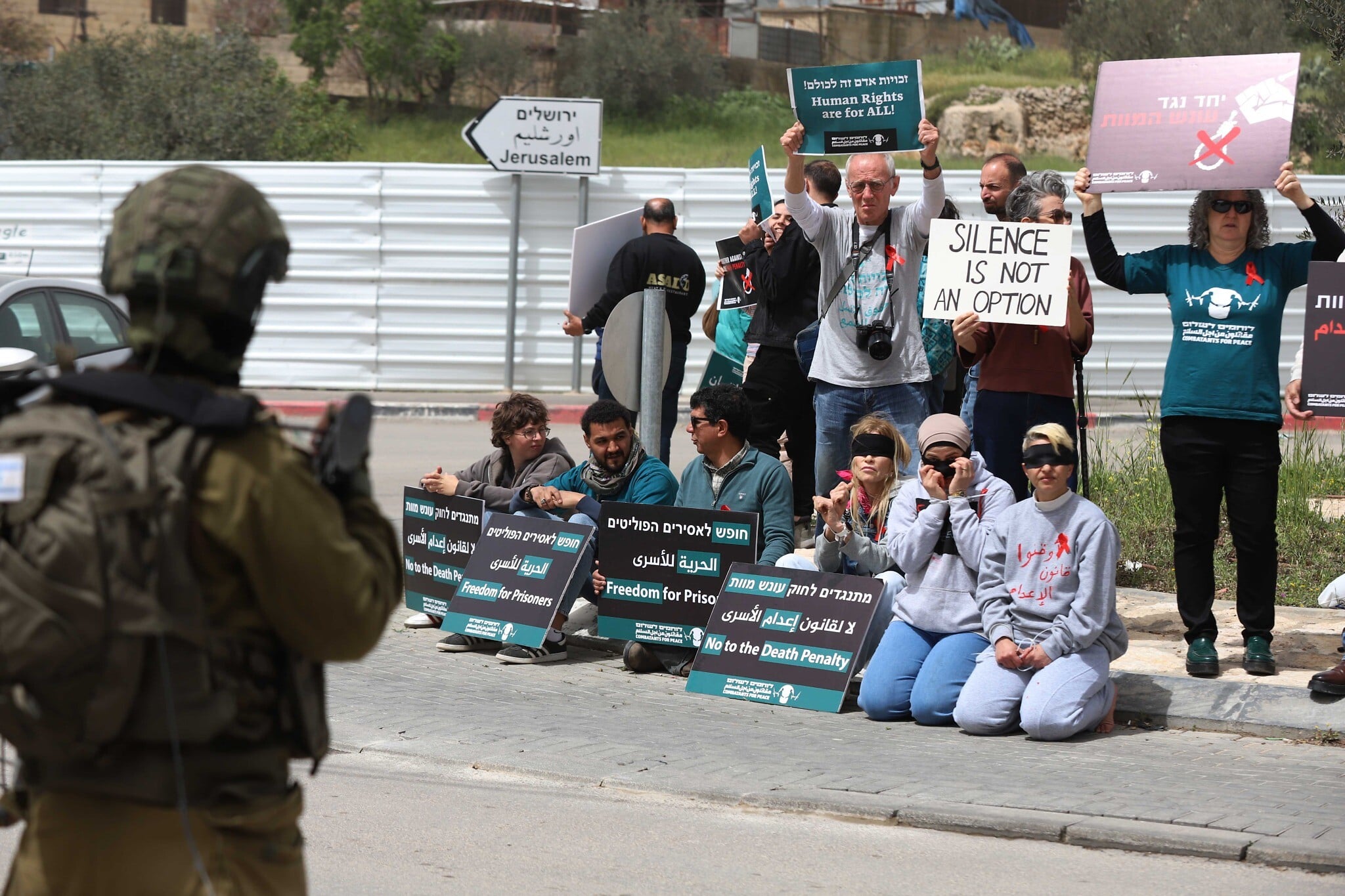
death penalty in the West Bank city of Beit Jala, on April 3, 2026.
Though a separate provision allows the court to impose the death penalty on anyone, including Israeli citizens, it applies only to those who “intentionally cause the death of a person with the aim of denying the existence of the State of Israel,” a definition designed to exclude Jewish terrorists.
Prof. Amichai Cohen, a senior fellow at the Israel Democracy Institute, said the law’s discriminatory element is one of the strongest legal arguments against it.
“There is previous legislation that wasn’t explicitly discriminatory, but it was clear to the court that the design of the law applied only to Palestinians, and the court struck it down,” he said, adding that the current law similarly does not explicitly mention Palestinians but makes clear in practice whom it is intended to apply to.
But both Roznai and Cohen cautioned that the court may choose to amend specific aspects of the law, such as the discriminatory element, rather than strike it down in its entirety.
According to Cohen, the court could reject the petitions now, but later strike down the legislation if it comes up in a future case involving a judge reluctant to impose capital punishment as mandated by the law.
Attorney General Gali Baharav-Miara, December 1, 2025.
However, Roznai says that the legal defects are significant enough that the entire statute could be invalidated, especially considering the intent of its authors.
“Usually, when the court faces questions of constitutionality, it tries to solve them through interpretation, but in this case, it’s very hard to see how the court could interpret it in a manner that makes it more constitutional,” he said.
According to Cohen, the law also appears to violate several fundamental rights laid out in Israel’s quasi-constitutional Basic Law: Human Dignity and Liberty, including the right to life, human dignity, due process and equality.
A Basic Law can be infringed upon by another law or policy if it is proven that the measure achieves a specific goal that would otherwise be impossible. Proponents of the law say it meets that test by deterring terrorism. Long prison sentences, they argue, fail to do the job, especially given that many inmates are released in swaps for hostages before serving out their punishments.
But scholars question whether there is evidence showing that the imposition of the death penalty would have that effect.

convicted of deadly acts of terror in Nablus, West Bank, March 31, 2026.
“The Knesset passed the law without any clear indication, professional or expert opinion proving that it might deter terrorism,” Cohen said. “The Israeli Basic Law allows the Knesset to infringe on specific rights if it has a very good reason to do it, but you need a factual record, and they don’t have one.”
Roznai said both academic research and the views of Israeli security professionals in fact cast doubt on the idea that the threat of execution helps tamp down terrorism.
Experts have pointed out that most Palestinian attackers carry out assaults knowing that there is a high likelihood they will be killed in the act. And Cohen noted that Israel’s defense community has long opposed the death penalty.
“According to scholarly literature from other countries on the death penalty, and according to the professional security views of the Shin Bet for many years, it is uncertain that the death penalty would even provide deterrence,” Roznai said.
A law or a campaign?
Legal scholars say the legislation stands out not simply because it authorizes capital punishment, but because of how far it goes in limiting judicial discretion and removing safeguards, which makes Israel an anomaly among democracies that are, if anything, moving toward abolishing the death penalty.
Both Roznai and Cohen note that the only other democracies that still use capital punishment — the US and Japan — also have legislation designed to restrict the sentence to only the few cases that overcome extensive procedural hurdles and safeguards.
“It is no coincidence that almost all democratic countries in the world have abolished the death penalty. We’re joining a very small group of mostly undemocratic and basically totalitarian states apart from the US, and this law is far more extreme than the American death penalty,” Roznai said.
The Knesset law sets execution by hanging as the default penalty, rather than giving judges discretion to impose it only in certain cases, and it mandates that executions take place within 90 days of sentencing, voiding the lengthy appeals process prevalent in such cases elsewhere. The law also strips military commanders of the authority to commute death sentences.
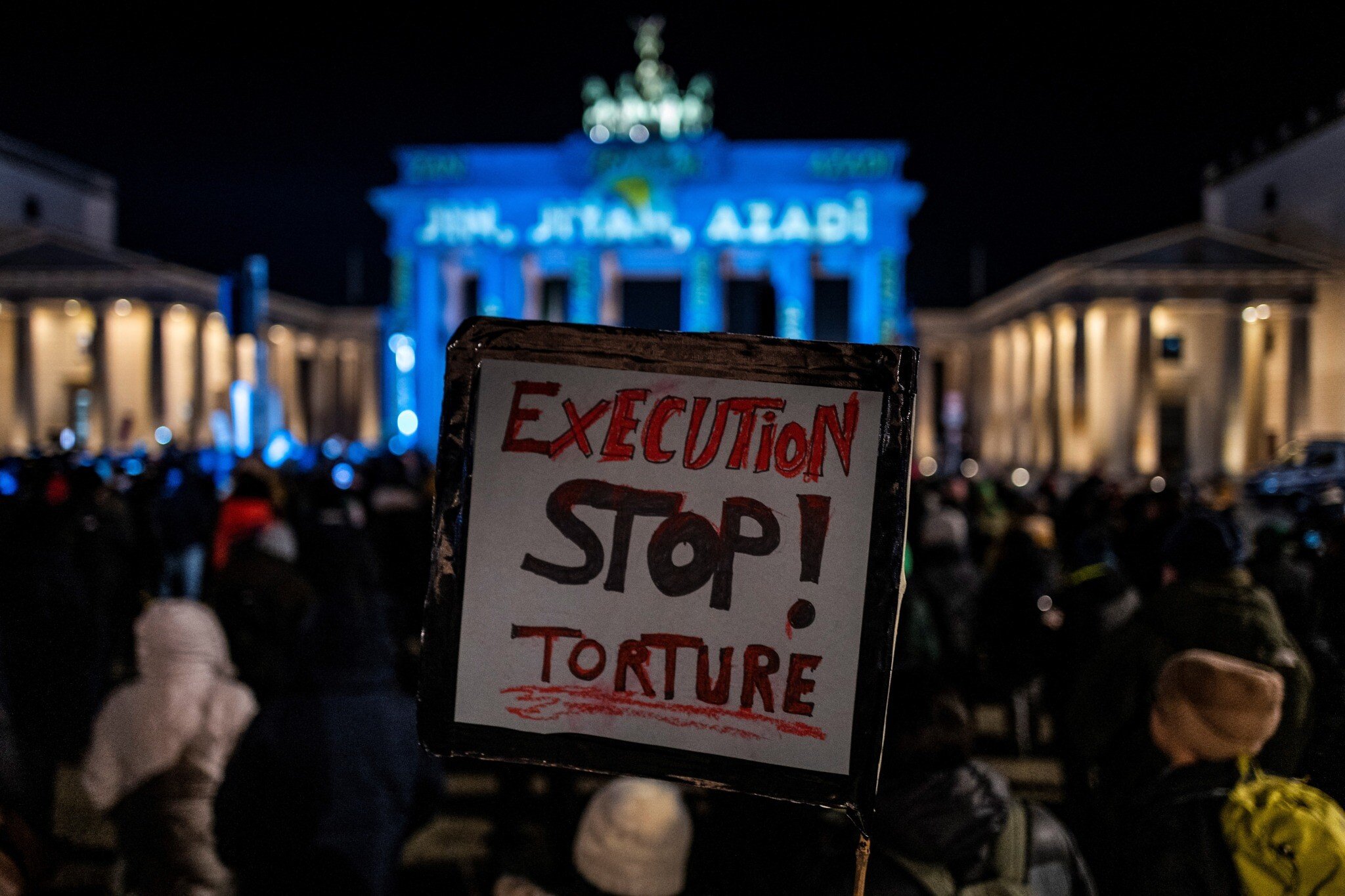
during a demonstration in support of protestors in Iran, in front of the Brandenburg
Gate illuminated with the words “Woman, Life, Freedom” in various languages
including Kurdish and Persian, in Berlin on December 13, 2022.
“Even if one supports the death penalty in principle, at every junction, the Knesset took the more severe turn,” Cohen said.
“There is no democracy, to the best of my knowledge, which accepts a mandatory death penalty,” he continued.
He warned that passage of the law, regardless of whether it’s upheld, could wind up further damaging Israel’s reputation and diplomatic standing.
“It’s an affirmation of the view that Israeli society, politics, and now law is moving away from liberal values towards more conservative or nationalistic values,” he said, adding that it adds long-term harm to Israel’s “legitimacy as a liberal democracy.”
Some have surmised that the law was made egregiously severe with the assumption that it would be struck down, allowing lawmakers to provoke a politically expedient clash with the court and win points with right-wing voters predisposed against the judiciary just as elections approach.

August 20, 2008
According to Roznai, the legal risks associated with the bill were clearly identified during months-long Knesset deliberations, but lawmakers were incentivized to advance the law despite those warnings, knowing that its most controversial provisions — including the mandatory death sentence and discrimination — made it particularly vulnerable to constitutional challenge.
“For Ben Gvir and other coalition lawmakers, this is a win-win,” he said. “They enact a law that their base is happy with, and when the High Court strikes it down, they can then label the judges as enemies of the state.”
A Knesset source with knowledge of the matter told the Times of Israel that, based on how the law was drafted, “it’s clear they want the High Court to strike it down and that its purpose is an election campaign.
“Otherwise, there’s no way to explain their disregard for the position of all professional authorities and their violation of every restriction established regarding the death penalty under domestic law,” the source said.

penalty for terrorists on November 3, 2025
A spokesperson for Otzma Yehudit leader Itamar Ben Gvir said he saw no reason for the court to strike down the law.
“It passed the Knesset legal adviser and was approved. It passed the plenum, it passed committees, it was supported by every security body,” the spokesperson said in a WhatsApp message.
Still, the very idea that they may be being used as foils in a political campaign could shape how the justices approach the case, Roznai warned.
Amid sustained attacks on the judiciary by the government, the court may weigh not only the legal merits of the case but the institutional consequences of intervention, including the risk that striking down the law would further fuel efforts to undermine the court’s authority.
“We have a High Court that is under threat,” Roznai said, referring to the government’s campaign against the judiciary, whose authority it has tried to weaken since Prime Minister Benjamin Netanyahu’s right-wing coalition came into power in 2023.
“This isn’t just a law,” he added. “It’s a political campaign.”