- Brussels Seeks Strategic Partnership with Rabat as Migration Management and Border Security Take Center Stage
MARRAKECH: The European Union is preparing to increase financial support for Morocco’s migration management and border-control efforts following the recent crisis in Ceuta, as Brussels seeks to finalize a long-delayed strategic partnership with Rabat by the end of the year, EU officials told Euronews in an exclusive report published Thursday.
The proposed agreement is expected to establish a strategic and comprehensive partnership between the EU and Morocco, broadly modeled on the €7.4 billion package concluded by the European Commission with Egypt in 2024 to support economic development, migration management and regional stability.
The EU-Morocco agreement has been under negotiation for several years but was delayed amid differences over the Western Sahara issue. Momentum resumed following a meeting in Brussels in January 2026, although the broader dispute remains unresolved.
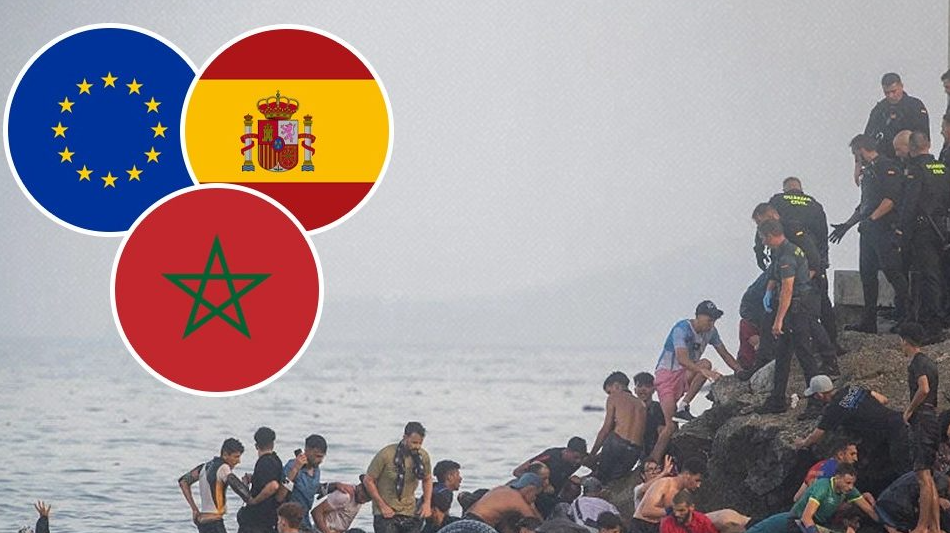
The recent crisis in Ceuta has now added urgency to the negotiations. According to Euronews, approximately 72,000 people crossed the border irregularly at the end of July, while around 100 people reportedly lost their lives.
The episode has prompted Brussels to consider strengthening the agreement’s provisions on migration management, border security and early-warning mechanisms, while also increasing technical and financial assistance to Morocco.
Rabat Rejects Role as Europe’s “Gendarme”
The crisis has once again fueled debate in European capitals over Morocco’s role in managing migration toward Europe. Unsubstantiated allegations emerged suggesting that Moroccan authorities had encouraged irregular crossings into Ceuta, claims firmly rejected by Rabat.
Spanish Member of the European Parliament Juan Fernando López Aguilar, a former justice minister, told Euronews that when migration situations become “completely out of control,” it was difficult to rule out the possibility that Moroccan tactics or strategic decisions were involved. However, no evidence has been presented publicly to substantiate such allegations.
Morocco has consistently rejected the characterization of its migration cooperation with Europe as an outsourced border-control arrangement.
Foreign Minister Nasser Bourita has repeatedly emphasized Rabat’s position, declaring in 2018 that Morocco “has never been, is not, and will never be anyone’s gendarme.” During the 2021 migration crisis involving Spain, he similarly stressed that Morocco was neither “the gendarme nor the concierge of Europe.”
Rabat maintains that its cooperation with European partners is based on sovereignty, reciprocity and shared responsibility, rather than an obligation to police Europe’s external borders on its behalf.
Funding Gap Highlights Unequal Burden
EU financial support for Morocco’s migration efforts has also come under scrutiny. According to a European Commission spokesperson cited by Euronews, the EU committed approximately €222 million to Morocco between 2021 and 2024 for migration management and expects to provide an additional €190 million through 2027.
The funding remains significantly below the amounts allocated to Türkiye. European Commission figures indicate that approximately €1.19 billion has been directed specifically toward migration management in Türkiye, including major investments in border surveillance and related security measures.
Morocco received approximately €234 million through the EU Trust Fund for Africa between 2015 and 2021, with a substantial portion allocated to integrated border management and combating migrant smuggling and trafficking. A further programme worth roughly €150 million was agreed in 2022.
The disparity becomes even more pronounced when broader refugee assistance is considered. The EU has allocated close to €12.4 billion to refugees and host communities in Türkiye since 2011, covering areas such as education, healthcare and financial assistance in addition to migration management.
Brussels Calls for Stronger Cooperation
European Commission President Ursula von der Leyen has underscored Morocco’s importance as a strategic partner, particularly on migration. In an early-August letter to Spanish Prime Minister Pedro Sánchez, she reportedly called for stronger checks, physical barriers and enhanced early-warning mechanisms, alongside increased technical and financial assistance to Morocco.
The approach reflects the EU’s increasingly security-focused migration policy, while human-rights organizations have called for greater attention to the socioeconomic and political factors driving irregular migration.
Sara Prestianni of Euromed Rights argued that the Ceuta crisis should prompt Europe to examine why migrants are willing to undertake life-threatening journeys rather than simply strengthen border controls. Rights groups have also raised concerns over the treatment and exploitation of migrants in the context of European migration-control arrangements.
Morocco Seeks Partnership, Not Subcontracting Role
For Rabat, the issue extends beyond financial assistance. Morocco considers itself a sovereign strategic partner of Europe rather than a subcontractor responsible for Europe’s border security.
The country occupies a pivotal position along the Western Mediterranean and Atlantic migration routes and shares Europe’s only land border with a non-European state, through the Spanish-administered territories of Ceuta and Melilla.
The emerging EU-Morocco partnership therefore presents Brussels with a strategic choice: whether to deepen cooperation on the basis of shared responsibility and mutual interests, or continue placing disproportionate emphasis on border enforcement.
The Spanish government has declined to comment on whether it was aware of the ongoing negotiations.
BY: The Times Union