


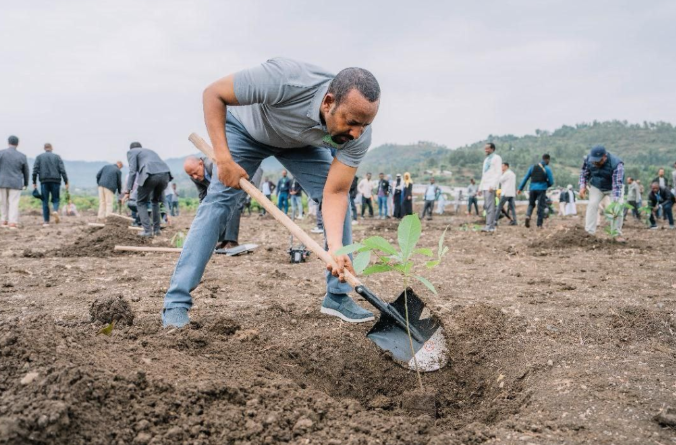
Addis Ababa – Ethiopia’s flagship environmental campaign, the Green Legacy Program, is showing remarkable progress in restoring ecosystems, mitigating climate change, and ensuring food security—especially in the ecologically vital Blue Nile Basin, where 27.5% of the program’s total seedling plantation has been concentrated.
Launched in 2019 under the visionary leadership of Prime Minister Abiy Ahmed, the Green Legacy Initiative has become a beacon of environmental renewal and sustainability, not only in Ethiopia but across the continent. Designed as a people-centered, transformative campaign to reverse deforestation and restore degraded landscapes, the program has now entered a new phase of impact and global recognition.
Reviving a River of Life: The Blue Nile Basin
Speaking to national media, Minister of Agriculture Dr. Girma Amente disclosed that a significant proportion of the seedlings planted under the Green Legacy Program were focused in the Blue Nile Basin—one of the most strategic and fertile regions of the country. As a result, forest coverage in the basin has increased to 25%, up from critically low levels due to decades of deforestation and land degradation.
The Blue Nile Basin, which plays a central role in Ethiopia’s agricultural productivity and regional water systems, is now at the heart of this green transformation. By restoring the forest canopy and preventing erosion, Ethiopia is securing the sustainability of a river that millions rely on—not only within its borders but downstream in neighboring countries.
National Achievements: A Green Milestone
Since 2019, Ethiopia has successfully planted over 40 billion seedlings across all regions, a feat that Minister Girma emphasized has boosted Ethiopia’s global standing as a leader in climate action and ecological restoration. The target for the current Ethiopian fiscal year is even more ambitious: 50 billion seedlings, with 7.5 billion to be planted during the ongoing rainy season alone.
This massive undertaking comes at a critical time. Ethiopia has long suffered from alarming deforestation rates, losing 90,000 to 100,000 hectares of forest annually, which has contributed to droughts, floods, declining agricultural yields, and environmental instability.
Through the Green Legacy Program, forest coverage has now increased to 23.6% nationwide, with a clear roadmap to reach 30% coverage in the coming years. This is more than an environmental campaign—it is a national rebirth rooted in sustainability and long-term resilience.
Combatting Erosion and Boosting Agricultural Productivity
One of the program’s most profound successes lies in its impact on soil conservation. Ethiopia has managed to reduce soil erosion by 50%, protecting tens of thousands of tons of fertile topsoil that previously washed away annually from farmlands. This shift is not only critical for restoring land productivity but also for safeguarding national infrastructure like dams, which have long been threatened by siltation.
Notably, the Minister mentioned the restoration of Lake Haromaya, a once-depleted water body, as a tangible example of the program’s success in reviving natural resources.
Moreover, reducing soil erosion has led to a tangible increase in crop yields, reinforcing Ethiopia’s push toward achieving food self-sufficiency—a top national priority amid global food security challenges.
A Model for Africa and the World
The Green Legacy Program is more than a domestic achievement—it is a model for the African Union’s Agenda 2063 and global initiatives such as the UN Decade on Ecosystem Restoration. Ethiopia’s commitment, scale, and grassroots mobilization are attracting admiration and replication in neighboring countries.
As the world grapples with climate change, desertification, and environmental degradation, Ethiopia is offering a powerful narrative of hope and resilience. Through visionary leadership, community participation, and an unwavering commitment to sustainability, the Green Legacy is no longer just a national program—it is a continental legacy in the making.
BY: The Times Union


