- Spain Deploys Security Forces After Unprecedented Surge; Sánchez Blames Smuggling Networks
CEUTA, Spain: At least 34 migrants have died amid an unprecedented surge of people crossing from Morocco into Spain’s North African enclave of Ceuta, according to local authorities, as Spanish and Moroccan security forces struggled to contain the crisis.
Ceuta President Juan Jesús Vivas said around 60,000 migrants had entered the territory over the previous 24 hours, a figure equivalent to roughly 70 percent of the city’s normal population. He described the situation as “absolutely unsustainable.”
Deaths Reported Amid Border Chaos
The border crisis intensified on Thursday and continued into Friday, with clashes reported between migrants and Moroccan security forces.
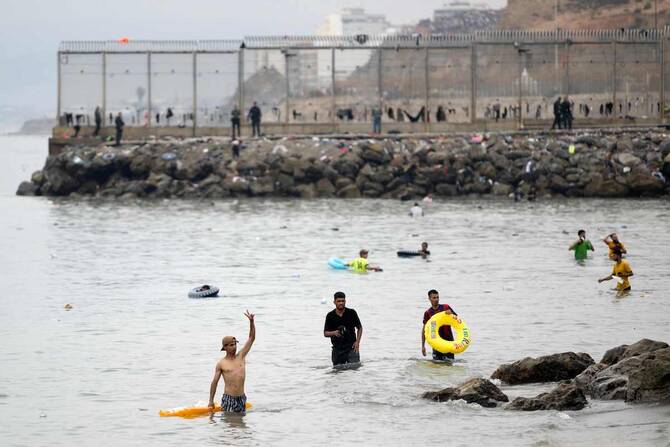
Many of those who died reportedly drowned while attempting to reach Ceuta by sea, while others were killed in a stampede near the Tarajal beach border area.
Witnesses and rights activists described a severe humanitarian emergency, with thousands of migrants, including unaccompanied minors, left without adequate shelter as authorities struggled to cope with the sudden influx.
Sánchez Condemns Border Breach
Spanish Prime Minister Pedro Sánchez condemned the mass crossing during a visit to Ceuta, calling it a violation of Spain’s territorial integrity.
Sánchez blamed human-smuggling networks for exploiting vulnerable migrants, saying misinformation surrounding a recent Spanish Supreme Court ruling had contributed to the sudden surge.
Spanish authorities have deployed additional police and military personnel, while Moroccan forces have used water cannons and other measures to prevent further crossings. Thousands of migrants have reportedly also returned to Morocco.
Supreme Court Ruling Sparks Dispute
Authorities in Madrid and Ceuta have linked the sudden increase to a recent Supreme Court ruling concerning the treatment of migrants who reach Spain by sea.
The Spanish government said smugglers had exploited an interpretation of the ruling, spreading information through migrant networks that encouraged people to attempt the dangerous crossing.
Moroccan rights activists, however, have questioned whether the court decision alone could explain the scale of the movement.
Political Fallout Spreads Across Europe
The crisis has triggered political repercussions beyond Spain. Italian Prime Minister Giorgia Meloni threatened stronger measures involving Spain and the Schengen area, while France announced tighter border checks.
The Spanish government rejected claims that its recent migrant regularization policy had encouraged the surge, insisting that the crisis was primarily linked to the interpretation of the court ruling and the actions of smuggling networks.
Melilla Also Sees Border Unrest
The migration crisis has also spread to Melilla, Spain’s other North African enclave, where groups attempting to cross from Morocco reportedly clashed with security forces.
Local reports said some migrants threw stones and set police vehicles on fire, while dozens were arrested and security personnel were injured.
The events in Ceuta and Melilla have intensified debate over migration management, border security and humanitarian responsibilities at one of Europe’s most sensitive entry points.
BY: The Times Union