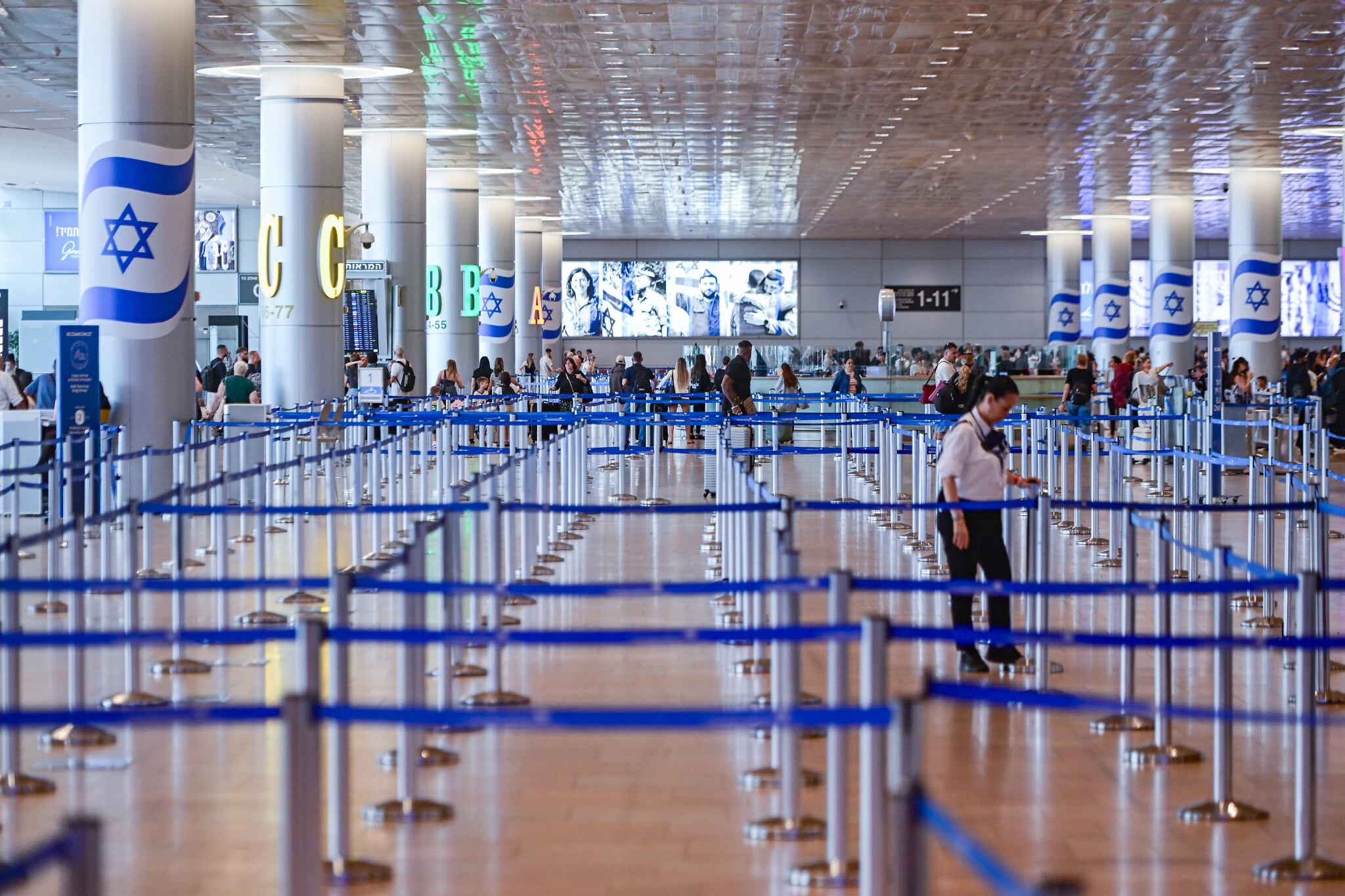
- The bedlam at Ben Gurion was not a sudden failure, but the inevitable result of a system hollowed out by nepotism, sham tenders, and political loyalists. And the rot extends across public service
On October 9, 2021, the Lebanese government did not warn its citizens of the country’s impending shutdown; it simply allowed it to happen overnight.
The country’s two largest power stations ran out of fuel, and by midday, the national electricity grid had completely failed. Hospitals, bakeries, and businesses were forced to rely on private generators—if they could afford to run them.
Power was restored a day later, after the military supplied emergency fuel. But the failure that seemingly switched off an entire country in an instant had been decades in the making.
It was the product of a public system that had become a playground for sectarian appointments, political interests, dubious contracts, and a complete absence of accountability. The lights went out in an instant, but the state had been rotting from within for years.
Israel is certainly not Lebanon, and Ben Gurion Airport is not the Lebanese power grid. But the severe disruptions and baggage delays recorded last week at Israel’s main gateway stemmed from the exact same principle: a seemingly sudden breakdown that laid bare a protracted, deeply rotten process that extends across public service.
Corruption without envelopes
When Israelis hear the word “corruption,” they typically imagine envelopes of cash or a contractor sitting in a police interrogation room. But the most dangerous corruption in public service is precisely the kind that operates in a semi-legal gray zone, or is simply too mundane to make the evening news.
.

This brand of corruption occurs when a public position becomes a political prize; when personal loyalty to a minister outweighs professional expertise; when an acting official is left in a temporary role for months or even years; when a talented employee realizes there is no point in competing against a candidate with the right connections; and when management prioritizes placating the press over acknowledging and fixing the root problem.
In isolation, each of these symptoms looks minor. Every delayed tender seems temporary. Every departing professional is somehow replaced. The system limps along only because the remaining employees run faster, work longer hours, and cobble together makeshift solutions. And then it collapses.
A state comptroller report published in 2014 found that a quarter of Israel Airports Authority employees had a relative working at the authority. Pinchas Idan — a prominent Likud central committee powerbroker who has headed the powerful airport workers’ union for 40 years — had at least 15 relatives employed at Ben Gurion as permanent staff at the time.
Because Idan’s union wields the power to unilaterally shut down Israel’s main gateway, transportation ministers have historically hesitated to cross him. Consequently, temporary employees with relatives at the authority enjoyed a disproportionately high chance of receiving permanent status.
A second comptroller report, which examined appointments to senior positions at the authority, found that, in roughly 30 percent of the internal tenders reviewed, there was only one candidate. Five senior officials had effectively been filling their positions for years before officially winning tenders in which they ran unopposed.
Operating with independent budgets, statutory bodies like the Israel Airports Authority (IAA) are prime targets for political patronage, existing far beyond the reach of direct parliamentary oversight.
The practices highlighted by the comptroller illustrate exactly how an organizational culture was built during Benjamin Netanyahu’s two-decade premiership: not in a single day, and not necessarily through envelopes of cash, but through family networks, sham tenders, powerful unions that dominate government ministers, and ministers who elevate loyalists over experts. The inevitable result is organizations led by managements incapable of actually managing.
The IAA has also had difficulty maintaining stability at the top. Director General Hagai Topolansky, a former IDF major general and head of the military’s Personnel Directorate, resigned in 2023 after less than eight months. His sudden departure highlighted how even top-tier military managers found the political interference at the authority unbearable. He explicitly stated that politics and extraneous considerations were taking precedence over performance and the public interest.
Following Topolansky’s departure, the authority operated for roughly 18 months without a permanent director general. A permanent chairman was appointed only in early 2026.
One more unprofessional appointment here, another cut corner there, a blind eye turned to this person’s poor performance and that person’s dysfunction—and one day, Israelis are astonished to discover that they no longer have a functioning airport, even though the writing had been on the wall for years. Or, more accurately, swept under the rug.
Not every collapse looks like Ben Gurion Airport
The hollowing out of Israel’s public service does not begin and end at Ben Gurion Airport. In other sectors, the crisis is no less severe than at the Airports Authority, but it provokes less public outrage because it unfolds gradually—much like the proverbial frog being boiled alive.
In the education system, collapse does not come in the form of school gates suddenly locking in the morning just as parents drop off their children. It appears as a teacher instructing a subject for which they were never trained, a principal desperately scouring WhatsApp groups for substitute teachers, or a student completing 12 years of education lacking basic life skills.
The state comptroller previously found that the Education Ministry failed to systematically manage the recruitment and placement of teachers, did not centralize the information principals needed, and failed to ensure that new teachers were assigned to the subjects they were actually trained to teach. These are not the kinds of failures that generate dramatic headlines; they simply erode the quality of education a little more with every passing day.
In the healthcare system, shortages do not manifest in a sudden announcement that all hospitals are closing. They show up as a continually lengthening queue, a specialist who cannot be found in the geographic periphery, and an acting manager who has no idea whether they will still hold their position six months from now.
In January 2026, the Knesset was informed that 1,049 positions in the healthcare system were filled not by permanent appointees, but by acting officials.
Likewise, in transportation, no one closes the roads — except, perhaps, halting state-funded infrastructure work on Shabbat to appease ultra-Orthodox coalition parties. This frequent political flashpoint shifts critical projects to weeknights, causing massive weekday traffic jams.
The broader deterioration is measured by the bus that never arrives, the 10 additional minutes sitting in traffic every year, the infrastructure project that runs billions of shekels over budget, and the political appointee parachuted into a professional role overseeing tens of billions of shekels.
Just last May, for example, Transportation Minister Miri Regev’s close associate Shimon Swissa — a longtime political ally and activist in her Likud circle — was appointed head of the ministry’s Infrastructure Administration. He was selected in a tender despite lacking any significant experience in planning transportation infrastructure on a national scale.

new road at Hatzor Haglilit in northern Israel, 2023. (Transportation Ministry)
From political appointments to blackouts
Looking abroad, we can already see how this trajectory ends if left unchecked.
In South Africa, the state electricity company Eskom became one of the clearest symbols of governmental decay, characterized by political appointments, procurement corruption, management turnover, and neglected maintenance.
The result was years of scheduled power cuts that severely damaged businesses and economic growth, forcing the government to inject hundreds of billions of rand into the company. A study cited by the OECD estimated the economic cost of power outages between 2007 and 2019 at 43.5 billion rand ($2.7 billion).
In Venezuela, Hugo Chávez’s regime fired more than 18,000 employees of the state oil company following a strike in 2003, sweeping out experienced managers, engineers, and technicians. The company was gradually restaffed with regime loyalists, transforming it into a mere tool for financing political objectives.
Oil production in one of the world’s most resource-rich countries subsequently plummeted. While international sanctions, falling oil prices, and a broader economic crisis contributed to the collapse, the catastrophic loss of professional expertise and rampant politicization came first. It left behind a hollowed-out company incapable of maintaining the core asset upon which the entire country depended.
The lesson here is not that Israel is inevitably on its way to becoming Venezuela or Lebanon. Israel still boasts a remarkably strong public service in many areas, highly dedicated employees, and an impressive capacity to deliver in times of crisis.
Paradoxically, those very strengths conceal the depth of the rot: As long as the last remaining professionals in the public service manage to save the system through overtime, nonprofit organizations, improvisation, and a deep sense of mission, politicians can continue dismantling it without the lights actually going out.
Dismissals are no substitute for management
Following last week’s disruptions at Ben Gurion Airport, Prime Minister Netanyahu and Transportation Minister Regev threatened that whoever was responsible would pay the price and “be sent home.” That is a terrific soundbite for the evening news, but a terrible way to run a country.
Citizens do not need a head served to them on a silver platter. They need to know how many workers are actually missing, who knew about the shortage, why the repeated warnings were ignored, who ordered the work stoppage, why there is no continuity plan to protect Israel’s virtually sole aerial gateway, and exactly what lessons will be implemented before the next period of peak congestion.
Real reform does not begin with summary dismissals. It begins with restoring professionalism as a basic, non-negotiable prerequisite: competitive and transparent tenders, effective restrictions on employing relatives, rapid and permanent appointments to management positions, publicly available service metrics, and absolute protection for professionals who tell a minister exactly what they do not want to hear.
Last week, the baggage conveyor belt stopped. But the far more dangerous conveyor belt is the one carrying cronies, loyalists, and political operatives straight into the centers of decision-making.
Ben Gurion Airport is already functioning again, at least partially. But there is no sign that the state has gone back to governing.
BY: Eran Hildesheim
Disclaimer: Views expressed by writers in this section are their own and do not necessarily reflect The Times Union‘ point of view