The reception that greeted Crown Prince Mohammed bin Salman in Washington was exceptional even by American standards. Full state honors, a 21-gun salute, mounted guards on horseback and fighter jets overhead signaled not only respect but recognition of the Kingdom’s rising global weight.
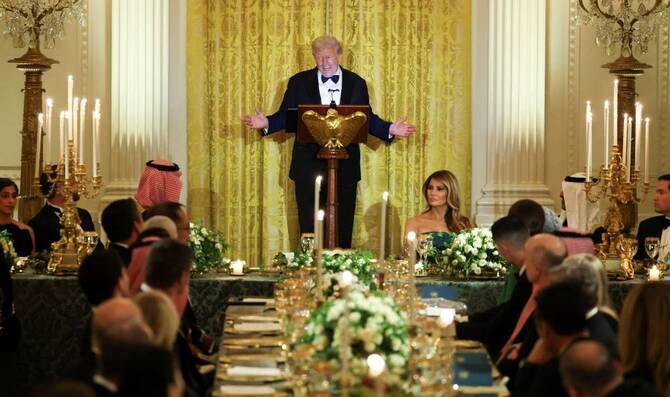
Later that evening, President Donald Trump hosted a black-tie dinner at the White House — an honor usually reserved for the closest US allies. The guest list, which included global figures such as Cristiano Ronaldo and Elon Musk, reflected the administration’s intention to showcase the visit as a defining diplomatic moment.
This was not mere ceremony. It was a deliberate message to the world: Saudi Arabia is today central to American strategic thinking and this visit carries consequences that extend far beyond Washington. In many ways, the warmth of this reception reciprocated the exceptional hospitality extended to Trump during his earlier visits to Riyadh — affirming a relationship built on mutual confidence, pragmatic cooperation and strategic alignment.
What followed exceeded even the most ambitious expectations. The two sides finalized a series of landmark agreements that will reshape the foundations of one of the world’s most consequential bilateral relationships. These agreements marked a shift from transactional understandings to a far deeper form of strategic parity — one in which Saudi and American interests intersect across security, technology, economics and regional diplomacy.
The centerpiece of the visit was the signing of the US-Saudi Strategic Defense Agreement, the most significant security pact between the two countries since 1945. This agreement strengthens deterrence across the Middle East and gives structure and predictability to a partnership that has long been exposed to the fluctuations of US domestic politics. For Saudi Arabia, it ensures sustained American commitment at a time when regional threats are evolving and when the stability of maritime routes, energy infrastructure and airspace requires constant vigilance.
Complementing the defense agreement was the US decision to designate the Kingdom a “major non-NATO ally,” a status that reduces bureaucratic delays and streamlines defense procurement. This designation has immediate operational implications. The US has now approved the first transfer of F-35 stealth fighters to an Arab country, along with advanced missile defense systems and nearly 300 modern tanks. These capabilities dramatically enhance the Kingdom’s capacity to neutralize missile and drone threats, safeguard its airspace and protect its territory — long-standing Saudi priorities now finally addressed.
Perhaps the most surprising breakthrough was the completion of negotiations on a Civil Nuclear Cooperation Agreement. For more than a decade, talks stalled under previous administrations, often linked to unrelated conditions such as normalization with Israel. Now, the Kingdom and the US have concluded a framework that enables Saudi Arabia to build nuclear power plants using American technology under the highest nonproliferation standards.
This agreement strengthens the Kingdom’s long-term energy security, supports industrial growth and allows Saudi Arabia to meet rising electricity demand without diverting more oil to domestic consumption. It also establishes a partnership of trust at a moment when global competition over nuclear markets is intensifying.
In today’s geopolitical environment, leadership in emerging technologies matters as much as conventional security. Here too, the visit delivered significant gains. A landmark memorandum of understanding gives the Kingdom access to world-leading American artificial intelligence systems and high-end computing capabilities. An agreement on exporting Nvidia’s most advanced chips further supports the digital and industrial transformation underway through Vision 2030.
A separate Critical Minerals Framework aligns the two countries’ strategies on securing the raw materials essential for batteries, advanced manufacturing and renewable technologies. These arrangements reflect a deeper compatibility of interests: Saudi Arabia seeks to diversify its economy and lead in future industries, while the US aims to strengthen its supply chains and maintain technological leadership.
Economic ties remain the backbone of the two countries’ long-term partnership. The crown prince announced that Saudi investments in the US would rise from $600 billion to nearly $1 trillion — an unprecedented figure that signals deep trust and confidence in the US economy. This commitment benefits both sides: it supports American jobs and infrastructure, while providing strong returns for Saudi funds and binding the two economies more closely together.
Wednesday’s Saudi-US Investment Forum in Washington built on this momentum, bringing together leaders in AI, the energy transition, critical minerals, advanced manufacturing, semiconductors, cybersecurity, financial technology, and next-generation digital industries. This reflects how the bilateral relationship has expanded far beyond its traditional bases into areas that drive global competitiveness.
The crown prince reiterated the Kingdom’s principled stance on the Palestinian issue. Saudi Arabia is prepared to contribute to regional prosperity and play a central role in Gaza’s reconstruction, but only within the framework of an irreversible path to a viable Palestinian state. Trump explicitly accepted this linkage — a notable departure from previous approaches that attempted to tie security and nuclear agreements to immediate normalization. Riyadh’s independent decision-making remains intact; normalization will come only when justice, legitimacy and statehood are firmly within reach.
Eighty years after the foundational meeting between King Abdulaziz and President Franklin Roosevelt, Saudi-US relations have entered their strongest and most balanced phase. The old model of exchanging oil for protection has evolved into a genuine partnership between equals — built on compatibility of interests, shared strategic objectives and a recognition of Saudi Arabia’s indispensable regional role.
Under the wise guidance of King Salman and the decisive, forward-looking leadership of the crown prince, the Kingdom has achieved breakthroughs that strengthen its sovereignty, security and long-term prosperity. These agreements serve Saudi national interests in ways that were long sought but never realized.
The crown prince has reaffirmed that the nearly $1 trillion investment commitment will be fully implemented — a signal of long-term confidence and continuity. For its part, the US must ensure that its security commitments remain steady despite the shifts of domestic politics. With the Strategic Defense Agreement, Washington has taken an important step toward institutionalizing this stability, but maintaining it will require consistency beyond election cycles.
If these outcomes are any indication, the Saudi-US partnership is not reverting to an earlier rhythm; it is moving into a new strategic horizon. The significance of the crown prince’s visit is unmistakable: Saudi diplomacy has delivered one of the most consequential realignments in the history of the relationship.
The Kingdom emerges from Washington stronger, more secure and better positioned to shape the future of its region and its global partnerships.
BY: Dr. Ali Awadh Asseri served as Saudi Arabia’s ambassador to Pakistan (from 2001 to 2009) and Lebanon (from 2009 to 2016). He is deputy chairperson of Rasanah, the International Institute for Iranian Studies, based in Riyadh. This article reflects his personal views.
Disclaimer: Views expressed by writers in this section are their own and do not necessarily reflect The Times Union‘ point of view