- Hundreds of Flights Diverted and Thousands of Passengers Disrupted as Outdated Aviation Systems Come Under Scrutiny
WASHINGTON: The US Federal Aviation Administration (FAA) on Friday night lifted a nationwide ground stop imposed following a major communications failure at regional air traffic control centres, allowing aircraft departures to gradually resume after hours of widespread disruption across the country.
However, the lifting of the restriction does not mean an immediate return to normal operations. Airlines are expected to face continuing delays and cancellations as aircraft and flight crews remain out of position following the unprecedented disruption.
The FAA had ordered a nationwide suspension of flight departures on Friday afternoon, citing what it described as extraordinary circumstances arising from communications problems at regional air traffic control facilities. The disruption forced hundreds of aircraft to return to their departure airports or divert to alternative destinations.
Homeland Security Secretary Markwayne Mullin told reporters at the White House that the incident appeared to involve the introduction of new technology into an ageing air traffic control infrastructure, potentially overwhelming existing systems.
The nationwide ground stop was the first of its kind since January 2023, when a malfunction in a critical FAA computer system disrupted aviation operations. It was also the second nationwide grounding of flights since the aftermath of the September 11, 2001, terrorist attacks.
Officials Investigate Cause of Communications Breakdown
US authorities said there was no immediate evidence suggesting that the communications failure resulted from a cyberattack or other deliberate interference.
Asked whether a cyberattack or an incident involving rogue artificial intelligence could be ruled out, Mullin said investigators had not identified any evidence of malicious activity.
“There’s nothing completely certain right now. It doesn’t appear that way,” he said, adding that the available indications pointed towards a technical or mechanical failure. Investigations were continuing to establish the precise cause.
According to aviation analytics company Cirium, at least 827 flights had been diverted by 7:05 p.m. Eastern Standard Time. Of these, 670 aircraft were sent back to their original departure airports, while 157 were redirected to alternative airports.
Major diversion destinations included Washington Dulles International Airport, Los Angeles International Airport, Cincinnati/Northern Kentucky International Airport and Nashville International Airport.
Approximately 11,000 flights carrying more than 1.5 million passengers had been scheduled to depart from US airports after 4 p.m. EST, raising concerns about further cancellations, delays and operational complications.
International flights were being assessed individually, with some permitted to depart on Friday evening, according to Mullin.
Passengers Face Travel Chaos Across Major Airports
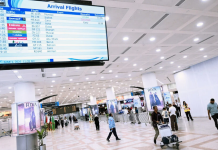
The disruption caused widespread confusion at airports throughout the United States, leaving passengers uncertain about their travel arrangements and alternative options.
At Chicago O’Hare International Airport, travellers discovered the nationwide ground stop through departure boards displaying extensive delays. Many contacted family members and friends to reconsider their plans, including whether to arrange overnight accommodation or seek alternative transportation.
Several passengers reported being informed of the restrictions after boarding their aircraft.
Among them was Austin Curtis, who was travelling with his wife from South Bend, Indiana, to Denver for a friend’s baby shower. Their aircraft had already boarded at O’Hare when passengers were instructed to disembark.
Curtis said passengers observed luggage being removed from their aircraft and others, indicating that the disruption could continue for an extended period.
Meanwhile, 27-year-old Seattle software engineer Amber McQuilkin faced the possibility of missing a planned trip to New York for the League of Legends World Finals after taking a week of leave for the occasion.
The incident highlighted the broader impact of the technical failure on passengers, airlines and the country’s wider transportation network.
Sports Teams and Cargo Operations Also Affected
The aviation disruption extended beyond commercial passenger travel, affecting professional sports teams and cargo transportation.
NBA, NHL and college sports teams encountered difficulties reaching their destinations, while NFL teams faced uncertainty over whether they would be able to travel in time for their scheduled weekend fixtures.
Cargo operations were also affected by the nationwide restrictions. FedEx, the world’s largest cargo airline, said it was prepared to activate contingency arrangements to minimise potential disruptions to its delivery network.
According to Airlines for America, the US aviation industry transports approximately 61,000 tons of goods daily, connecting more than 220 countries through the movement of letters, parcels and commercial cargo.
Despite the nationwide aviation restrictions, SpaceX proceeded with the launch of its Starship rocket from Texas on Friday afternoon as part of its latest test flight.
Outdated Air Traffic Control Infrastructure Under Renewed Scrutiny
The incident has renewed concerns about the condition of America’s ageing air traffic control infrastructure and the urgent need for technological modernisation.
The US government has been pursuing a major overhaul of the systems used by air traffic controllers following congressional approval of $12.5 billion for the initiative last year.
The modernisation programme includes replacing ageing copper communication cables with fibre-optic networks and gradually upgrading outdated radio communication systems at airports and air traffic control facilities.
However, significant work remains. Transportation Secretary Sean Duffy has estimated that an additional $30 billion will be required to complete the modernisation programme, while the White House has begun urging Congress to approve further funding.
Mullin said investigators would also examine whether the incident had any connection to the FAA’s nationwide introduction of a new artificial intelligence system designed to help identify operational problems and recommend alternative flight routes.
The system, however, operates from a single facility near Washington, D.C., and provides recommendations to air traffic control centres rather than directly managing aircraft movements.
Aviation safety expert Steve Arroyo, a former United Airlines pilot, said Friday’s incident appeared similar to a communications outage affecting air traffic control operations in the northeastern United States in September, although the latest disruption had a nationwide impact.
He emphasised that reliable communication between pilots and air traffic controllers is fundamental to aviation safety, warning that flights must remain grounded whenever controllers cannot guarantee effective communication with aircraft.
Arroyo also noted that Friday’s incident differed from the nationwide grounding following the September 11 attacks, as aircraft were not ordered to land immediately and pilots were apparently still able to communicate with airport ground controllers.
The latest disruption has exposed the vulnerabilities of critical aviation infrastructure and intensified calls for accelerated investment in modern air traffic management systems to ensure the safety, reliability and resilience of the US aviation network.
BY: The Times Union