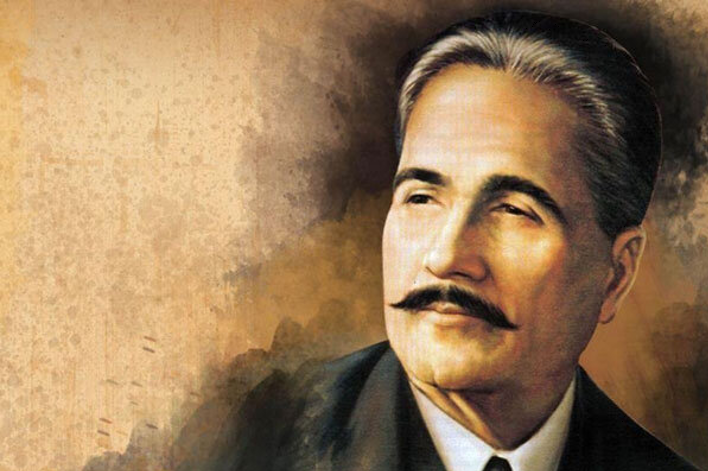
Allama Muhammad Iqbal, the renowned philosopher, thinker and poet of the Indian subcontinent, holds a special place in Iran, one rarely accorded to thinkers from outside its borders. Iran’s Supreme Leader, Ayatollah Khamenei, has described him as the “Bright Star of the East”, a title that reflects not only the depth of his intellectual vision but also his profound and multifaceted connection with Iran and its cultural heritage.
Although Iqbal never set foot on Iranian soil during his lifetime, geographical distance did little to weaken his connection with the country. His poetry and ideas were deeply rooted in the cultural atmosphere of Iran, and his intellectual world remained closely intertwined with the spirit of Persian civilisation.
Persian was the foundation of this enduring bond. Iqbal was born into a Muslim family in Punjab, India, and his mother tongue was Urdu. Yet Persian became the principal language of his poetic expression. Of his major poetry collections, only three were written in Urdu, while works such as Asrar-e-Khudi, Rumuz-e-Bekhudi, Zabur-e-Ajam, Javid Nama and Armaghan-e-Hijaz were all composed in Persian.
This was a deliberate choice. For Iqbal, Persian was more than a language of poetry; it was a medium through which he could express philosophical ideas, spiritual insights and his message of Islamic revival. Iran Press has even described him as the “reviver of the Persian language in Pakistan”, highlighting his central role in preserving and promoting this shared cultural heritage.
However, Iqbal’s relationship with Iran went far beyond language. He was an heir to, and a continuation of, Iran’s rich intellectual and literary tradition. He regarded himself as a student of the great masters who had shaped Persian literature. Addressing a gathering at Ferdowsi University of Mashhad, Pakistan’s Consul General in Iran openly acknowledged that Rumi, Hafez and Ferdowsi were among Iqbal’s primary sources of inspiration. Their spirit of resilience, resistance and hope in the face of despair had left a lasting impression on him.
His admiration for Hafez ran so deep that he once suggested that whenever his poetic imagination and intellectual faculties reached their highest point, the spirit of Hafez would come alive within him, almost as if he himself had become Hafez. Of Rumi, he famously said: “Rumi introduced me to myself, and it was through him that I discovered who I truly was.” The prominent Iranian intellectual Ali Shariati went so far as to describe Iqbal as “the most Iranian of all foreigners”, a phrase that captures the remarkable affinity between Iqbal’s thought and the cultural spirit of Iran.
This literary and spiritual attachment was rooted in Iqbal’s deep academic understanding of Iran. His doctoral dissertation at the University of Munich, titled The Development of Metaphysics in Persia, explored the history of philosophy in Iran. Throughout this work and his wider writings, he spoke with profound respect and admiration for Iranian scholars and thinkers, regarding them as a source of pride not only for the Muslim world but for human civilisation as a whole.
His poetry frequently draws upon Iran’s cultural and historical symbols, from the legendary Jam-e Jam (the Cup of Jamshid) to the kings of Persian mythology. He even envisioned Tehran becoming the “Geneva of the East” and emerging as an intellectual and political centre of the Muslim world. This vision went beyond personal admiration; it reflected his broader belief that Iran was one of the central pillars of Islamic civilisation.
Iqbal believed that Islamic civilisation could never have reached its full intellectual and cultural richness without Iran. He compared the Muslim conquest of Persia with the Roman conquest of Greece: just as Greek civilisation helped shape the intellectual foundations of the West, Persian civilisation gave the Muslim world much of its philosophical depth and cultural richness.
Perhaps the most remarkable aspect of Iqbal’s connection with Iran lies in his poetic vision of the country’s future. Decades before the 1979 Islamic Revolution, he wrote a celebrated poem addressed to the “Young Men of Persia”, in which he spoke of the emergence of a man who would break the chains of bondage. Through an opening in the prison walls of the Iranian nation, Iqbal seemed to catch a glimpse of this future figure.
The poem, widely known by its opening reference to the Chiragh-e Lala (the tulip lamp), begins with these lines:
Like a tulip lamp, I burn in your streets;
O young men of Persia, my soul is bound to yours.
This was not a prophecy in the supernatural sense. Rather, it reflected Iqbal’s profound understanding of the spirit of awakening and the untapped potential within Iranian culture and the wider Muslim world. Through his philosophy of Khudi (selfhood), which he regarded as the foundation of human dignity and self-awareness, Iqbal sought to awaken the dormant identity of Muslim nations. He saw Iran as one of the principal centres of this intellectual and spiritual revival. This is why some scholars have described his influence on the emergence of the Islamic Revolution in Iran as “distinctive and undeniable”.
Iqbal, the Star of the East, belongs not to a single nation or geographical territory. He represents a bridge between Iran and Pakistan and, beyond them, between all Muslim nations seeking to rediscover their identity, dignity and place in the world.
Through nearly ten thousand verses of Persian poetry, which experts consider comparable in quality to the finest works of Persian-speaking poets, Iqbal demonstrated that the Persian language and its literary heritage could serve as powerful vehicles for awakening, unity and intellectual renewal.
His influence continues to resonate in Iran today. His ideas have found echoes in the works of Iranian poets and intellectuals, from Nima Yushij and Ahmad Shamlou to later generations. He remains a source of inspiration for those seeking to rediscover the strengths of their cultural identity and historical heritage.
Iqbal lived with a deep love for Iran, drew inspiration from its intellectual traditions, and remained committed to the awakening of the East until the end of his life. He was, and remains, a star whose light continues to shine across the cultural skies of Iran and the wider Muslim world.