- Diplomatic Rupture with Abu Dhabi Risks Harming Algeria’s Aviation, Trade and Regional Connectivity
Islamabad: Algeria’s decision to sever diplomatic relations with the United Arab Emirates and subsequently restrict UAE-registered aircraft from its airspace marks a serious escalation in relations between two Arab countries and raises important questions about whether the measures ultimately serve Algeria’s own economic and strategic interests.
Algeria announced on September 10 that it was breaking diplomatic relations with the UAE, accusing Abu Dhabi of “provocative and hostile” actions. However, the Algerian authorities did not publicly identify a specific incident that prompted the dramatic decision, saying only that all available efforts to preserve bilateral relations had been exhausted.
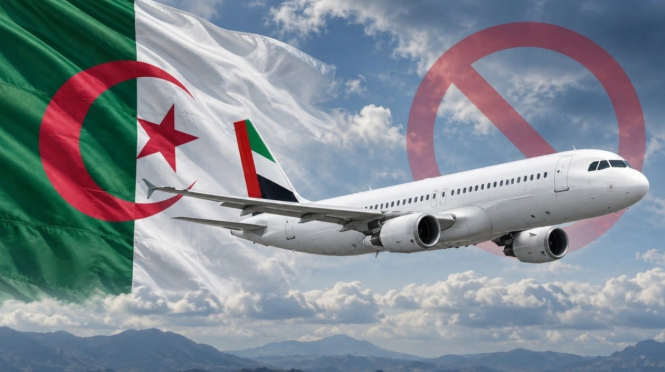
The following day, Algeria moved to close its airspace to civilian and military aircraft registered in the UAE. The measure represents a significant escalation because aviation restrictions extend the diplomatic dispute beyond government-to-government relations and into the fields of transport, commerce, tourism and people-to-people connectivity.
A Dispute That Could Become an Economic Burden
While Algeria has the sovereign right to determine which foreign aircraft may use its airspace, the strategic wisdom of such a decision deserves serious scrutiny.
Diplomatic disagreements between governments are normally addressed through negotiations, diplomatic channels, economic dialogue and, when necessary, carefully targeted political measures. Turning a political dispute into restrictions affecting aviation can create unintended costs for businesses, travelers and ordinary citizens on both sides.
The UAE is one of the Gulf’s major aviation and commercial hubs, while Dubai and Abu Dhabi serve as important gateways linking Africa with Asia, Europe and the wider Middle East.
For Algeria, maintaining efficient connections with major international aviation centers is not merely a matter of convenience. It is directly connected to tourism, investment, business travel, trade and international economic engagement.
The danger is therefore that a measure intended to pressure Abu Dhabi could ultimately impose costs on Algerian companies and citizens as well.
Commercial Flights Given Temporary Exemption
The impact of the decision has been partly moderated by an important exemption.
According to reports, commercial civilian flights operating to and from Houari Boumediene International Airport in Algiers will continue under an existing arrangement until the end of 2026. The exemption means that the immediate disruption to ordinary commercial air travel is less severe than a complete aviation blockade.
Nevertheless, the uncertainty surrounding aviation relations could discourage future cooperation and investment in the sector.
The episode also follows Algeria’s earlier move in February 2026 to begin terminating its air-services agreement with the UAE, originally concluded in 2013. That earlier decision demonstrated that bilateral aviation relations had already become increasingly vulnerable to the wider political dispute.
The central question for Algiers should be whether measures designed to punish another government could unintentionally punish Algeria itself.
Every restriction affecting aviation has consequences beyond the aircraft involved. Airlines, airports, tourism companies, exporters, importers, investors, hotel operators and passengers can all be affected when air links become politically uncertain.
Algeria is seeking to strengthen its economy, attract foreign investment and expand its international partnerships. In that context, creating additional obstacles to international connectivity could send an uncomfortable message to potential investors.
A country seeking greater economic integration generally benefits from more connectivity—not less.
Regional Politics Behind the Crisis
The deterioration in Algerian-UAE relations has developed against a wider backdrop of competing regional policies.
The two countries have increasingly found themselves on different sides of several major Middle Eastern and North African political questions. Algeria strongly opposes normalization with Israel, while the UAE established diplomatic relations with Israel in 2020. The countries have also taken opposing positions regarding the Western Sahara dispute, with Algeria supporting the Polisario Front and the UAE backing Morocco’s position.
Their differences have also extended into broader regional affairs, including developments in the Sahel and North Africa.
These disagreements are serious and legitimate subjects for diplomatic discussion. But regional rivalry should not automatically become a justification for policies that undermine economic opportunities and connectivity.
A More Constructive Alternative
Instead of allowing relations to deteriorate further, Algeria could consider reopening diplomatic channels and seeking a structured dialogue with Abu Dhabi.
Both countries are members of the Arab League and the Organisation of Islamic Cooperation, while maintaining broader interests in Arab, African and international affairs. Their populations have no inherent reason to become victims of a political confrontation between governments.
The UAE has also signaled that it hopes the rupture will be temporary and emphasized the importance of its relationship with the Algerian people.
That position provides an opportunity for diplomacy.
Algeria could preserve its political positions while keeping economic and humanitarian channels open. Similarly, the UAE could address Algerian security concerns through direct diplomatic engagement rather than allowing mistrust to deepen.
Sovereignty Is Important—But So Is National Interest
Algeria’s sovereignty and security concerns deserve respect. If the Algerian government possesses evidence of hostile activity, it has a legitimate responsibility to protect its national interests.
But national interest should be measured not only by political symbolism. It must also include economic growth, employment, investment, aviation connectivity, tourism, trade and the welfare of ordinary citizens.
This is where Algeria’s latest decision deserves careful scrutiny.
A diplomatic disagreement can be temporary, while damage to economic relationships and international confidence can take years to repair.
Algeria Should Choose Dialogue Over Isolation
The closure of airspace to UAE-registered aircraft may demonstrate Algeria’s determination, but determination alone does not constitute effective foreign policy.
The stronger approach would be to use diplomatic leverage while keeping economic and people-to-people channels open.
Algeria is an important North African country with enormous natural resources, a large domestic market and a strategic position linking Africa, the Mediterranean and the Arab world. Its long-term interests are better served by expanding international partnerships rather than narrowing them.
The current crisis with the UAE should therefore become an opportunity for reflection rather than further escalation.
The fundamental question for Algiers is simple: does this confrontation weaken Abu Dhabi—or does it risk weakening Algeria’s own economic and strategic position?
A foreign-policy decision should ultimately be judged by whether it advances the country’s national interest. In this case, Algeria would be better served by diplomacy, engagement and economic pragmatism than by measures that risk turning a political dispute into a broader confrontation with potentially costly consequences.
BY: Nadeem Faisal Baiga