- New Tariff Doubles Price for Consumers Exceeding Monthly Quota as Inflation, Currency Weakness Deepen Household Strain
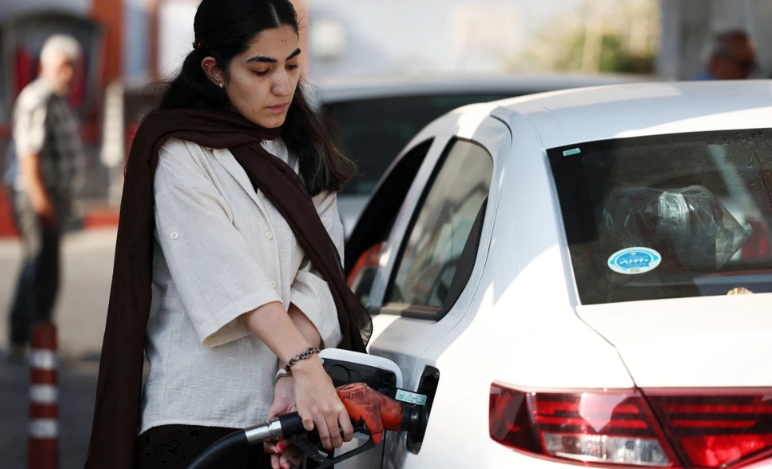
TEHRAN: Iran has raised gasoline prices for its heaviest consumers, state media reported early Tuesday, introducing the second fuel-price increase since December as the country faces mounting economic pressures following months of war.
Under the new pricing system, motorists purchasing more than their monthly quota of 110 litres (29 gallons) will now pay 100,000 rials — approximately 7 cents — per litre, double the previous rate that had been in effect since December.
Although the government did not explicitly link the measure to its conflict with the United States, its announcement referred to the “current situation” and said revenues generated through the higher price would be distributed among households.
Higher Fuel Costs Raise Inflation Concerns
The move comes at a particularly difficult time for Iran’s economy, with the national currency continuing to lose value and household purchasing power under severe pressure.
The US dollar was trading at around 2.22 million rials on Monday, while Iran’s annual inflation rate has reached approximately 67 percent, according to the country’s Statistics Center.
While Iran continues to offer some of the world’s cheapest gasoline, economists warn that even modest increases in fuel prices can have a significant impact on the cost of transportation and consumer goods.
The country has a long and politically sensitive history with fuel-price increases. A sharp increase in 2019 triggered nationwide demonstrations and a subsequent security crackdown in which more than 300 people were reportedly killed.
Only 15 Percent of Consumers Expected to Be Affected
Keramat Veis Karami, chief executive of Iran’s state-owned oil distribution company, said the new pricing structure would affect approximately 15 percent of gasoline consumers, the official IRNA news agency reported.
He said gasoline consumption reached a record 145 million litres (38 million gallons) per day in August, significantly exceeding domestic production capacity of around 122 million litres per day.
The shortfall is being covered through imports, highlighting the growing pressure on Iran’s domestic fuel supply despite its status as a major oil-producing country.
Government Seeks to Curb Record Fuel Consumption
Iranian authorities have sought to reduce excessive gasoline consumption, which experts attribute partly to the country’s ageing vehicle fleet, limited availability of spare parts and inadequate public transportation infrastructure.
Higher fuel prices could help moderate consumption and reduce the widening gap between domestic production and demand.
However, economists caution that the policy could also intensify inflationary pressures by increasing transportation and operating costs across the economy.
Fuel Prices Remain a Sensitive Issue in Iran
Cheap gasoline has long been regarded by many Iranians as an established social entitlement, making fuel-price reforms particularly sensitive.
Public opposition to higher fuel prices has a long history in Iran. In 1964, a previous increase contributed to demonstrations and a strike by taxi drivers, prompting the shah’s government to deploy military vehicles to replace the striking taxis.
Against this backdrop, authorities are closely monitoring public reaction to the latest increase.
Iranians Voice Concern Over Rising Cost of Living
Within an hour of the new pricing system taking effect, two of eight filling stations visited by The Associated Press were temporarily closed as operators adjusted their pumps to the new rates.
The remaining stations were operating, with queues of around a dozen vehicles reported at each location. Security was also visibly increased, with uniformed and plainclothes police officers present around the stations.
For many Tehran residents, the fuel-price increase is another burden amid rapidly rising living costs.
Asghar Rahimi, a 34-year-old Tehran resident, questioned whether the additional revenue would meaningfully address the country’s economic challenges.
“The tiny amount cannot help the government manage problems like poverty and unemployment,” he said, warning that the latest increase could be followed by further rises in the coming months.
Ali Salari, 55, expressed concern that higher gasoline prices would push up the cost of other essential goods, including bread and meat.
“It has been that way ever since the government manipulated gas prices,” he said.
Another Tehran resident, Hamid Mirzei, 43, said rising food prices were already placing basic necessities beyond the reach of many households.
He said a grocery trip for staples such as beans and lentils could cost as much as 100 million rials, underscoring the erosion of purchasing power.
“Life has become difficult for all of us. Even basic groceries are becoming unaffordable,” Mirzei said.
“If gasoline prices go up as well, things will only get much worse,” he added.
Economic Balancing Act for Tehran
The latest gasoline-price increase reflects the difficult balance facing Iran’s authorities: curbing record fuel consumption and reducing pressure on domestic supplies while avoiding additional inflation and social unrest.
With household incomes already squeezed by currency depreciation and rising prices, the government faces growing pressure to ensure that any additional fuel revenues translate into tangible economic relief for ordinary citizens.
BY: The Times Union