- Registered on Iran’s National Heritage List, the tower serves as a tangible link between contemporary Urmia and its medieval past.
Islamabad – Nestled within the historic urban fabric of Urmia in northwestern Iran, the Se Gonbad Tomb Tower stands as one of the city’s most distinguished and well-preserved monuments from the Seljuk era. Constructed approximately eight centuries ago, this cylindrical edifice—built from a combination of stone and brick—offers an invaluable window into the architectural sophistication, funerary customs, and artistic mastery of medieval Persia.
Situated today in the central and older quarter of Urmia, the tower was originally erected on the city’s southeastern outskirts. Over time, relentless urban expansion has enveloped the structure, seamlessly integrating this centuries-old landmark into the heart of the modern metropolis.
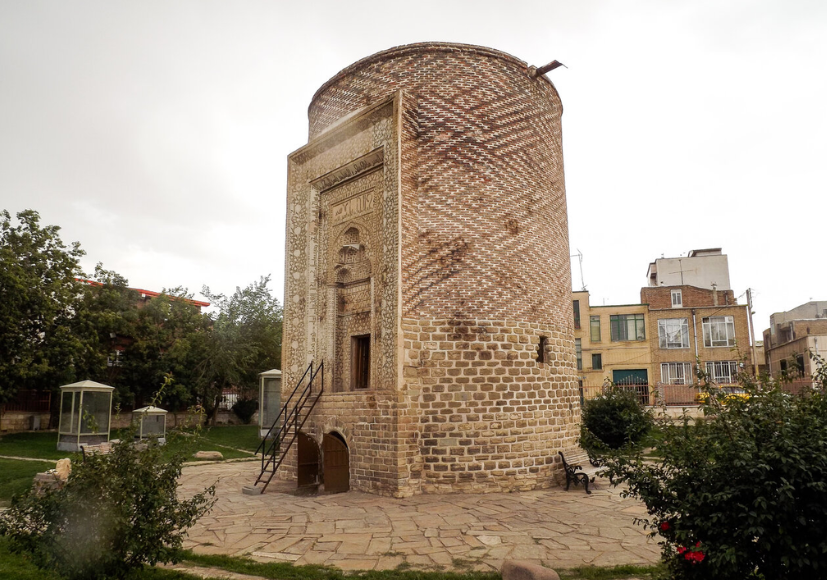
The monument’s appellation, Se Gonbad—Persian for “Three Domes”—derives from its distinctive and unconventional domical configuration. The structure encompasses two separate domed chambers, with a smaller dome crowning the main edifice. This unique architectural signature has not only defined the tower’s enduring identity but has also established it as one of Urmia’s premier historical landmarks.
An inscription at the portal, deciphered by the 19th-century Russian orientalist, geographer, and ethnographer Nikolai Khanikov—who played a pivotal role in introducing the monument to the international scholarly community—dates the tower’s construction to 580 AH (circa 1184 CE), firmly within the Seljuk period. The inscription further reveals that the tower was commissioned by Sheith Qathe al-Muzaffari, a figure identified as a Seljuk ruler. Widely believed to have functioned as a mausoleum, the site is supported by the discovery of numerous graves in its vicinity, suggesting that the surrounding grounds once served as an associated courtyard, possibly reserved for the interment of distinguished individuals due to the site’s perceived sanctity.
The Se Gonbad also invites scholarly debate regarding its origins. While some hypotheses propose that the tower was erected atop the remnants of a Sasanian-era fire temple, no credible evidence substantiates this claim. Its architectural form has likewise invited comparisons with towers from the Tughrol period; however, the extant epigraphic evidence and stylistic parallels with other sixth-century AH mausoleums conclusively affirm its Seljuk provenance.
Architecturally, the tower rises to a height of approximately 13 meters, with a diameter of roughly five meters. Its cylindrical shaft showcases a dual-material construction: finely cut gray stone masonry forms the lower 3.6 meters, while square bricks constitute the superstructure. The monument is organized on two levels: a lower crypt or cellar, accessible via a small iron door (approximately one meter by 70 centimeters), and an upper burial chamber, reached by a wooden ladder about 2.5 meters in height. The lower level is separated from the upper by an arched covering.
Notable functional and aesthetic features include light shafts on the northern and southern façades, as well as four internal channels connecting the two levels, which facilitate illumination and ventilation while enhancing the tower’s architectural expressiveness. The exterior is distinguished by its ornate entrance, where stone and gypsum elements are artfully arranged into geometric patterns and Kufic inscriptions, exemplifying the decorative repertoire of medieval Iranian architecture.
Inside, a square burial chamber is ingeniously integrated within the cylindrical form. The chamber is adorned with cruciform ornamentation at its corners, sharp crescent-shaped arches, and finely executed carvings. Its ceiling, of domical appearance, features bricks arranged in concentric circles toward the apex. Although portions of the lower dome and flooring have collapsed, remnants of decorative brickwork persist along the edges and corners, offering clues to its original form. While the original dimensions of the lower dome remain indeterminate due to damage, scholarly estimates suggest a height of approximately 1.5 meters.
The monument is especially celebrated for its towering main dome, reported to have reached an impressive height of about nine meters. Beyond its domical features, however, the Se Gonbad is distinguished by its integrated decorative program—encompassing stone embellishments, cruciform motifs, geometric patterns, and intricate carvings—that collectively set it apart from other medieval tomb towers.
Remarkably, the structure has withstood the vicissitudes of eight centuries with its walls and principal ceiling largely intact. Ongoing conservation efforts have been implemented to safeguard the monument, including the establishment of protective boundaries that insulate it from the pressures of urban encroachment. The Se Gonbad has been inscribed on Iran’s National Heritage List, underscoring its profound cultural and historical significance.
For the discerning traveler, the monument also serves as a gateway to the broader historical and cultural milieu of Urmia. As the capital of West Azarbaijan province, the city is situated at an elevation of approximately 1,330 meters on the Urmia Plain, near the Shahar River. To the east lies Lake Urmia, one of the world’s largest salt lakes, while the Turkish border lies to the west—a geographic position that has long rendered Urmia a pivotal crossroads between Iran, Anatolia, and the wider northwestern region.
Urmia’s cultural tapestry is equally diverse, having been home over the centuries to Azerbaijanis, Kurds, Persians, Assyrians, and Armenians, as well as Muslim, Christian, Jewish, and Sufi communities. At the turn of the 20th century, Christians constituted a substantial segment of the urban population, though subsequent conflict and migration profoundly reshaped the city’s demographic composition.
A visit to Se Gonbad can thus be seamlessly integrated into a broader exploration of Urmia’s historic and cultural attractions. Its location within the old city fabric ensures convenient access for travelers seeking to engage with the city beyond its contemporary veneer.
The Se Gonbad is accessible year-round; however, the spring and summer months offer more temperate conditions, particularly for visitors unaccustomed to the harsh winters of northwestern Iran, which are characterized by significant snowfall. The warmer seasons afford a more comfortable environment for appreciating the monument and the surrounding attractions.
For those with an interest in Iran’s medieval heritage, Se Gonbad offers far more than an imposing architectural relic. Its inscription, funerary purpose, ornamental richness, and evolving relationship with the urban landscape collectively narrate the story of a monument that has remained an integral part of Urmia for nearly eight centuries. Standing today within the city’s historic core, this Seljuk-era tower provides a tangible and evocative link between contemporary Urmia and a formative chapter of Iranian civilization.
BY: The Times Union