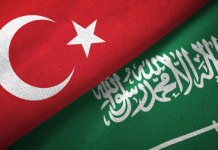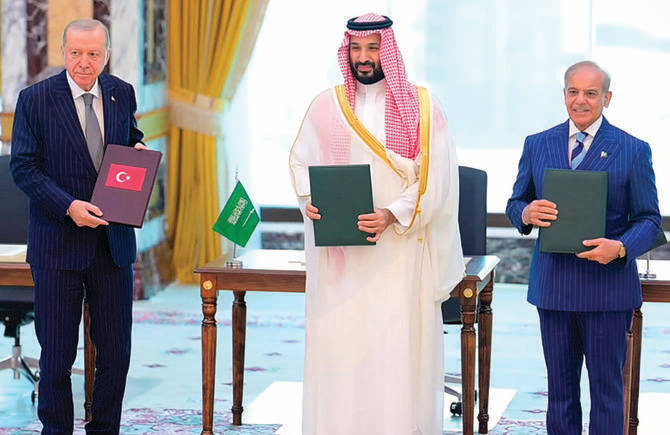
The signing of the Makkah Joint Defense Agreement by Saudi Arabia, Turkiye and Pakistan marks an important development in the Middle East’s evolving security landscape. Predictably, the agreement has prompted speculation about whom it is intended to confront. In a region accustomed to viewing alliances through the lens of rivalry, competing axes and geopolitical confrontation, new security arrangements are often interpreted as the creation of a new bloc against an existing one. That reading risks missing the broader significance of the agreement.
The Makkah Agreement should not be viewed as a pact targeting Iran, Israel or any other country. It should be understood primarily as a defensive partnership designed to strengthen deterrence, protect sovereignty and contribute to regional stability. The distinction matters because deterrence and aggression are not the same thing. Indeed, the purpose of credible deterrence is often to prevent the sort of conflicts that military capabilities are designed to confront.
The agreement comes at a time when the Middle East has experienced an extraordinary accumulation of security threats, including wars, missile and drone attacks, threats to maritime routes and growing uncertainty over traditional security arrangements. Saudi Arabia, Turkiye and Pakistan have each been affected by this instability, either directly or indirectly. Their decision to strengthen defense cooperation is therefore neither surprising nor inherently provocative.
If an attack against one member is to be treated as an attack against all three, the message is unmistakably one of deterrence. Potential aggressors must understand that any attack will not remain a limited confrontation involving a single country. It could trigger a collective response involving three significant regional powers. That calculation can make aggression less attractive. This is the fundamental logic of deterrence: not to make war inevitable but to make it an irrational choice.
This is the fundamental logic of deterrence: not to make war inevitable but to make it an irrational choice
Hani Hazaimeh
The agreement also reflects a broader shift in how countries across the region view their security responsibilities. For decades, Middle Eastern security arrangements have relied heavily on external powers, particularly the US. While such partnerships remain important, successive conflicts have encouraged regional states to develop greater capacity to protect their own interests and contribute to regional security.
Saudi Arabia, Turkiye and Pakistan bring different but complementary strengths to this partnership. Saudi Arabia has enormous economic weight, strategic geography and growing diplomatic influence. Turkiye possesses one of the region’s most capable conventional militaries, substantial defense-industrial capabilities and the strategic experience of NATO membership. Pakistan brings extensive military experience, a large armed force and long-standing strategic ties with Saudi Arabia. Together, they represent three important centers of power in the Muslim world.
Their cooperation does not have to mean confrontation with anyone. On the contrary, a credible regional security framework can create more room for diplomacy by ensuring that political dialogue takes place alongside credible deterrence. Peace cannot depend solely on goodwill or declarations. It also requires convincing those who might contemplate aggression that military escalation will not produce easy gains.
The Middle East has suffered greatly from the tendency to interpret every security partnership as preparation for confrontation. When one alliance is immediately treated as a threat, others respond by creating counteralliances. The result is a cycle of suspicion, arms competition and strategic polarization. The region does not need another such cycle.
The Makkah Agreement should instead be viewed as an opportunity to promote a different principle: that regional states can take greater responsibility for their own security without automatically defining themselves against others.
This is particularly important because Saudi Arabia, Turkiye and Pakistan do not share identical foreign policy positions on every regional issue. They have different interests, relationships and diplomatic channels. That diversity could make the agreement more useful. Rather than becoming another dividing line, it could serve as a bridge between different parts of the region and the wider Muslim world.
The Middle East has had enough alliances defined by fear and conflicts driven by miscalculation
Hani Hazaimeh
If the agreement is presented as an “Islamic NATO” aimed at a particular adversary, it will inevitably generate suspicion and encourage countermeasures. If it is consistently presented as a defensive framework committed to sovereignty, stability and peace, it can acquire much broader legitimacy.
This raises an important question for countries that are already expressing concern about the agreement: Why oppose or criticize a regional security arrangement before seeing what it can become? Why not engage with it instead?
That does not mean every country must immediately become a member, nor does it require states to abandon their independent foreign policies. It simply means that the door should remain open to countries willing to support sovereignty, nonaggression and the peaceful resolution of disputes.
There is nothing contradictory about building military strength while pursuing peace. A country or alliance that possesses credible defensive capabilities can be better positioned to negotiate because potential adversaries understand that coercion will not produce easy victories. But strength must be accompanied by responsibility.
The symbolism of signing the agreement in Makkah reinforces that responsibility. Makkah represents unity and spiritual connection for Muslims across the world. An agreement signed there should aspire to communicate something greater than military cooperation: a commitment to protecting life, sovereignty and peace.
The Middle East has had enough alliances defined by fear and conflicts driven by miscalculation. What it needs is a security environment in which countries understand that their stability is interconnected and that war is ultimately a failure of regional politics.
The Makkah Agreement should therefore be judged not by whom it might confront but by what it prevents. Its greatest success would be the crisis that never becomes a war, the attack that is never launched and the political dispute that is resolved before military force becomes the answer.
The Makkah Agreement should not be seen as an alliance against someone. It is an alliance to prevent another war. And rather than rushing to criticize it, other countries should consider a more constructive alternative: engage with it, help shape it and, where their interests and commitments permit, join it in building a more stable regional security order.
BY: Writer Hani Hazaimeh is a senior editor based in Amman.
Disclaimer: Views expressed by writers in this section are their own and do not necessarily reflect The Times Union‘ point of view