Across Africa, foreign aid is disappearing, climate shocks are multiplying, and strategic competition has replaced economic cooperation as the organizing principle of international affairs. Many policymakers continue to debate these developments as though they belong to separate conversations. Reality suggests otherwise. Each reflects the same transformation: a unipolar order giving way to multipolarism, where power is measured by control over supply chains, critical minerals, industrial capacity, shipping routes, digital infrastructure, and financial systems.
Africa has stumbled into this era at the worst possible moment. External financing is contracting precisely when climate adaptation requires record investment. Public debt has reached levels unseen in decades. Competition among foreign powers is intensifying across the continent’s ports, mines, transport corridors, and energy infrastructure. Economic interdependence, once celebrated as a guarantee of peace and prosperity, increasingly serves narrow self-interested objectives.
Much of the discourse, however, mourns the erosion of the liberal global order as a tragedy, but African governments, on the other hand, have less reason to mourn its passing. Rules were seldom applied equally across the continent. Access to finance, trade preferences, development assistance, and security partnerships frequently reflected the interests of dominant powers rather than universal principles. Growing fragmentation, therefore, represents both danger and opportunity. After all, previous certainties are disappearing, while new bargaining space is emerging for countries capable of acting collectively.
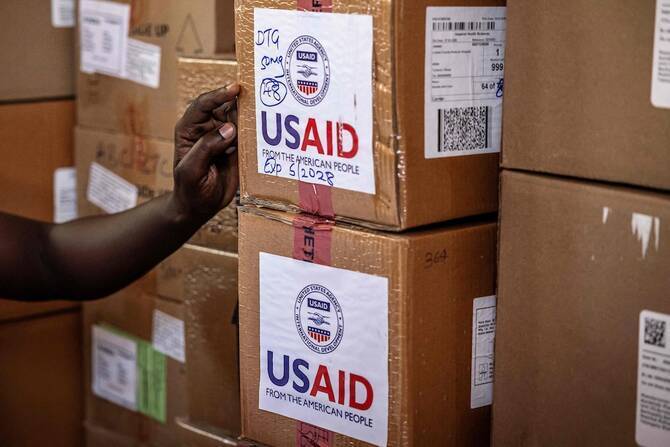
Recent developments in foreign assistance are the clearest example yet of the changing winds blowing over the continent. Bilateral official development assistance to sub-Saharan Africa fell by nearly a quarter in 2025, fundamentally reshaping the aid architecture that had supported large sections of Africa’s critical sectors for decades.
Moreover, projections suggest further reductions through 2028 rather than any return to previous funding levels. Ethiopia and the Democratic Republic of Congo have each lost hundreds of millions of dollars in bilateral support, while countries such as South Sudan and the Central African Republic now face aid losses exceeding 10 percent of total government revenue, making financial dependence an expensive liability.
Worse still, a rapidly warming planet magnifies every one of these pressures. Africa contributes less than 4 percent of global emissions, yet warming across much of the continent is happening faster than the average. Agricultural productivity already suffers from longer droughts, erratic rainfall, flooding, and expanding desertification.
Projections indicate crop yields across much of sub-Saharan Africa could decline by as much as 20 percent under 2°C of warming. At that level, many present-day corn, millet, and sorghum production zones will become unsuitable for cultivation. The resulting food insecurity pressures carry significant fiscal consequences as governments continuously divert scarce resources toward emergency relief instead of productive investment.
Meanwhile, competition over Africa’s strategic assets has become more crowded than at any point since independence. Washington and Beijing remain influential actors, but no longer dominate the field. Middle powers are pursuing defense partnerships and long-term access to energy and fertilizer supplies, while also offering security assistance for political influence and resource concessions. Europe, meanwhile, increasingly frames investment through the language of economic security and supply-chain resilience. Unfortunately, every actor seeking dependable access to Africa’s resources does not prioritize Africa’s structural transformation.
Zero-sum geoeconomics rewards scale, coordination, and bargaining power. Fragmentation rewards external competitors. Continuing to negotiate as 54 largely disconnected economies will deepen external dependence precisely when the international system has become less forgiving. Collective economic action offers a far stronger foundation for navigating an era where cooperation has become increasingly conditional and competition increasingly permanent.
However, external competition alone does not explain Africa’s vulnerability. Domestic politics have amplified many of the continent’s economic risks and woes. Successive governments have often treated foreign rivalries as opportunities to secure immediate financing, military support, or political backing. Such calculations produce quick victories for individual administrations while weakening Africa’s collective negotiating position over time.
History rarely offers comfortable transitions.
Hafed Al-Ghwell
It is this capacity to speak with one voice that is needed now more than ever, beginning with resource diplomacy. After all, critical minerals are the foundation of the global energy transition, placing Africa at the center of a race for lithium, cobalt, copper, graphite, manganese, and rare earths. The DRC supplies more than half of global cobalt production. Southern Africa possesses almost one-third of known critical mineral reserves, while the continent holds more than 26 million tons of identified lithium resources. Every major economy wants reliable access to these materials, yet few are interested in developing Africa’s processing industries.
In addition, competition among African producers frequently works to the advantage of external buyers. Governments negotiate separately, offer generous fiscal incentives, and export unprocessed ores to attract investment. Every concession made by one producer places pressure on neighboring states to match the same terms or risk losing lucrative investments.
Similar dynamics are at play with the lauded Lobito Corridor stretching across Angola, the DRC, and Zambia. Efficient rail links could transform regional commerce, encourage manufacturing, and deepen continental supply chains. Coordinated African planning, however, remains limited. Absent a shared industrial strategy, the corridor risks functioning primarily as a faster route for exporting raw materials to foreign factories rather than connecting African producers to African consumers.
Financial pressures further reduce room for independent decision-making. More than half of low-income African countries are either in debt distress or face a high risk of entering it. Annual debt servicing exceeds $100 billion, consuming public revenues that could otherwise finance schools, hospitals, transport networks, industrialization, and climate adaptation. Meanwhile, the continent’s financing gap is projected to average roughly $245 billion annually over the next five years, while domestic savings remain well below the investment levels required to sustain rapid economic growth.
As global geoeconomic fragmentation intensifies, it threatens to amplify each of these vulnerabilities. Today’s economic modeling suggests sub-Saharan Africa will suffer larger long-term losses than any other region if global trade permanently divides into competing geopolitical blocs. Smaller national markets possess limited bargaining power against continental-scale economies. And persisting with fragmented policies will only further discourage regional manufacturing, cross-border investment, and reduce economies of scale.
Changing international conditions, therefore, demand a different strategic mindset. Africa already possesses many of the ingredients required to prosper in a zero-sum world. The challenge lies in organizing them collectively. Expanding regional value chains, coordinating mineral policies, and investing in domestic processing will strengthen Africa’s bargaining position while retaining more wealth on the continent.
History rarely offers comfortable transitions. Foreign aid is unlikely to return to previous levels, geopolitical rivalry will continue to intensify, and climate pressures will become more severe. Africa must decide. Fifty-four countries negotiating alone will continue reacting to global events. A continent acting with unified purpose can begin shaping them.
BY: Writer Hafed Al-Ghwell is senior fellow and program director at the Stimson Center in Washington and senior fellow at the Center for Conflict and Humanitarian Studies.
Disclaimer: Views expressed by writers in this section are their own and do not necessarily reflect The Times Union‘ point of view