- Beijing Accuses Washington of Protectionism and ‘Unilateral Bullying’ as Technology Trade Tensions Escalate
BEIJING: China has warned that it will take “resolute” countermeasures to safeguard its interests if the United States proceeds unilaterally with restrictions on imports of new Chinese robots and power inverters, further intensifying tensions between the world’s two largest economies.
China’s Ministry of Commerce on Thursday called on Washington to immediately withdraw the measures, accusing the United States of discriminating against Chinese companies and products and using national security concerns to justify what Beijing described as restrictive and protectionist policies.
Beijing Condemns New US Restrictions
The warning followed measures announced Tuesday by the US Federal Communications Commission (FCC) aimed at protecting the country’s artificial intelligence infrastructure and critical industries from perceived national security risks.
China said the FCC had disregarded repeated representations from Beijing and continued to expand restrictions targeting Chinese technology.
The Commerce Ministry accused Washington of unnecessarily broadening the definition of national security, describing the measures as a form of “market distortion and unilateral bullying” that undermines the interests of businesses and consumers in both countries.
The latest restrictions cover new imports of quadruped robots, commonly known as robotic dogs, which US authorities say could pose cybersecurity and other national security risks. Washington has also expressed concern that reliance on overseas manufacturing could leave critical supply chains vulnerable to disruption.
Power Inverter Restrictions Raise Supply-Chain Concerns
The FCC’s restrictions also target new Chinese-made power inverters, devices that convert direct-current electricity into alternating current. Such equipment is widely used in renewable energy systems, data centers and household electrical applications.
FCC Chairman Brendan Carr said the measures were intended to “secure America’s critical supply chains” and clarified that the restrictions apply to new versions of the affected products.
The move represents the latest in a series of US restrictions targeting Chinese technology, following measures affecting products such as drones and controls on the export of advanced US technologies to China.
Washington is also considering restrictions on the use of Chinese open-source artificial intelligence models as Chinese AI companies continue to expand their global presence.
New Flashpoint Ahead of Trump-Xi Meeting
Analysts say the latest restrictions could become another point of contention ahead of a planned meeting between US President Donald Trump and Chinese President Xi Jinping in September.
“This is a steady drumbeat of potential flashpoints heading into the Trump-Xi summit planned for September,” said Samm Sacks, a senior fellow at the New America think tank specializing in Chinese technology policy.
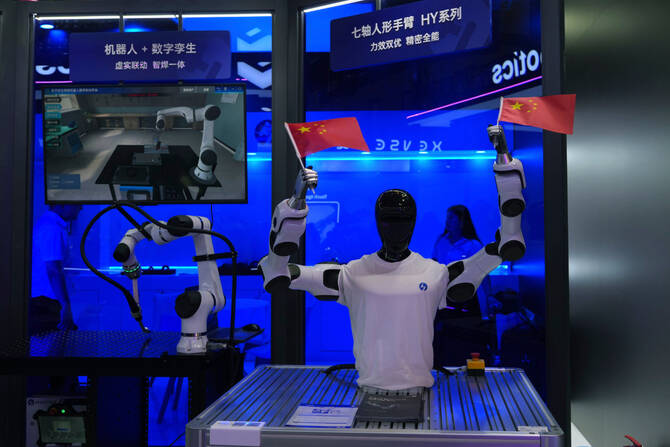
China has rapidly expanded its robotics industry through extensive government support and investment. Morgan Stanley analysts estimate that China’s humanoid robotics market could reach $15 billion by 2030.
“Chinese manufacturers have been scaling production and reducing costs faster than most overseas competitors,” said Kangyuxiao Li, an analyst at Morningstar.
Li said restricting Chinese companies’ access to the US market could eliminate an important future market and shield American manufacturers from increased price competition. However, he added that the restrictions were unlikely to significantly slow China’s broader humanoid robotics development because of its large domestic manufacturing base and expanding opportunities in other international markets.
Chinese Robotics Industry Gains Global Ground
China’s growing dominance in humanoid robotics highlights the scale of the challenge facing US manufacturers.
According to technology research and advisory firm Omdia, approximately 15,000 humanoid robots were shipped worldwide in 2025. Chinese companies Unitree and AGIBOT each accounted for more than 5,000 shipments, while US-based companies such as Tesla and Figure AI shipped only a few hundred units or fewer.
Analysts said the disparity demonstrates the significant manufacturing capacity China has developed in the emerging robotics sector.
Beijing Warns Protectionism Could Hurt US Consumers
China’s Foreign Ministry separately criticized the US measures, accusing Washington of exploiting national security concerns to suppress Chinese technology companies.
Beijing said it would take “all measures necessary” to protect the legitimate rights and interests of Chinese businesses.
“Protectionism does not make the US more competitive, and it will only hurt the interests of US companies and consumers,” Foreign Ministry spokesperson Mao Ning told reporters in Beijing on Wednesday.
Analysts also warned that the restrictions could complicate technology partnerships between US and Chinese companies.
Nvidia, for instance, unveiled a humanoid robot reference design in June that incorporates the chassis of Chinese robotics manufacturer Unitree, highlighting the growing technological links between companies in the two countries despite rising geopolitical tensions.
Pentagon’s China Technology Watchlist Adds to Tensions
The dispute comes amid broader US scrutiny of Chinese technology companies.
The Pentagon recently placed Unitree and several other major Chinese technology firms on a list of companies it said have links to or provide assistance to the Chinese military. Beijing has rejected the allegations.
The latest FCC restrictions, combined with existing technology controls and growing scrutiny of Chinese companies, are likely to add another layer of complexity to US-China economic and technological relations as both sides prepare for potentially significant high-level talks later this year.
BY: The Times Union