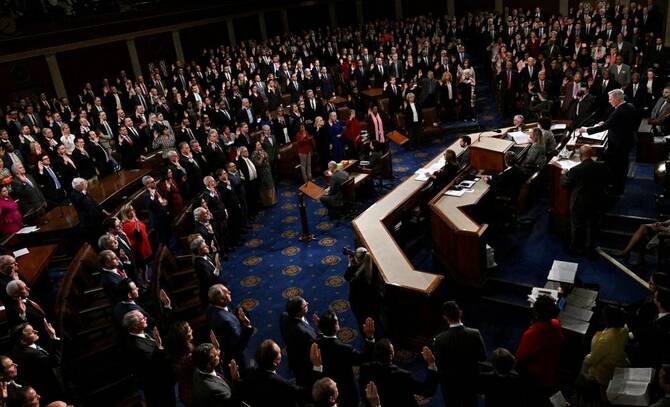
A major showdown on the floor of the House of Representatives seemed imminent. An amendment, advanced by the Rules Committee, was poised to force a rare and telling vote on stripping Israel of $3.3 billion in annual US military aid.
Brought forward by Republican Rep. Thomas Massie and drawing support from key progressive Democrats like Reps. Alexandria Ocasio-Cortez and Greg Casar, the measure was set to put every lawmaker’s stance on unconditional foreign assistance under a public microscope.
However, the high-stakes vote never actually happened. Last Tuesday, the entire legislative package collapsed under the weight of Washington’s internal political warfare. In a dramatic procedural twist, a coalition of Democrats and disgruntled conservative Republicans voted down the mandatory “rule” required to even begin debating the underlying State Department spending bill.
But even if the vote on Massie’s amendment had occurred, the result would have been entirely predictable. It would have been defeated, as support for Israel on both sides of the congressional aisle remains structurally entrenched — even as the American public shifts against Israeli policy in historic numbers.
According to a watershed Gallup poll published in February, a plurality of Americans now sympathizes more with the Palestinians than the Israelis, by 41 percent to 36 percent. This was the first time since Gallup began tracking the metric more than two decades ago that Israel did not hold the upper hand in terms of public sympathy.
This shift is part of a broader, undeniable trend. A nationwide survey published last month by Quinnipiac University revealed that an unprecedented 48 percent of American voters now think the US is “too supportive” of Israel — the highest percentage recorded since the pollster first began tracking the question in 2017.
This is why Massie’s amendment carries such profound weight. It is significant not because US politicians have suddenly developed a collective moral conscience, but because recent election cycles represented the first time in modern American history where Palestine factored as a major, decisive variable in how citizens cast their ballots.
For years, conventional political analysts dismissed pro-Palestinian mobilization, claiming Americans only vote based on immediate socioeconomic interests and rigid party loyalties. That assessment has since proven faulty.
The political cost of Washington’s complicity became undeniable following the fallout of the 2024 presidential race, a reality confirmed by those within the inner sanctums of power. In the postelection debates, senior administration insiders admitted that the handling of the Gaza genocide alienated core voter blocks. Internal party data proved the administration’s Gaza policy was a “net negative” on the ballot.
This finding — disclosed during internal briefings by Democratic National Committee 2024 election autopsy author Paul Rivera — confirmed that the party’s unconditional backing of Israel fractured its base and ultimately contributed to its loss.
November’s midterm elections are expected to be fiercely contested and Gaza will, once more, be on the ballot. Following a series of victories for progressive, antiwar candidates in local primaries, it was reported that US foreign policy toward the conflict had effectively “turned into something of a litmus test for the left.”
This historic transformation in the popular American perception of Palestine and Israel does not indicate that a political rupture will soon follow, as US politicians are known for their moral flexibility and ability to spin language in whatever way is necessary to remain in power.
Indeed, the evolution of the language used by Ocasio-Cortez regarding using the word “genocide” to describe what is happening in Gaza tells the entire story of how the Democratic establishment is never compelled by genuine moral urgency, but rather by political expediency.
In the early months of the genocide, Ocasio-Cortez hesitated to use the word, being acutely aware of the deep sensitivities surrounding such language in US media and mainstream society. “The fact that this word is even in our discourse … demonstrates the mass inhumanity that Gaza is facing,” she stated, attempting to navigate an acceptable rhetorical middle ground in January 2024.
It is the people who hold the true power to influence — and even coerce — politicians to make the right choices.
Dr. Ramzy Baroud
But, under the relentless weight of pressure from an increasingly mobilized progressive constituency, she upgraded her language in March of the same year, declaring on the House floor: “If you want to know what an unfolding genocide looks like, open your eyes. It looks like the forced famine of 1.1 million innocents.”
This linguistic shift continued to intensify until it reached the Munich Security Conference in February this year, when Ocasio-Cortez finally deployed the term without any qualification. Unconditional US aid, she flatly argued, “enabled a genocide in Gaza.”
Ocasio-Cortez is one of many Democratic progressives who carefully filtered their vocabulary to avoid the political fallout of saying “genocide” too early or too late. Her position was eventually corrected not because of a sudden moral awakening or the discovery of new information, but because the margin for error allowed by a newly conscious American public was completely closed.
Therefore, the strategic focus must remain on reaching out to the public, for it is the people who hold the true power to influence — and even coerce — politicians to make the right choices.
Ultimately, the current movement serves as a crucial barometer, proving that sustained, grassroots antiwar pressure is successfully destabilizing Israel’s traditionally unquestioned shield in Washington.
BY: Dr. Ramzy Baroud is a journalist, author and the editor of The Palestine Chronicle. His latest book, “Before the Flood,” was published by Seven Stories Press. His website is ramzybaroud.net.
Disclaimer: Views expressed by writers in this section are their own and do not necessarily reflect The Times Union‘ point of view