- Beijing Defends Launch as Routine Military Exercise as Regional Powers Express Growing Security Concerns
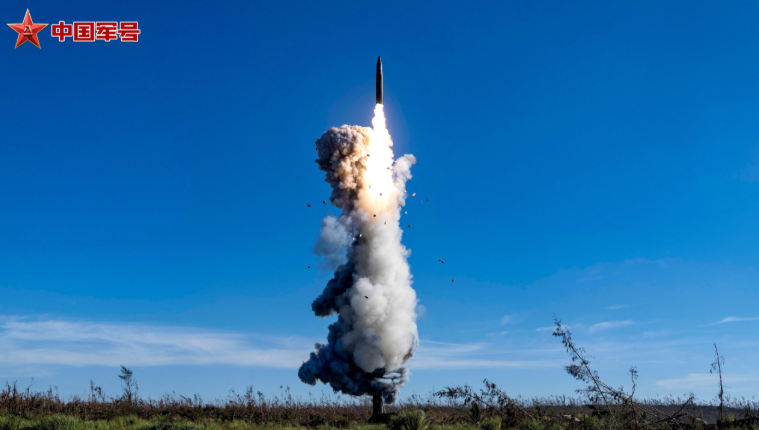
WASHINGTON, United States: The United States has expressed deep concern over China’s expanding nuclear capabilities after Beijing conducted a test launch of an intercontinental ballistic missile (ICBM) carrying a dummy warhead into the Pacific Ocean, a move that has intensified regional security concerns and renewed calls for greater nuclear transparency.
The launch marks China’s second known long-range missile test over international waters in recent years, following a similar exercise in 2024 that sent an ICBM into waters near French Polynesia—the country’s first such test in more than four decades.
US officials said the latest test underscores Beijing’s accelerating military modernization and its rapidly expanding nuclear arsenal, developments that Washington says threaten strategic stability in the Indo-Pacific and beyond.
“At a time when the United States is working harder than ever to prevent nuclear proliferation, China is doing the opposite,” State Department spokesman Tommy Pigott said in a statement.
“Beijing’s rapid and opaque nuclear weapons buildup is of great concern to the region and the world,” he added.
Washington urged Beijing to engage in substantive arms control negotiations and establish a regular notification mechanism for all intercontinental-range ballistic missile and space launches to reduce the risk of miscalculation.
The concerns come after the expiration of the New START Treaty, the last major US-Russia nuclear arms control agreement, which Washington allowed to lapse earlier this year while seeking a broader framework that would also include China. Beijing has consistently rejected such proposals, arguing that its nuclear arsenal remains significantly smaller than those of the United States and Russia.
Analysts Highlight Expanding Sea-Based Nuclear Reach
Military analysts said the latest launch demonstrates China’s growing ability to deploy long-range nuclear weapons from sea-based platforms, significantly enhancing the survivability and reach of its strategic deterrent.
Monitoring organizations indicated that the missile was launched from a Chinese nuclear-powered submarine and landed in waters near the Solomon Islands, a Pacific nation that signed a controversial security agreement with China in 2022.
Lyle Morris, a senior fellow at the Asia Society Policy Institute, described the test as a significant milestone in China’s strategic capabilities.
“A test of this distance suggests China is developing a far more survivable and longer-range sea-based nuclear deterrent,” Morris said, adding that it indicates the Chinese navy could potentially target the continental United States while operating relatively close to Chinese waters.
Pacific Nations Respond with Concern
According to New Zealand, China notified Pacific nations approximately two hours before the missile launch, although it remains unclear whether the United States received advance notice.
Chinese navy spokesperson Wang Xuemeng defended the exercise, describing it as “a routine arrangement of China’s annual military training” and stating that relevant countries had been informed beforehand.
The missile test coincided with the signing of a major defense agreement between Australia and Fiji, reinforcing Canberra’s efforts to strengthen regional security partnerships amid China’s expanding influence in the Pacific.
Australian Foreign Minister Penny Wong described the launch as “destabilizing to the region,” while Japan, which confirmed it had received prior notification, said it had urged Beijing to reconsider the exercise and voiced “serious concerns” over China’s increasing military activity.
Tensions between Beijing and Tokyo have escalated in recent months following remarks by Japanese Prime Minister Sanae Takaichi, who suggested that a future Chinese attack on Taiwan could potentially warrant Japanese military involvement.
Russia Backs China
Russia, one of China’s closest strategic partners, defended the missile test, calling it Beijing’s sovereign right.
The Kremlin said China “is not threatening anyone in the world,” dismissing criticism from Western governments over the launch.
The latest missile test reflects intensifying strategic competition across the Indo-Pacific, where China’s military expansion and growing nuclear capabilities continue to reshape the regional security landscape and fuel concerns among the United States and its allies.
BY: The Times Union – AFP