The US has traditionally excelled at developing soft power. However, those historical patterns appear to be shifting, significantly, under Donald Trump’s second presidency, creating opportunities for other powers, especially China.
Indeed, this could even be a generational moment that has not been as favorable to Beijing since perhaps the closing years of George W. Bush’s presidency. That was in the midst of the global economic crisis of 2007-08, and the aftermath of the US wars in Iraq and Afghanistan.
To be sure, China’s grand strategy has been founded on a longer-term, extended transition to power. However, unexpected political gifts will not be shunned by Beijing along its gradualist journey.
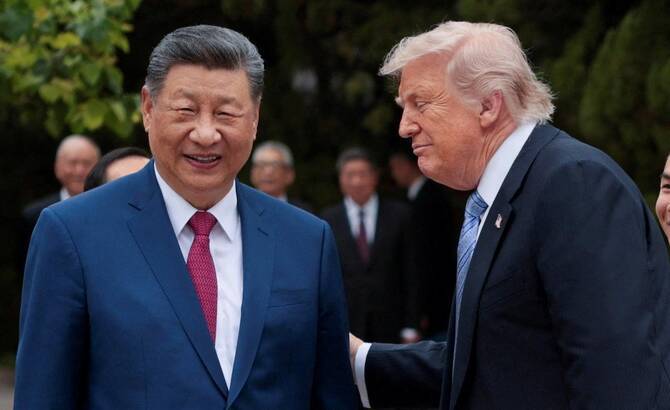
Following Trump’s summit with President Xi Jinping last week, which demonstrated China’s growing confidence on the world stage, one such window may exist to significantly boost Beijing’s prestige given the tumult in international relations. The opportunity is at least on two levels: the first in the growing numbers of world leaders traveling to China to meet senior officials. These meetings often feature discussions about recasting international relations given the shocks to global affairs for at least the past 15 months.
In addition, public opinion data shows a dramatic change in sentiment. Take the example of a European Council on Foreign Relations report released in January. This polled almost 26,000 respondents across 21 countries last November, around 12 months after Trump’s presidential reelection victory.
Even before key global controversies of this year, polling pointed to growing warmth toward Beijing. So much so that the council asserts a “China First” world is on the horizon. This is based on opinion trends which show less concern about a rising China in much of the world. More people now see Beijing as a necessary partner or even ally, including in India, where almost half the populace hold this view, despite historical tensions between the two powers.
Moreover, a growing number of populations in key geographical areas also anticipate deeper ties with China over the next half decade. This is perhaps no big surprise in Russia given the close relationship between Xi and President Vladimir Putin. What is more striking is that clear majorities in other key emerging markets expect the same, including South Africa, with 71 percent, and Brazil, with 52 percent.
This sentiment is combined with growing expectations that China’s already significant global influence will grow over the next five years — not only politically, but also in its tech and wider economic strength.
In major Western powers such as the US and EU, Beijing is widely seen to be increasingly preponderant in renewable energy tech. In the EU, too, China is perceived as having a growing global edge on electric vehicles, and this is an increasing, although not yet a majority, view in the US.
The European Council on Foreign Relations data is supported by other surveys, including a Pew Global study published last summer. That July survey, which engaged more than 28,000 people in spring 2025, indicated that in 15 of 25 nations, people had a favorable view of China. This marks a significant change since the pandemic when views of Beijing reached historic or near historic lows in Pew’s data set.
More people perceive Beijing as the world’s leading economic power.
Andrew Hammond
Pew also found more people, in the 25 surveyed nations, now perceive Beijing as the world’s leading economic power, a significant shift from two years ago when considerably more people saw the US in this role. A median of 41 percent now view China as the top economic power, compared with a median of 39 percent giving that mantle to the US.
While the trends are broadly positive for China, they are not uniform in their direction, and could potentially also result in headaches for Beijing. On the first point, both the ECFR and Pew surveys show that the data about perceptions of China are patchy in places.
The Pew survey found, for instance, that despite the growing sense that China is now the leading global economy, people in nearly all countries surveyed prioritize strong economic ties with Washington over Beijing. This finding was revealing, even though the share of people who prioritize economic ties with China has grown in more than half of the countries compared with earlier Pew surveys.
Moreover, Pew found that favorable views of China have improved significantly, especially in middle-income nations, but less in higher-income nations. This latter finding probably reflects, in part, the emphasis that China increasingly puts on “democratizing” the Western-led global order. This message, other things being equal, will tend to appeal more to low and mid-income nations.
On the second point, there have been other occasions in the past, including during Trump’s first presidency, when many internationally believed the global balance of power had swung in China’s favor. This sometimes created tensions, and not only in Beijing’s relations with Washington.
While many in China welcome recognition of the country’s growing might, it has occasionally exposed the country to greater foreign scrutiny. This has sometimes been seized on by insurgent, anti-establishment politicians to try to tap into growing angst about China’s rise.
The brighter spotlight on the country has sometimes exposed a soft power deficit. Soft power, which rests on the international attractiveness of a country’s foreign policy, political values, and culture, is recognized by Beijing as a key political commodity, but one it has had limited success in cultivating.
As international perceptions of the country’s power change, its global favorability has become more of a challenge to try to manage. If this critical scrutiny intensifies, Beijing will need to find better ways to tackle this problem.
Taken together, many signs now point to a potential sea change in perceptions of the global political and economic landscape, including the balance of power and Beijing’s place in it. While this contains a significant soft power opportunity for China, it comes with key challenges that may be difficult to manage.
BY: Andrew Hammond is an associate at LSE IDEAS at the London School of Economics.
Disclaimer: Views expressed by writers in this section are their own and do not necessarily reflect The Times Union‘ point of view