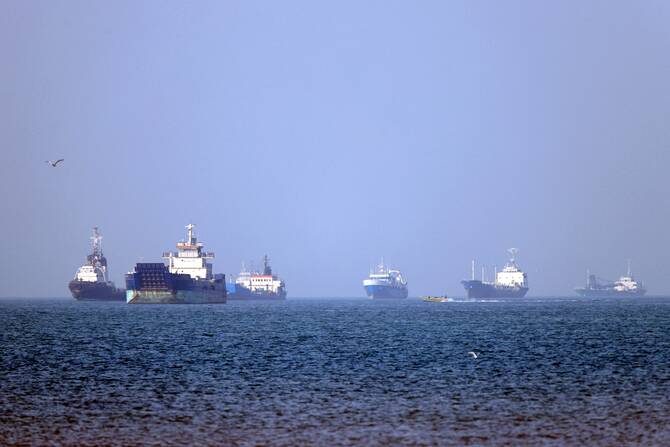
Iran is asking for acknowledgement of its sovereignty over the Strait of Hormuz. It knows that the US is being pushed into a corner by the absence of a silver bullet that can end the war and hand President Donald Trump a victory. Tehran feels it is in the driver’s seat, especially after Trump backed down and extended the ceasefire. However, Iran should be careful, as this show of power — embodied by its claim over the Strait of Hormuz — is counterproductive and will ultimately end up hurting it.
Iran wants to have indefinite control over the strait and collect tolls from passing ships. Some experts have argued that Iran can collect money the same way Turkiye charges vessels to cross the Bosphorus. However, the Strait of Hormuz is different, as it separates two countries, Iran and Oman. In that sense, it is more like the Strait of Dover that passes between France and Britain. But the main issue is not really about the legality of this claim; rather, it is about Iran’s show of power in the face of its Arab Gulf neighbors.
The Iranian government should, for its own sake, rephrase its demand and its narrative. It is in the interest of Iran to have good relations with its neighbors. Tehran states that it is seeking brotherly relations with its Arab Gulf neighbors. It also wants American forces to leave the region, as it perceives the US presence as a threat.
The worst policies are the ones driven by hubris. The current claim over the Strait of Hormuz falls into this category
Dr. Dania Koleilat Khatib
The Arab Gulf states will not ask the Americans to leave as long as they sense a threat coming from Iran. In this respect, it is in the interest of Iran to show humility toward its neighbors and give them assurances. Previous claims made by Iranian politicians — such as the boast that Tehran controls four Arab capitals — have only reinforced the Arab Gulf perception that US support is needed to contain a belligerent neighbor. The worst policies are the ones driven by hubris. The current claim over the Strait of Hormuz falls into this category.
Iran’s claim is even set to serve American interests. It will drive the Arab Gulf away from Iran and closer to Washington. It will enforce the US narrative that Iran is seeking hegemony and only an American presence and weapons can prevent that.
The US might initially cunningly pretend to acquiesce to Iran’s claim. Iran should be careful not to believe such a bluff. When Trump says things like “me and the ayatollah” “will jointly” control the Strait of Hormuz, the Iranians should understand this is only a ruse that hypes up Iranian national pride. The US will use the Iranian claim over the strait to put pressure on the Arab Gulf states. The US approach toward these states would be as follows: The US can put up with Iranian dominance over the Gulf if the Arab Gulf states are fine with it. And the claim over the Strait of Hormuz is only the tip of the iceberg when it comes to Iran’s hegemonic ambitions
For sure, this will make the Arab Gulf states more attached to the Americans than ever. Iran should have learned by now that its belligerent revolutionary-style narrative is counterproductive when it comes to its Arab neighbors. The more measured and conciliatory tone it adopts when addressing its neighbors, the more effective its messaging will be.
The more measured and conciliatory tone it adopts when addressing its neighbors, the more effective its messaging will be
Dr. Dania Koleilat Khatib
Former Qatari Prime Minister Hamad bin Jassim has already stated the obvious: The US wants the Arab Gulf states to confront Iran; this way, it would be able to retreat from the fight and sell weapons to its Gulf allies. So far, the Gulf states have been able to dodge this bullet. Nevertheless, they will not cede their sovereignty to Iran. Hence, if they feel that Iran is trying to exert dominance over them, they will likely change their neutral stance. Once they succumb to US pressure and take an offensive stance toward Iran, America will definitely change position.
Iran should change its narrative and say that, in the postwar phase, it will seek — after agreeing with its neighbors on a method and a time limit — to collect tolls in order to support the reconstruction effort. It should also state that once an end to the war is finalized, it will call for a conference under the auspices of the Organization of Islamic Cooperation to discuss the management of the Strait of Hormuz, as well as a regional security arrangement. It should also stress that any new framework will ensure that no state or ethnicity will dominate the system.
The tolls collected from the strait could be worth about $10 billion a year. It is not that sum that will upset the Arab Gulf states but rather the significance of this levy. To them, this would be an unacceptable act of hegemony. Since the revolution in Iran in 1979, the leadership in Tehran has adopted a belligerent tone when addressing its neighbors, starting with Ruhollah Khomeini calling for the overthrow of “American-backed” Arab rulers and for exporting the concept of the Islamic revolution. This belligerent tone continued under Ali Khamenei.
Iran needs to understand that it will not have good relations with its neighbors as long as they see it as a threat. As long as they see Iran as a threat, they will ask for the help of a hegemon to preserve their security. The first step for Iran, if it is to no longer be perceived as a threat, is to stop this belligerent discourse and this show of power.
BY: Writer Dr. Dania Koleilat Khatib is a specialist in US-Arab relations with a focus on lobbying. She is co-founder of the Research Center for Cooperation and Peace Building, a Lebanese nongovernmental organization focused on Track II.
Disclaimer: Views expressed by writers in this section are their own and do not necessarily reflect The Times Union‘ point of view