- Japanese assistance to Pakistan Red Crescent Society to boost blood collection capacity and support lifesaving medical services
Islamabad: The Government of Japan has announced a grant of USD 65,470 (approximately PKR 18 million) under its Grant Assistance for Grassroots Human Security Projects (GGP) Programme to support the enhancement of blood donation services in the capital region.
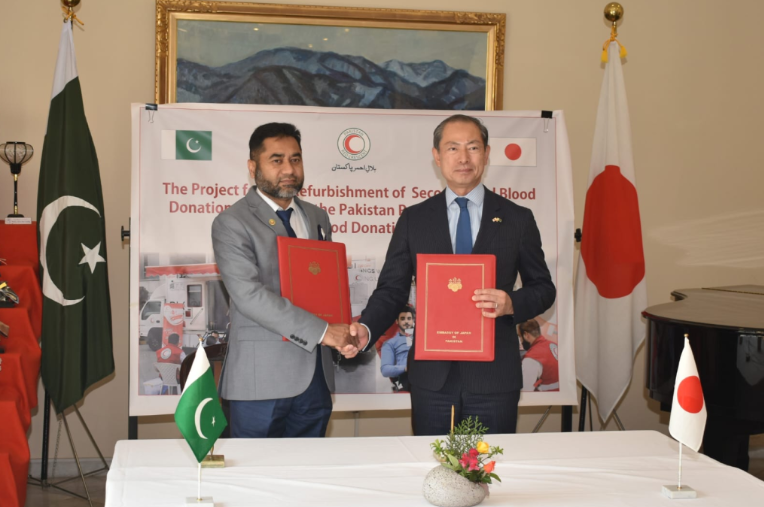
The grant agreement was signed on March 6, 2026, at the Embassy of Japan in Islamabad between Akamatsu Shuichi, Ambassador of Japan to the Islamic Republic of Pakistan, and representatives of the Pakistan Red Crescent Society (PRCS).
The initiative, titled “The Project for the Refurbishment of Second-hand Blood Donation Vehicle for the Pakistan Red Crescent Society Regional Blood Donation Center,” aims to strengthen the operational capacity of the PRCS Regional Blood Donation Centre in Islamabad to collect and supply safe blood to vulnerable patients and emergency cases.
Established in 1947, the Pakistan Red Crescent Society is one of the country’s leading humanitarian organizations, operating nationwide in disaster response, health services, and community support. The PRCS Regional Blood Donation Centre in Islamabad relies entirely on voluntary, non-remunerated blood donors and has recorded a steady increase in blood collection over the past decade. However, limited outreach capacity and operational constraints have posed challenges in meeting the growing demand for safe blood supplies.
Through this grant, PRCS will acquire a refurbished second-hand blood donation vehicle from Japan, enabling the organization to expand mobile blood collection campaigns. The vehicle will facilitate blood donation drives at universities, workplaces, public spaces, and mosques across Islamabad and surrounding areas.
According to PRCS, the project is expected to increase blood collection capacity by approximately 30 percent, potentially helping save the lives of nearly 12,000 patients annually, including those suffering from thalassemia, hemophilia, and cancer, as well as victims of road traffic accidents. The initiative will also enhance preparedness during natural disasters and other emergencies.
Speaking at the signing ceremony, Ambassador Akamatsu emphasized that human security begins with safeguarding each individual life, which forms a cornerstone of Japan’s development assistance policy. He noted that ensuring adequate blood stocks is directly linked to saving lives and improving access to critical medical treatment.
Reaffirming Japan’s longstanding partnership with Pakistan, the Ambassador stated that the Government of Japan will continue to support capable local non-governmental organizations through grant assistance programmes aimed at advancing human security and community resilience.
He also expressed hope that the project would further strengthen the enduring friendship between Japan and Pakistan and contribute to improved healthcare services for communities in the capital region.
BY: Nadeem Faisal Baiga