VERONA, Italy – The curtain came down on the Milan Cortina Winter Olympics with Sunday’s closing ceremony at the ancient Arena di Verona marking the end of the landmark games featuring 116 medal events, staged for the first time across four clusters in northern Italy.
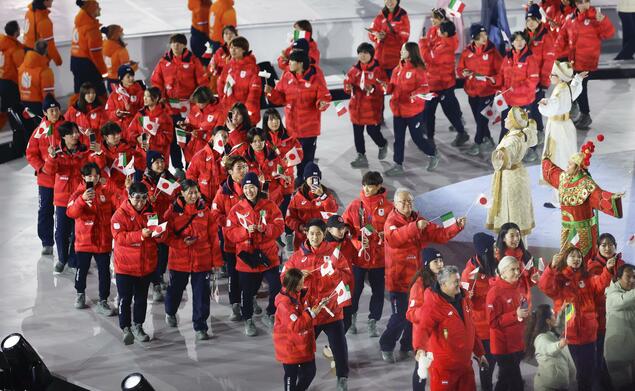
Figure skater Kaori Sakamoto and speed skater Wataru Morishige were the flagbearers for the Japanese team, which waved Japanese and Italian flags, as it did at the opening ceremony, after achieving its Winter Games-best 24 medals, including a record-tying five golds alongside seven silvers and 12 bronzes.
The flames inside the two identical Olympic cauldrons that were kindled simultaneously on Feb. 6, placed around 250 kilometers apart at the landmark Arco della Pace in Milan and Piazza Angelo Dibona in Cortina d’Ampezzo, went out together to mark the games’ closure.
“You have been incredible — each and every one of you. Brave. Fearless. Full of heart and passion. You left it all on the snow and ice,” International Olympic Committee President Kirsty Coventry said. “The Olympic Games will continue to be a space where the athletes can inspire the world through sport: freely, safely and proudly.”
The organizers said some 1.3 million tickets were sold, accounting for 88 percent of the total that went on sale. The newly added ski mountaineering sold out, while speed skating and figure skating were especially popular.
Norway topped the medal table by some distance with 18 golds and 41 overall, with its men’s cross-country skiing phenomenon Johannes Hoesflot Klaebo enjoying a perfect six-gold sweep and Jens Luraas Oftebro winning three golds in the Nordic combined.
The United States was second in both categories with 12 golds and 33 medals overall, while Italy and the Netherlands both amassed 10 golds. The host smashed its previous high of 20 medals by winning 30, with short track speed skater Arianna Fontana reaching 14 Olympic medals in her career, one short of the Winter Games record.
It was a breakthrough games for Japan, with its five gold medals the country’s most at an overseas Winter Olympics and tying its previous best as host in 1998 in Nagano. Its 24 medals comfortably eclipsed its 18 from 2022 in Beijing and placed fifth-most among all nations at the Milan Cortina games.
Snowboarding contributed the most medals to the haul, with four gold and nine overall. Kira Kimura won the men’s big air to open the floodgates, followed by Kokomo Murase winning the women’s event. Yuto Totsuka won the men’s halfpipe and Mari Fukada the women’s slopestyle in Livigno.
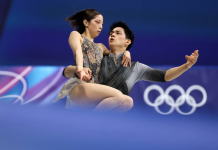
Figure skating added six medals overall, including Japan’s first pairs gold for Riku Miura and Ryuichi Kihara in Milan, while ski jumping provided the next-most medals, with four at Val di Fiemme.
Japan also reached exactly 100 Winter Olympic medals, beginning with Chiharu Igaya winning men’s slalom silver at the 1956 Cortina Games.
Sakamoto, who said she would retire at the season’s end, won two silvers, while speed skater Miho Takagi added three bronzes to take her career tally to 10 medals, the most by a Japanese Winter Olympian and most by a Japanese woman at either Summer or Winter Games.
On the penultimate day of these games, Satoshi Furuno narrowly missed Japan’s 101st medal in the four-man freestyle skiing ski cross final.
Earlier in the games, 42-year-old snowboarder Tomoka Takeuchi made her seventh consecutive and final Olympic appearance, the 2014 women’s giant parallel slalom silver medalist bowing out in the qualifying round to end her career.
Nordic combined skier Akito Watabe, 37, retiring at the end of the season, could not continue his run of three straight Olympics with a medal after competing in three events.
Japanese Olympic Committee President Seiko Hashimoto believes the games “served as a catalyst for young people to get interested in sport,” with the athletes set for a parade in Tokyo on April 25. She suggested Japan could make a multiple-city bid in the future following the success of the games in Italy.
The JOC said its first 24-hour monitoring of online abuse on SNS, which involved staff based both in Milan and Tokyo, resulted in the deletion of 317 posts from 1,919 requests since before the start of the games.
The Milan Cortina Winter Paralympics will be held March 6-15, while the IOC is considering bringing forward the 2030 French Alps Winter Olympics by a month in response to climate change, with the possibility of some events being added from the Summer Olympic program.
BY: The Times Union – KYODO