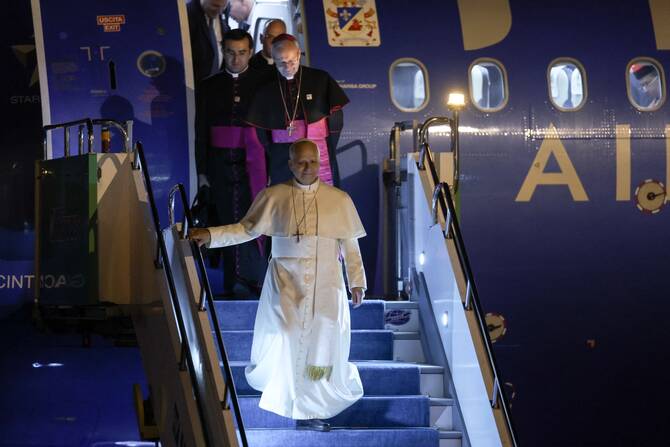
Pope Leo XIV’s much-anticipated visit to Turkiye — his first official foreign trip as pontiff — has both diplomatic and religio-historic importance.
Paul VI became the first pope to visit Turkey in 1967, following the establishment of relations between the Holy See and Ankara seven years earlier. This is the fifth papal visit since that landmark trip.
Leo arrived in Turkiye on Thursday and will stay until Sunday, with a busy itinerary. Traditionally, papal visits to Turkiye have had two main stops: Ankara and Istanbul. In Ankara, meetings with officials are held, in which discussions mainly focus on regional and international humanitarian issues. While in Istanbul, meetings are held with religious figures and community members.
In this visit, Ankara was the pope’s first stop. There, he visited Anitkabir, the mausoleum of Mustafa Kemal Ataturk, the founder of modern Turkiye, and was then welcomed with an official ceremony at the Presidential Complex by President Recep Tayyip Erdogan.
Leo’s visit serves several purposes. While Turkiye is a Muslim-majority country, it is also home to the Ecumenical Patriarch Bartholomew I, who is considered the spiritual leader of the Eastern Orthodox Church. His headquarters are in Istanbul. The first purpose of the visit is to send a unification message regarding Catholic-Orthodox relations.
In addition, Turkiye is considered by the Vatican as a significant geopolitical actor that plays a key role in regional crises. Thus, the second purpose of the visit focuses on Turkiye-Vatican relations, which have seen improvement of late, particularly in the context of the Russia-Ukraine conflict and the Gaza war.
The Vatican has expressed appreciation for Turkiye’s efforts to mediate between Russia and Ukraine. Although the Holy See has also attempted to broker a ceasefire between Kyiv and Moscow, those initiatives have so far failed. In addition, the war in Gaza has intensified diplomatic traffic between the Holy See and Ankara. Erdogan and the late Pope Francis held several phone calls on the Gaza war. The Holy See has particularly drawn international attention with its stance on the plight of the Palestinians, an issue also of deep sensitivity to Turkiye.
The last papal visit to Turkiye took place in 2014, continuing the tradition of popes visiting the country in the early years of their tenures. During his 2014 visit, Francis visited the Hagia Sophia, then a museum before it was converted to a mosque in 2020, and the Sultanahmet Mosque, known as the Blue Mosque, where his prayer was widely seen as a gesture of interfaith dialogue and a symbol of strengthening Catholic-Muslim relations. Leo’s itinerary includes only the Blue Mosque. In 2014, Francis was warmly welcomed by the Turkish public and a similar atmosphere surrounds this visit. Souvenirs and posters featuring a portrait of Leo alongside the Turkish flag have been prepared.
Overseas trips are considered an important part of the Holy See’s soft power, giving the pope the opportunity to meet leaders, engage with Christian communities and draw global media attention to regional issues. During his visit to Turkiye, Leo is expected to focus on continued efforts toward Catholic-Orthodox reconciliation, strengthen dialogue between Christians and Muslims, raise concerns over regional issues, and support local Christian communities.
There have been reports that the pope is likely to raise the possible reopening of a Greek Orthodox religious seminary in Turkiye, known as Heybeliada school, which was closed in 1971 following a Constitutional Court ruling that private higher education institutions must be affiliated with state universities. The seminary, founded in 1844, is a symbol of Orthodox heritage and it trained generations of Greek Orthodox patriarchs, including Bartholomew.
Turkiye has long faced pressure from the US and EU to reopen it. Optimism grew after US President Donald Trump discussed the issue with Erdogan at the White House in September. Erdogan reportedly told Trump at their meeting that “we are ready to do whatever is incumbent upon us regarding the Heybeliada school.”
However, the central purpose of Leo’s Turkiye trip is to mark the 1,700th anniversary of the First Council of Nicaea, Christianity’s first ecumenical council, which was held in 325 A.D. in today’s Iznik, in the northwestern Turkish province of Bursa. The pope will pray with Bartholomew toward the ruins of the Basilica of St. Neophytos and sign a joint declaration as a symbolic gesture of Christian unity. According to reports, 15,000 Christians are expected to attend the ceremony in Iznik.
Data from the Catholic Church states that about 33,000 Catholics currently live in Turkiye. The meeting between Leo and Bartholomew is considered an important step for the convergence of the Catholic and Orthodox churches. The pope is also scheduled to perform a prayer service to an estimated 4,000 people at the Volkswagen Arena in Istanbul. Leo has also met the head of Turkiye’s Presidency of Religious Affairs and the country’s chief rabbi.
Within this context, the pope’s first overseas visit being to Turkiye comes as no surprise. It is both a papal tradition and a deliberate choice. Turkiye is a mosaic of faiths, home to Muslims, Christians, Jews and other religious minorities. It also hosts religious archaeological sites, making the country particularly important in the eyes of other communities. The timing of the visit is also important, as it comes when greater reconciliation is needed. Leo hopes to foster stronger Turkiye-Vatican relations, while also encouraging a united moral stance toward crises from Gaza to Ukraine.
BY: Writer Dr. Sinem Cengiz is a Turkish political analyst who specializes in Turkiye’s relations with the Middle East.
Disclaimer: Views expressed by writers in this section are their own and do not necessarily reflect The Times Union‘ point of view