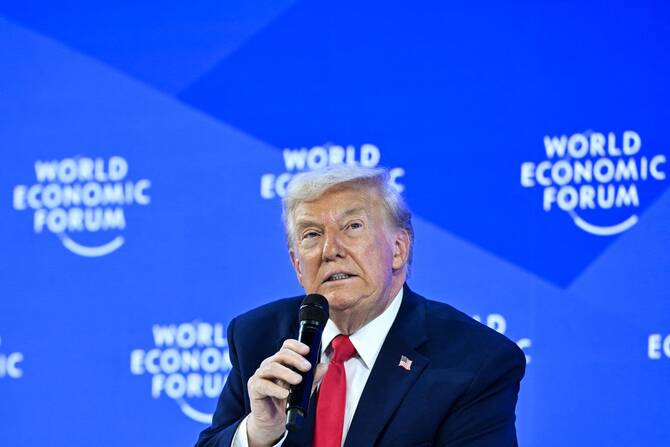
It is difficult for an analyst to come away with an accurate picture of the deliberations of the World Economic Forum in Davos, Switzerland. With such events, it is very useful to understand the atmosphere, body language, implicit messages and positional “test signals.”
The stances expressed in speeches and discussions are carefully calibrated; they reflect participants’ principles and vested interests. However, this task requires prudence that makes them easier to swallow and more readily accepted by the broader public.
In fact, participants know their audience well and are aware of what is expected to be heard. Yet the more perceptive speakers understand that the message is stronger and more effective when it transcends narrow interests and impacts the wider sphere of interests.
When a figure from the forum’s elite, such as Larry Fink, chairman of the trillion-dollar asset management giant BlackRock, speaks of the challenges facing capitalism, he raises this issue out of concern for its survival in a changing world that can seem ungoverned at times.
In other words, people like Fink feel that capitalism may sometimes need to be rescued from its own excesses in a world where technology threatens to remove constraints, remove the brakes and universalize unknowns.
According to Fink, this trajectory threatens the “legitimacy” of the global economic system.
People like BlackRock’s Fink feel that capitalism may sometimes need to be rescued from its own excesses
Eyad Abu Shakra
Here, the American news site Axios reported that Fink reminded his audience that economic prosperity is not confined to cumulative growth (in the sense of the size of a country’s gross domestic product or the market capitalization of major corporations), but includes the breadth of the population that feels it, experiences it and builds its future upon it.
On another front, the influential global billionaire predictably addressed the impact of artificial intelligence, explaining that it will negatively affect the fate of office and clerical jobs to the same extent that globalization negatively affected manual labor jobs. Accordingly, he stressed that this challenge must be seriously and directly addressed. From this perspective, the head of BlackRock called for greater engagement in intensive dialogue across the world: more listening and less lecturing.
Against this deep realism, there were of course predictable excesses expressed in several economic and political quarters. As usual, the political spotlight focused on the positions of the US, which President Donald Trump conveyed in word and deed.
Trump arrived at Davos having just finished the “raid” on Venezuela that led to the removal of President Nicolas Maduro and amid his multipronged effort to capture the island of Greenland and remove it from Europe’s “embrace,” and his project for the future of the Gaza Strip.
In this regard, it has become clear that the world is beginning to absorb the shock, adapting to an unfamiliar American leadership with “out-of-the-box” views that, since the end of the Cold War at least, had seemed unthinkable in the West.
The rise of the Soviet Union as a global power at the end of the Second World War (on the ruins of Nazism, fascism and Japanese militarism) allowed for the emergence of a “global economic shift” following the success of the Maoist revolution in China.
Thus, the combined Soviet-Chinese effort, together with the emergence of a nonaligned Third World force outside the two major blocs (the capitalist West and the communist East), led to the growth of global “liberation” movements across Asia, Africa and the Americas. But the rules of the game changed with the end of the Cold War, the collapse of European communism and with it the fall of the Berlin Wall.
For a few decades, it seemed that a new world order had emerged from the “end of history” that Francis Fukuyama heralded, marked by the West’s “victory,” while laying the groundwork for the “clash of civilizations” between the West and the Islamic world that Samuel Huntington anticipated.
Indeed, despite tremors here and there, the “new world order” appeared to be steadily consolidating. But four developments altered the trajectory.
First, Russian President Vladimir Putin succeeded in preventing his country’s collapse and launched a retaliatory counterwar against the West, beginning with his embrace of far-right extremist forces. In truth, Putin exposed the fragility of democracy and of the integration project of the “institutional state” in Western Europe, and then in the US itself.
As usual, the political spotlight focused on the positions of the US, which Trump conveyed in word and deed
Eyad Abu Shakra
Second, China got back on its feet, successfully (so far) distracting the world from its strategic ambitions by appearing to focus on the economy, manufacturing and scientific research.
Third, the exponential acceleration of the technological revolution, from communications and information technologies to AI, could change various formulas worldwide.
Fourth, building on these three developments, came the change in patterns of thinking and the redefinition of priorities in the US through the nationalist, populist “Make America Great Again” current, under the political leadership of Trump and the ideological vision of figures like Steve Bannon.
Under MAGA, the priorities shifted. The traditional enemy was no longer an enemy and the traditional ally was no longer an ally. The language of diplomacy was set aside, replaced by the language of imposition or threats. Long-term calculations were replaced by quick deals. In Davos, Trump confirmed this shift.
Conversely, the world adapted to this state of affairs: world leaders avoided confronting Trump or directly opposing his projects, while gradually disengaging from commitments.
The “rebellion” began with Canada, Spain and France, and now extends to Germany and Italy as well.
They decided that it was not in their interest to marginalize themselves and sacrifice major international institutions, such as the UN and NATO, for personal interests that ultimately serve the interests of the “man in the White House,” as his rival, Democratic California Gov. Gavin Newsom, reminded them from the heart of Davos.
BY: Eyad Abu Shakra is managing editor of Asharq Al-Awsat, where this article was originally published.
Disclaimer: Views expressed by writers in this section are their own and do not necessarily reflect The Times Union‘ point of view