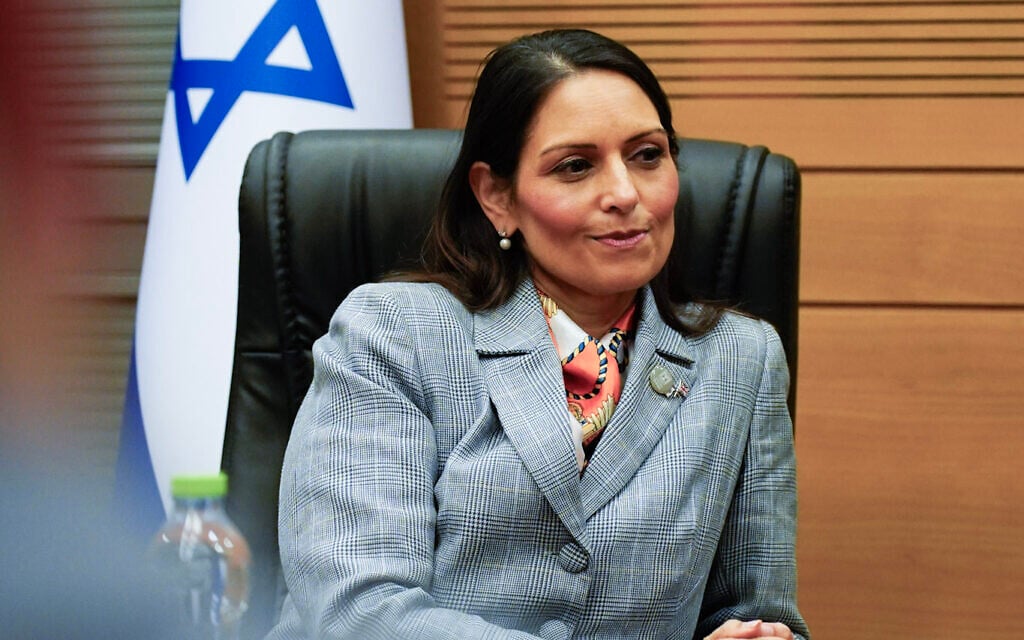
- In Jerusalem, pro-Israel stalwart and Conservative shadow foreign minister Priti Patel accuses Labour of becoming irrelevant in Mideast, emboldening Hamas, and whiffing on antisemitism
Under Keir Starmer’s Labour government, the United Kingdom “no longer has a seat at the table” on key decisions about the future of the Middle East, the top foreign affairs official in Britain’s opposition has charged.
“It’s not even at the front door, let alone the table,” Priti Patel, Britain’s shadow foreign secretary, told The Times of Israel from the Knesset in Jerusalem on Tuesday.
Though Starmer attended US President Donald Trump’s Gaza peace summit in Sharm El-Sheikh last month, London has not been a central player in mediating between Israel and Hamas or crafting Trump’s 20-point plan for Gaza. Starmer was among the world leaders Trump singled out for praise during the Sharm summit.
The UK “has chosen to abdicate responsibility and not be a player,” argued Patel, a former home secretary and secretary of state for international development for the Conservatives. “That was evident when Britain could not even say where it stood on those Iranian strikes early on a few months back, which is just terrible. It shows that Britain isn’t a player in the world.”
After the US joined Israel’s bombing campaign against Iranian nuclear sites in June, Starmer said that Iran cannot be allowed to attain a nuclear weapon, while stressing the importance of de-escalation and a return to the negotiating table.
The Royal Air Force took part in countering Iran’s two major missile and drone attacks on Israel in 2024, but was not asked to help with the attacks on Iran’s nuclear sites this year.

A Labour Friends of Israel spokesperson defended Starmer’s record on Iran.
“Priti Patel served in a government which did little to nothing to tackle the threat posed by Iran,” the LFI spokesperson told The Times of Israel. “By contrast, Keir Starmer’s government has instituted ‘snapback” sanctions against Tehran, it is bringing forward legislation to proscribe the [Islamic Revolutionary Guards Corps] and has instituted new curbs to combat those lobbying on behalf of the regime.
As an opposition MP, Patel does not make decisions on Britain’s foreign policy or have direct influence on London’s stance when it comes to the Middle East or elsewhere. But the position marks her as likely to take up the foreign secretary role in a Tory-led administration, and gives her a powerful platform to criticize those making the decisions and rally opposition to government decisions her party sees as mistaken.
Patel said she sees it as her responsibility “to hold the government to account on the fact that they no longer have a seat at the table alongside our friends in Israel.”
On Sunday, Patel visited the Civil-Military Coordination Center in Kiryat Gat, the headquarters of the US-led international effort to implement US President Donald Trump’s 20-point plan for Gaza. The UK has sent military and civilian personnel to the CMCC, but is not playing a leading role there.
Patel met with Maj. Gen. Tom Bateman, head of the British mission there, and with IDF representatives from the Coordinator of Government Activities in the Territories.
She called for an expanded British presence at the CMCC to ensure “the elimination of Hamas.”
“We’re only interested in the elimination of Hamas,” said Patel. “That has to be the starting point right now. There can be no continuation of Hamas, full stop. There should be nothing left of them whatsoever.”
“We all say, well, they can’t govern, and all this stuff. We shouldn’t even be uttering that sentence. Hamas has be eliminated,” she insisted.

Six weeks after the Gaza ceasefire went into effect, Israel’s frustrations with what it calls repeated Hamas violations are boiling over.
On Saturday, Israel carried out deadly strikes across Gaza, including a strike on Gaza City targeting Hamas’s military chief.
The first phase of Trump’s 20-point ceasefire plan formed the basis of Israel and Hamas’s October 9 truce-hostage deal.
In the next stage of the plan, Israel is meant to withdraw from more of Gaza. The outline also includes the establishment of a transitional authority to govern Gaza, the deployment of the multinational security force meant to take over from the Israeli military, the disarmament of Hamas, and the start of reconstruction as part of phase two.
“There is complete focus in terms of the eradication and the elimination of Hamas,” said Patel of the CMCC. “And if there is collective will to work towards that, then we need to be supporting that and backing that. And by the way, I think the United Kingdom should be embedded in there and doing exactly the same.”
Patel said, however, that she does not support British boots on the ground in Gaza.
In September, Starmer joined a wellspring of Western countries recognizing a Palestinian state as part of a campaign meant to push Israel to end the war in Gaza and begin working toward a comprehensive peace deal with the PA. But Patel charged that the move eased pressure on Hamas to agree to release the hostages and to accept a US-backed ceasefire proposal, according to Patel.
“It absolutely emboldened them,” she said. “There’s no question about that.”
Starmer announced the UK’s formal recognition of a Palestinian state on the same day as Canada, Australia and Portugal, saying proudly that it would “revive the hope of peace for the Palestinians and Israelis, and a two-state solution.”
France led the wave of recognitions with an announcement in July that Paris would make the move at the United Nations General Assembly in September.
“Keir Starmer doesn’t have a backbone on this type of stuff,” Patel argued. “When he announced recognition, he hid behind [Canadian Prime Minister] Mark Carney and [French President Emmanuel] Macron, the other left governments.”
Middle East Minister Hamish Falconer blasted Patel for her account of the Starmer government’s record.
“The UK Government wholly rejects the description of British diplomacy by the Shadow Foreign Secretary who shouldn’t be talking Britain down in this way around the world,” Falconer told The Times of Israel.
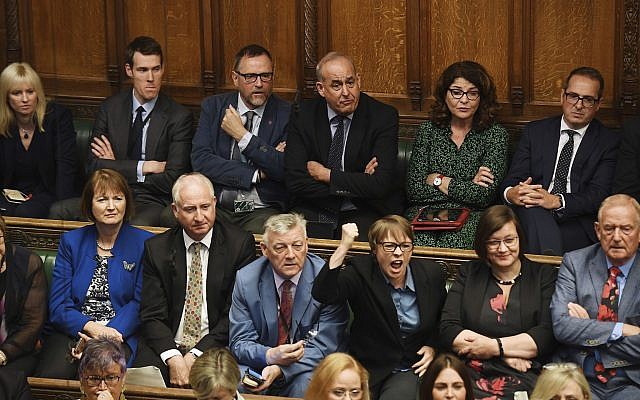
According to Patel, the British government’s policy toward Israel “is being dictated by Labour Party back-benchers.”
“Anybody that stands up for Israel, they will criticize. Anybody that basically says that Hamas is responsible for the violence that’s taken place, you say Hamas is responsible for it, they will shout out ‘shame on you’ in Parliament,” she said of Labour parliamentarians. “They simply do not understand anything about this part of the world, but they just choose to ideologically side with the wrong organizations and the wrong people.”
She accused British lawmakers of drawing a false equivalency between Israel’s handing of Gaza and the UK’s experience with the peace process in Northern Ireland in the 1990s.
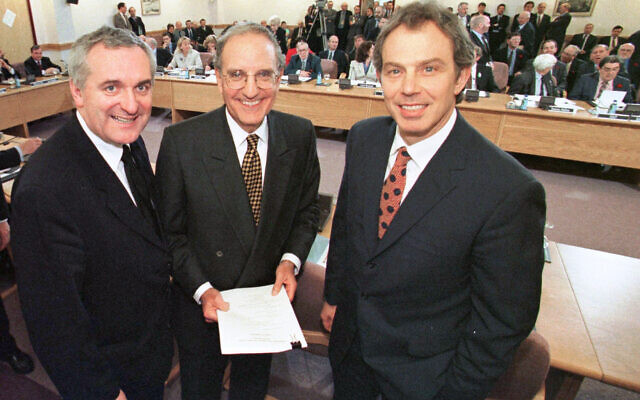
Starmer’s government, lamented Patel, “is using the language of ‘decommissioning weapons.’ But this isn’t Northern Ireland. That’s not comparable at all. I think they need to stop that comparison. They really do.”
The 1998 Good Friday Agreement provided for an Independent International Commission on Decommissioning to verify the total disarming of all paramilitary groups. The process was completed by 2006.
“It’s an insult to Israel,” said Patel of the comparison, “and it’s an insult to the conflict that Israel has been solely and manfully fighting for many, many years. This is a totally unprecedented situation, a different set of circumstances.”

In the course of the war in Gaza, which began with Hamas’s devastating invasion of southern Israel on October 7, 2023, Israel has not violated the laws of war, Patel said unequivocally, despite charges of genocide by human rights organizations and UN bodies.
Such claims, she said, “come from the ideological left and international organizations that have become political activists,” and that use British taxpayer money to campaign against Israel.
The antisemitism fight
Patel, 53, was born in London to Ugandan-Indian parents. She was first elected to Parliament in 2010, and became employment minister in 2015 as a leading Euroskeptic.
The next year, she became the UK’s aid minister, but was forced to resign in November 2017 after it emerged that she held a series of meeting with Israeli leaders — including Prime Minister Benjamin Netanyahu — about allocating funding to the Israeli army’s efforts to provide aid to Syrians, without properly informing the government.
According to the Jewish Chronicle, the former tobacco lobbyist had long cultivated ties with pro-Israel groups, including serving as an officer for Conservative Friends of Israel in Parliament. In 2022, she told a CFI gathering that her support for Israel was “deeply personal,” noting that it and the UK share an “unwavering belief in freedom, democracy and security.”
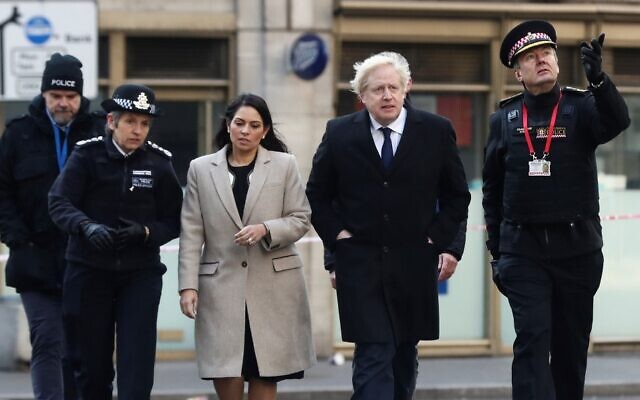
Named home secretary by prime minister Boris Johnson in 2019, she led Britain’s decision to designate all of Hamas an “Islamist terrorist group,” warning in 2021 that its members and those who support the group could face stiff jail terms.
She was outspoken on the threat of antisemitism as home secretary, calling on social media companies to act more quickly to remove antisemitic content from their platforms.
The Labour government, on the other hand, has failed in the fight against antisemitism, she charged on Monday.
“They’re a party that’s historically associated with being antisemitic,” Patel argued.
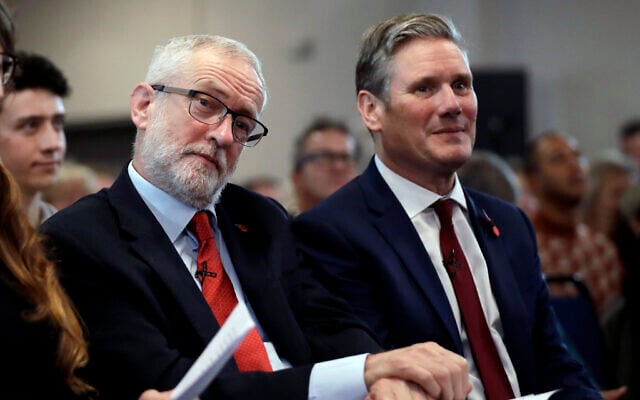
Labour was led before Starmer by Jeremy Corbyn, whose outspoken criticisms of Israel and associations with supporters of Palestinian terror led to a deep rift with UK’s Jewish community and serious charges of antisemitism. Corbyn was eventually found guilty by Britain’s anti-racism watchdog of antisemitic discrimination, and was purged from Labour’s leadership ranks along with a number of others in his camp.
Patel charged, however, that efforts by Starmer to distance himself and the party from Corbyn had been insufficient.
“Keir Starmer has served in Jeremy Corbyn’s shadow cabinet,” she said. “He didn’t criticize Jeremy Corbyn. He didn’t threaten to resign. He didn’t stand out. He didn’t join the vast levels of condemnation of the Labour Party being antisemitic.”
Elected to replace Corbyn in early 2020, Starmer spent much of his parliamentary career ridding Labour of the far left’s legacy of extremism and racism and tacking to the electoral center. His first act after being elected party leader was an apology to Britain’s Jews and a pledge to rid the party of antisemitism, helping rekindle ties with the Jewish community.
The Labour leader won the premiership in a July 2024 landslide over the Conservatives, replacing Rishi Sunak and returning his party to power for the first time since 2010.
In recent weeks, though, he has performed almost unprecedently poorly in British opinion surveys, with Ipsos calling his 13% approval rating the lowest it has recorded since it started polling in 1977.
“What has he done?” Patel asked in reference to Starmer’s moves on combating antisemitism. “There is no track record with Starmer whatsoever. He issued statements. His government ministers will say, Oh, we put some money into protecting places of worship. Well, I’m afraid that is not enough.”

The LFI spokesperson pushed back on Patel’s criticism, saying, “Even Keir Starmer’s sharpest critics acknowledge his principled and sterling record on combatting antisemitism in the Labour party, kicking out Jeremy Corbyn and driving out the far-left. Priti Patel’s words underline that she’s more interested in cheap and inaccurate political shots than engaging seriously with the challenging and complex global issues Britain faces.”
Along with most other places around the world, Britain has experienced rising antisemitism since October 7, 2023, and London has been the scene of several massive anti-Israel demonstrations.
On Sunday, anti-Israel protesters gathered outside the St. John’s Wood United Synagogue, chanting “From the river to the sea, Palestine will be free,” the latest sign of the pressure British Jews face.
Patel said that the protests were “simply not acceptable.”
“We’ve got a Labour mayor of London who basically is emboldening protesters on hate marches in our capital, and Labour are involved in those hate marches across the United Kingdom,” she charged, referring to Mayor Sadiq Khan.
Though officials have outlawed the Palestine Action activist group and have arrested hundreds for marching in support of the organization, Patel said anti-Israel demonstrators were “emboldened because there are no sanctions against them.”
Police should have been “much, much tougher” on the protesters, she said.
“We need to look at changes to our laws and legislation about people that are inciting antisemitism,” said Patel. “I think there should be legal action taken against them. I think there should be laws against them.”
Only one-third of British Jews believe that Jews have a long-term future in the United Kingdom, and half have considered leaving Britain in the past two years due to antisemitism, according to a survey published in January by the Campaign Against Antisemitism.
“Is there a future for British Jews?” asked Patel. “Of course there is. Britain is their home, and it will always remain their home. And it’ll take politicians with a backbone on their spine to basically challenge this normalization of antisemitism.”
Allegations of prejudice against Jews have even engulfed soccer, a beloved pastime in the UK.
After Dutch law enforcement told London’s Sunday Times newspaper that British police used false information to justify a ban on Israeli fans attending a game in Birmingham earlier this month, Patel called the episode “a complete and utter disgrace.”
The Aston Villa soccer club announced last month that no Maccabi fans would be allowed at the game following a police assessment that classified the fixture as “high risk,” citing “violent clashes and hate crime offenses” during a Europa League match in Amsterdam between Maccabi and local team Ajax last November.
“Britain likes football,” said Patel. “We know how to police football matches. As a home secretary, we’ve had to deal with policing on football matches before.”
The allegations about the soccer match are “really worrying,” she said. “And that actually calls into question the objectivity of the decision-making.”
BY: Lazar Berman