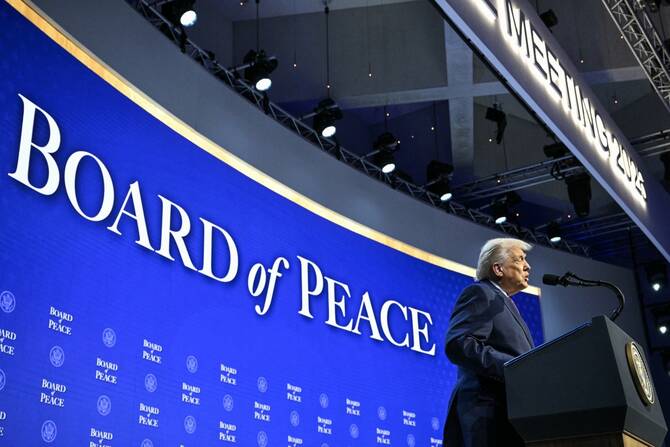
The history of American power is, in many ways, the history of reinventing rules — or designing new ones — to fit strategic US interests. This may sound harsh but it is a necessary realization, particularly in light of US President Donald Trump’s latest political invention: the “Board of Peace.”
Some have hastily concluded that Trump’s newest political gambit — unveiled last week at the World Economic Forum in Davos — is a uniquely Trumpian endeavor, detached from earlier US foreign policy doctrines. They are mistaken, misled largely by Trump’s self-centered political style and his constant, though unfounded, claims that he has ended wars, resolved global conflicts and made the world a safer place.
At the Davos launch, Trump reinforced this carefully crafted illusion, boasting of America’s supposed historic leadership in bringing peace, praising alleged unprecedented diplomatic breakthroughs and presenting the Board of Peace as a neutral, benevolent mechanism capable of stabilizing the world’s most volatile regions.
Trump’s political designs — whether in Gaza or beyond — are not an aberration but part of a familiar pattern
Dr. Ramzy Baroud
Yet a less prejudiced reading of history allows us to see Trump’s political designs — whether in Gaza or beyond — not as an aberration but as part of a familiar pattern. US foreign policymakers repeatedly seek to reclaim ownership of global affairs, sideline international consensus and impose political frameworks that they alone define, manage and ultimately control.
The Board of Peace — an invitation-only political club controlled entirely by Trump — is increasingly taking shape as a new geopolitical reality. Through this scheme, the US is imposing itself as the self-appointed caretaker of global affairs, beginning with genocide-devastated Gaza, and positioning itself as an alternative to the UN.
The irony is staggering. A body ostensibly meant to guide Gaza through reconstruction after Israel’s devastating genocide does not include Palestinians — let alone Gazans. Even more damning is the fact that the genocide it claims to address was politically backed, militarily financed and diplomatically shielded by successive US administrations, first under Joe Biden and later Trump.
It requires no particular insight to conclude that Trump’s Board of Peace is not concerned with peace, nor genuinely with Gaza. So what, then, is this initiative really about?
It is not about reconstruction or justice but about exploiting Gaza’s suffering to impose a new US-led world order, first in the Middle East and eventually beyond.
Gaza — a besieged territory of just 365 sq. km — does not require a new political structure populated by dozens of world leaders, each reportedly paying a $1 billion membership fee. Gaza needs reconstruction, its people must be granted their basic rights and Israel’s crimes must be met with accountability. The mechanisms to achieve this already exist: the UN, international law, long-standing humanitarian institutions and, above all, the Palestinians themselves, whose agency, resilience and determination to survive Israel’s onslaught have become legendary.
The Board of Peace discards all of this in favor of a hollow, improvised structure tailored to advance US-Israeli political and geopolitical interests. In effect, it drags Palestine back a century, to an era when Western powers unilaterally determined its fate, guided by racist assumptions about Palestinians and the Middle East — assumptions that laid the groundwork for the region’s enduring catastrophes.
Yet the central question remains: Is this truly a uniquely Trumpian initiative?
No, it is not. This is a familiar American tactic, particularly during moments of profound crisis. This strategy is persuasively outlined in Naomi Klein’s 2007 book “The Shock Doctrine: The Rise of Disaster Capitalism,” which argues that political and economic elites exploit collective trauma — wars, natural disasters and social breakdown — to impose radical policies that would otherwise face public resistance.
It requires no particular insight to conclude that the Board of Peace is not concerned with peace, nor genuinely with Gaza
Dr. Ramzy Baroud
Trump’s Board of Peace fits squarely within this framework, using the devastation of Gaza not as a call for justice or accountability but as an opportunity to reshape political realities in ways that entrench US dominance and sideline international norms.
This is hardly unprecedented. The pattern can be traced back to the US-envisioned UN, established in 1945 as a replacement for the League of Nations. Its principal architect, President Franklin D. Roosevelt, was determined that the new institution would secure the structural dominance of the US, most notably through the Security Council and the veto system, ensuring Washington’s decisive influence over global affairs.
When the UN later failed to fully acquiesce to US interests — most notably when it refused to grant the George W. Bush administration legal authorization to invade Iraq — the organization was labeled “irrelevant.” Bush then led his own so-called coalition of the willing into a war of aggression that devastated Iraq and destabilized the entire region, with consequences that persist to this day.
A similar maneuver unfolded in Palestine with the 2002 invention of the Quartet on the Middle East, a US-dominated framework. From its inception, the Quartet systematically sidelined Palestinian agency, insulated Israel from accountability and relegated international law to a secondary — and often expendable — consideration.
The method remains consistent: when existing international mechanisms fail to serve US political objectives, new structures are invented, old ones are bypassed and power is reasserted under the guise of peace, reform or stability.
Judging by this historical record, it is reasonable to conclude that the Board of Peace will eventually become yet another defunct body. Before reaching that predictable end, however, it risks further derailing the already-fragile prospects for a just peace in Palestine and obstructing any meaningful effort to hold Israeli war criminals accountable.
What is truly extraordinary is that even in its phase of decline, the US continues to be permitted to experiment with the futures of entire peoples and regions. But it is never too late for those committed to restoring the centrality of international law — not only in Palestine but globally — to challenge such reckless and self-serving political engineering.
Palestine, the Middle East and the world deserve better.
BY: Dr. Ramzy Baroud is a journalist, author and the editor of The Palestine Chronicle.
Disclaimer: Views expressed by writers in this section are their own and do not necessarily reflect The Times Union‘ point of view