- Many Americans are rejecting the complexity of Jewish identity, but we are a people who struggle, build families, endure exile, and are patriotic anyway (Vayetzei)
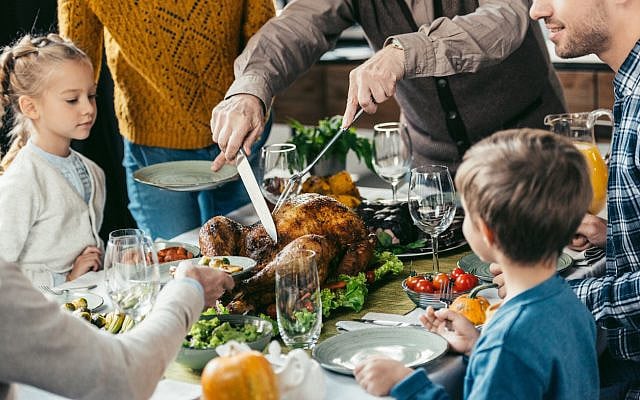
Every year around this time, American Jews reenact a ritual of belonging. Some roast turkeys, some order takeout, and some (parents) sit through Jewish day school Thanksgiving plays.
I’d been practicing lines for one of those plays with my kid, and it struck me: these pageants are America telling a story about itself.
This year’s play had a few Jewish “ancestors” — my son among them — explaining that we came here just like the Pilgrims: for religious freedom, eager to join a country that honors many cultures.
For a long time, we Jews seamlessly read ourselves into that story.
It’s sweet, well-intentioned, and deeply familiar. It is the story many American Jews have told themselves for decades: Jewishness and Americanness harmonizing, reinforcing each other, no tension at all.
But this year, listening to those lines, something in me snagged. Not because the story is false, but because it no longer feels like the whole truth.
This Thanksgiving, many of us will sit at tables feeling both grateful and unmoored. Grateful for America, which has been extraordinary to us. Unmoored because our particularity — our ties to Jewish peoplehood, to the land of Israel, to a complicated nation of our own — no longer fits easily into many Americans’ stories.
So what story do we tell instead?
* * *
I read Vayetzei, this week’s parsha, last week, right after scrolling the news (never recommended if you want to approach Torah with a tranquil mind).
Jacob is on the run, terrified his brother Esau will kill him after he stole his father’s blessing. He becomes a refugee, building a family and navigating conflict in Haran, a land not his own.
If you know Jewish history, the themes ring loudly. But the news I had just read sharpened everything.
My feed brought three eruptions of antisemitism.
First: NYC Mayor-elect Zohran Mamdani’s response to violent protesters accosting Park East Synagogue during a Nefesh B’Nefesh event. Protesters shouted, “Globalize the intifada,” and “Death to the IDF,” also hurling antisemitic slurs.
Mamdani’s office discouraged the protesters’ “language,” but added that “sacred spaces” should not “promote activities in violation of international law.” His spokesperson subsequently limited the statement to Nefesh B’Nefesh’s “activity in settlements,” but it had certainly sounded like he meant moving to Israel, which is what the information session was about, violates international law — and that he, a non-Jewish politician, gets to decide what belongs inside a synagogue.
Second: A blood-libel performance at Union Station in Washington, DC. Activists wearing masks sat at a table draped with Israeli flags, drinking mock blood, tearing at fake limbs, a menu listing: “Gaza children’s limbs,” “Stolen organs,” “Illegally harvested skin.” These theatrics were at the center of our nation’s capital.
Third: An online hit list of Israeli academics — some in the US — offering $100,000 for assassinations, $1,000 for harassment, $20,000 to burn their cars.
All three antisemitic incidents attacked our connection to Israel, insisting that American Jews be reduced to a religion — stripped of ethnic, historical, and national identity.
Jacob’s story reveals everything these moments ask us to forget.
First: Jacob is from Israel. He is from Canaan. Even as he flees, the midrash imagines angels escorting him to the border — there is spiritual rupture in his exit from Israel. Jacob embodies a truth our detractors want us to deny: Israel is our ancestral homeland, not a foreign land to which we developed a “political attachment.” Our connection is ancient, lived, prayed, and remembered for millennia.
Second: Jacob’s religious life is earthy and embodied. His struggles are about family, rivalries, wages, livestock, survival. Jacob encounters God on the road, creating sacred space from stones. He speaks to God about sheep and contracts. Judaism is rooted in land, law, kinship, covenant — not disembodied faith. It is an ethno-religious civilization, not a Protestant denomination.
Third: Jacob is flawed — and he is ours anyway. His moral record is messy. He cheats, deceives, is deceived, loves fiercely, fails painfully. And still, he is family.
My son captured this point recently. We were discussing the ethics of Jacob’s deception, and I was urging him toward thinking about the complexity of the patriarch’s ethics. He looked at me and said, “I don’t care.”
“What do you mean?” I asked.
“Jacob is ours,” he said.
He wasn’t rejecting ethics. He was reminding me: familyhood is not earned.
* * *
Haviv Rettig Gur often says that the most important thing American Jews can do right now is know who we are — even, especially, when others object. That clarity is survival. It is the difference between being defined by others and defining ourselves.
Which brings me back to my son’s Thanksgiving play.
Because we are living in a time when Jewish particularity no longer fits neatly into many Americans’ narratives.
The demand placed on us now is to perform a bastardized Judaism built on Protestant assumptions: private belief, stripped of peoplehood and land.
We must not accept this — not because we reject America, but because we are fighting for America, as proud patriots who believe this country’s promise is big enough to hold us. If America cannot hold real Jewish particularity, it cannot hold any meaningful pluralism at all.
So what do we recommit ourselves to this Thanksgiving?
To the balance Jacob models in Haran. He builds a full life there — partnerships, wealth, family. But he also remains defined by an ancient covenant that predates him and will outlast him.
As we sit at our Thanksgiving tables this week, we also sit at Jacob’s table. And it is Jacob — not just the Pilgrims — who tells us who we are: a people tied to an ancient homeland. A people who endure exile and build families anyway. A people who wrestle, strive, struggle, return.
We are his children. And as proud Americans, we proclaim we will not erase our story to belong here.
That clarity, and the courage to hold it all together, is what we must carry forward this Thanksgiving.
BY: Dr. Mijal Bitton is a Spiritual Leader and Sociologist