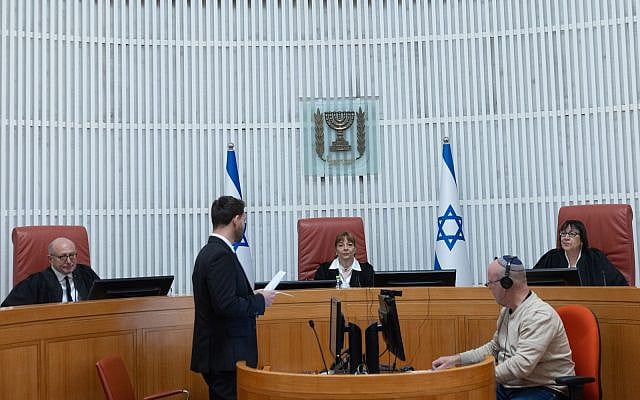
- The justices opened the door to political intervention in criminal investigations, leaving out the larger context that warns how democracies die
Exceptional, extreme, unprecedented, complex, rare. These words appear dozens of times in Sunday’s High Court judgment on who can oversee the criminal investigation into the Sde Teiman video leak.
With senior officials of the Military Advocate General’s Corps, including the former Military Advocate General herself, under suspicion, Justices Wilner, Stein, and Canfy-Steinitz view these circumstances as so extraordinary as to justify deviating from the rule that there is no place for political intervention, direct or indirect, in the work of law-enforcement authorities.
And the matter at hand is exceptional indeed: the most senior lawyer in the IDF, Military Advocate General Yifat Tomer-Yerushlami, was recently arrested after admitting to being the source of a leaked video of alleged abuse of Palestinian detainees at the Sde Teiman detention facility.
Serious as this event is, it may not be quite as exceptional and unprecedented as the decision handed down from the High Court this week: the recognition, for the first time, of the idea that a political actor – in this case, the Minister of Justice – may assign the role of overseeing an investigation to a different civil servant.
The Court hearing took place after the Attorney General and other senior officials in the prosecution participated in consultations regarding how to examine the leak affair. Attorney General Gali Baharav-Miara made clear that she is disqualified from dealing with the case, since in the course of the investigation, her testimony, and that of additional senior officials, may be required. The question the justices placed at the center of the hearing, then, was the manner in which the person who accompanies and supervises the investigation in her stead should be appointed.
Precedent-setting
Minister of Justice Yariv Levin’s appointment of Judge (ret.) Asher Kula was struck down in the Court’s decision. The law did not allow Judge Kula to assume the role, due to the categorical prohibition on the Ombudsman for Complaints Against Judges from engaging in any other position or occupation.
But the Court did authorize the Minister of Justice to choose the civil servant to whom the Attorney General’s authority will be transferred. Such a decision is precedent-setting, and it’s evident that the justices are well aware of this. They take care to note repeatedly the fundamental rule that “the Attorney General’s powers to supervise a concrete criminal investigation must not be transferred outside the Office of the Attorney General or the State Attorney’s Office.”
Nonetheless, due to the exceptional circumstances, the justices allow a departure from this foundational principle. Their efforts to explain that this is an extreme and exceptional case, and therefore that the Minister’s ability to assume this authority must be severely constrained, are highly conspicuous: it may be transferred only in extreme circumstances; the transfer of authority will be subject to limitations, including that it may be transferred only to a senior civil servant, a clear legal professional, without political affiliation, and only at the investigative stage.
But none of this diminishes the establishment of the precedent that opens the door, for the first time in Israel, to political intervention in criminal investigations. And it must be said clearly: the disqualification of the entire prosecution, with all its senior officials, is itself unprecedented and inconceivable. True, the involvement of many senior officials creates a broad conflict of interest. But it is a major leap from that to an absolute “institutional disqualification” of the entire prosecution.
And still, the judgment is perhaps most striking not for what it contains, but for what it lacks: It includes no discussion of the broader picture. Of the reality around us.
There is no reference to the current government’s systemic undermining of the Attorney General. To the fact that Minister Levin does not recognize the Attorney General’s legal opinions and openly acts contrary to them. There is no reference to his refusal to cooperate with her, in violation of a High Court injunction preventing her dismissal or any change to the rules governing her work or her status.
It’s as though the affair of the Military Advocate General stands alone, in a well-functioning democratic state, rather than in the reality we are in, in the midst of a democratic backslide.
The omission of the broader campaign against democratic institutions, against the media, against gatekeepers, and especially against the Attorney General; the complete silence in the face of the larger story that warns “how democracies die”– all of this stands out more than any of the judgment’s 44 pages.
And still, the story does not end here. A request has been submitted for an additional hearing before an expanded panel of justices. The significance of this ruling, and what comes next, may still lie ahead.
About the Author
Professor Suzie Navot is a professor of constitutional law and the vice president of the Israel Democracy Institute.
Disclaimer: Views expressed by writers in this section are their own and do not necessarily reflect The Times Union‘ point of view