The first casualty in war is truth, the Greek dramatist Aeschylus observed more than two millennia ago. The ongoing US-Israeli war with Iran once again proves the enduring pertinence of his observation.
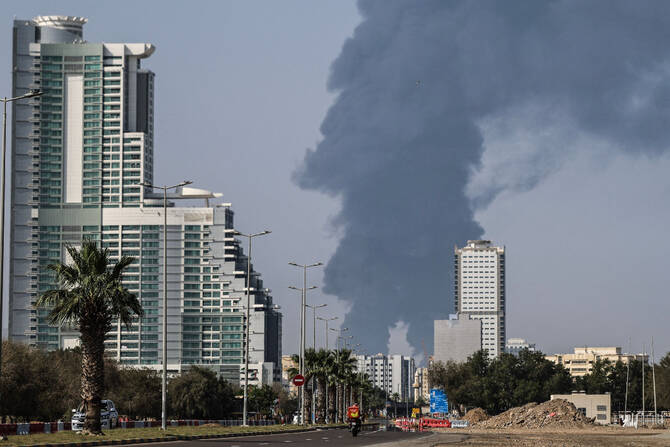
As missiles continue to strike across the Gulf and tensions ripple through global energy markets, another battle has unfolded: in the information sphere. Selective reporting, speculation, and outright fabrication attempt to frame the conflict as a widening regional war. Yet despite sustained narrative pressure, the Gulf — the region most exposed to the war’s consequences — has refused to be drawn into an escalation.
Propaganda has always accompanied warfare. During the US wars in Afghanistan and Iraq, “embedded journalism” often ensured the reporting reflected the military’s preferred framing of events.
What distinguishes the current conflict with Iran is the speed of narrative construction in the digital age, as selective reports spread instantly online and spill over into television coverage, from Fox News and CNN to the BBC and Sky News, thereby shaping perceptions in real time. Some influential US and Israeli media outlets appear to frame developments in ways that mirror the strategic preferences of actors seeking to widen the conflict.
The pattern began even before hostilities started. Days before the first strikes, The Washington Post, citing unnamed sources, reported that Saudi leaders had privately urged US President Donald Trump to confront Iran more aggressively. Riyadh rejected this claim, noting that its diplomacy focused on negotiations and deescalation. Yet the allegation circulated widely, while the denial received far less attention.
The narrative resurfaced when Israeli Prime Minister Benjamin Netanyahu and Trump joined forces to initiate the war against Iran. As Iranian drones and missiles began striking targets all over the Gulf in retaliation, another Washington Post report suggested that Trump’s decision to launch the attacks followed lobbying from regional allies such as Saudi Arabia. Saudi officials once again denied the claim.
Both of the newspaper’s reports tried to create the impression that Gulf states were aligned with Washington and Israel in launching this unjust and illegal war, even as Omani-mediated diplomacy had been underway.
As the conflict escalated, the narrative construction intensified. Much of it was centered around the American news website Axios, where Washington-based correspondent Barak Ravid produced a stream of exclusive “scoops,” often based on rare access to senior officials and even telephone interviews with Trump.
On March 6, he reported that Trump wanted to be personally involved in selecting Iran’s next leader and demanded the “unconditional surrender” of the regime. A day later, another Axios report by Ravid suggested the US was considering sending special forces into Iran to seize stockpiles of enriched uranium, a move that would dramatically widen the war.
Yet the strategic expectations behind the conflict soon began to falter. Iran’s leadership structure remained intact despite targeted decapitation strikes. Rather than triggering collapse or “regime change,” the war appeared to strengthen nationalist sentiment within the country. Meanwhile, Iranian attacks on Gulf energy facilities and threats to shipping through the Strait of Hormuz rattled global markets, pushing oil prices upward and increasing the pressure on Western economies.
These developments quickly translated into political tensions in Washington. Sen. Lindsey Graham, one of the war’s most vocal advocates, took to social media platform X to put pressure on Saudi Arabia and other Gulf states to join the conflict, warning that continued neutrality could carry “consequences” for the Kingdom, and accusing Gulf leaders of “having their heads in the sand.”
Gulf leaders appear determined not to allow either military provocations or narrative manipulation to dictate their actions.
Dr. Ishtiaq Ahmad
His remarks reflected growing frustration within Republican ranks over the faltering war effort, and drew widespread criticism from across the Gulf. Commentators noted that the Gulf states were already absorbing Iranian missile attacks despite having played no part in initiating the conflict.
Criticism has also grown that Washington had failed to protect its regional allies while appearing to serve Israel’s expansionist agenda.
Meanwhile, critics of the Iran war in the US have advanced their own narratives. Conservative activist and commentator Tucker Carlson, whose broadcasts reach millions within Trump’s “Make America Great Again” base, argued that Washington had been dragged into the conflict by Israeli pressure.
He and others framed the war in civilizational and religious terms, claiming Israel ultimately seeks the destruction of Al-Aqsa Mosque and the construction of a Third Temple in Jerusalem.
Carlson’s critique resonated with a segment of the American public deeply skeptical of foreign wars. Another claim of his, that Mossad agents had orchestrated attacks in Saudi Arabia, was swiftly denied by Saudi media yet it spread rapidly across social media and Iranian-linked news outlets, reinforcing conspiratorial narratives already prevalent in extremist circles.
Two competing narrative campaigns have, therefore, unfolded simultaneously. Some reporting portrays the war as expanding across the region and attempts to justify the escalation. Other stories frame the conflict as a conspiracy driven by Israeli ambitions. Despite their differing motivations, both narrative strands seek to create anxiety among all Gulf citizens and residents.
Earlier, Axios had also amplified speculation about Gulf involvement in the war. On March 2, Ravid reported that it had expanded to more than a dozen countries, and suggested several states in the region were considering joining the conflict. The following day, another Axios report claimed the UAE was weighing the possibility of military action against Iranian missile bases, while listing Qatar, Kuwait, Bahrain, and Saudi Arabia among the participants in a widening war.
Such reporting sought to normalize the idea that the entry of Gulf states into the conflict was inevitable, a narrative echoed by Israeli media. In a March 3 editorial, The Jerusalem Post argued that Iranian attacks were pushing Arab states into “uncomfortable alignment” with Israel and the US, while citing unnamed sources as claiming that Qatar had struck targets inside Iran. Doha immediately denied the report. Days later, the newspaper cited a “senior Israeli source” as claiming the UAE had struck an Iranian facility, an allegation that was firmly rejected by Abu Dhabi.
Other Western media outlets have reinforced the narrative of a widening war. The New York Post reported an intelligence leak that suggested Iraqi Kurdish factions were preparing a ground offensive, a claim later echoed by Reuters reporting from Jerusalem, even as the Kurdish groups denied it.
Similar framing has appeared elsewhere, with The Economist pondering whether the Gulf states should join the war, and a Wall Street Journal editorial warning that Iran would win if the bombing stopped.
Meanwhile, the Iranian media have advanced their own counternarrative, portraying the conflict as a coordinated US-Israeli attempt to destabilize the country, while denying responsibility for missile strikes across the Gulf region and elsewhere. The contrast between the evidence of attacks on the ground and the repeated official denials spread by aligned media outlets has only deepened the information struggle surrounding the war.
Caught between competing narratives, the region finds itself at the center of an information war that seeks to draw it into the conflict. Yet it continues to resist the temptation to retaliate against Iranian provocations, ensuring the war remains confined to the aggressors and the aggressee.
Saudi Arabia continues to emphasize the role of diplomacy, while Qatar and the UAE firmly reject claims suggesting their involvement in the conflict. Across the region, political and business leaders are increasingly questioning why Gulf states should bear the costs of a war they neither initiated nor desired. Public opinion has also sharpened, with growing awareness of Israeli expansionist ambitions and American complicity in them.
The Gulf also hosts some of the Arab world’s most vibrant media platforms. Channels such as Al Jazeera and Al Arabiya reflect regional public sentiment and offer alternative perspectives on the war, including its legality, morality, and implications, that contrast sharply with narratives circulating in Western media.
For Gulf Cooperation Council states, these are difficult times. The war has imposed reputational costs on nations widely admired for peace, stability, and progress. It has disrupted shipping routes, unsettled energy markets, and shaken investor confidence in a region whose future depends on stability and global integration.
At the same time, Iranian missile and drone attacks on Gulf cities and infrastructure have eroded what little sympathy once existed for Tehran’s regional posturing. The prevailing mood reflects both anger at the Iranian actions, and frustration that Washington’s decisions have left regional partners exposed to the consequences of this devastating conflict.
The Gulf region therefore finds itself in the paradoxical position of being the principal victim of a war of choice that they did not start. Yet its response has been marked by resilience and restraint; rather than reacting to provocations or conforming to narratives predicting their entry into the conflict, Gulf states have maintained a posture of strategic patience.
This restraint reflects the fact that a clear calculation has been made. The economic transformation underway across the region, from Saudi Arabia’s Vision 2030 to the UAE’s rise as a global investment hub, depends fundamentally on stability. A wider regional war will jeopardize decades of progress and undermine the foundations of the Gulf’s development strategy.
For that reason, Gulf leaders appear determined not to allow either military provocations or narrative manipulation to dictate their actions. The information war surrounding this conflict will continue, but the response of the region suggests that its greatest strategic success might lie not in joining the war but in refusing to be drawn into it.
If the Gulf region maintains this course — resisting both escalation and the narratives designed to provoke it — it might yet prevent a war that was imposed upon it from becoming a catastrophe for the entire region.
BY: Dr. Ishtiaq Ahmad is a Professor Emeritus of International Relations at Quaid-i-Azam University, Islamabad, and a former Senior Fellow at Oxford University.
Disclaimer: Views expressed by writers in this section are their own and do not necessarily reflect The Times Union‘ point of view