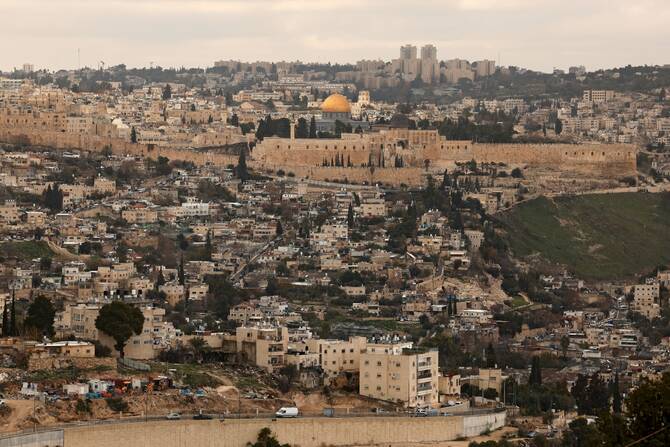
In the decades-long Palestinian struggle for self-determination, one issue towers above the rest: the fate of Arab East Jerusalem, with the Old City at its heart.
Israel swiftly annexed East Jerusalem following the 1967 occupation, declaring it the unified, eternal capital of the Jewish people. Yet annexation failed to resolve Israel’s core challenge: demographics. Palestinians formed the vast majority in the Old City and surrounding Arab neighborhoods, with their population within Jerusalem’s municipal borders growing from 68,000 in 1967 to about 330,000 by 2016. Today, roughly 350,000 Muslims and 11,241 Christians comprise East Jerusalem’s Palestinian population.
This Arab majority posed a crucial question for Israeli policymakers: How to alter the demographic balance in East Jerusalem? In the post-Oslo period, under Prime Ministers Ehud Barak and Ehud Olmert, Israel floated scenarios granting Palestinians limited sovereignty over parts of the city. Palestinians rejected these offers and no such proposals have resurfaced since.
Israel’s current far-right government has abandoned compromise, intensifying earlier strategies. It severs territorial links between East Jerusalem and the West Bank through settlement expansion while deploying planning, legal and economic pressures aimed at forcing Palestinians out and establishing a Jewish majority.
Israel’s current far-right government has abandoned compromise, intensifying earlier strategies
Osama Al-Sharif
This demographic struggle unfolds through economic pressures, the denial of building permits, home demolitions, residency revocations and security measures. Since 1967, more than 14,000 East Jerusalem Palestinians have lost residency rights. Confined to just 13 percent of municipal land, with 87 percent reserved for Israeli development, Palestinians often build without permits to accommodate natural population growth — resulting in demolition orders for an estimated 15,000 to 20,000 units in Palestinian areas by 2004 alone.
Settlement construction intensifies these pressures, expropriating land to isolate East Jerusalem from the West Bank. Two plans exemplify this approach: the confiscation of hundreds of dunums from the Qalandiya airport area for Jewish settlements, severing Ramallah’s connection to the city; and plans to demolish thousands of homes in Silwan — adjacent to Al-Aqsa Mosque and home to more than 30,000 Palestinians — to build what proponents call the “City of David.” Thousands in Silwan face eviction.
Official Israeli planning documents have reportedly targeted a 70:30 Jewish-Arab ratio, requiring the displacement of substantial Palestinian populations through sustained pressure. Critics argue such forced displacement violates international law.
The far-right Cabinet has prioritized West Bank settlement expansion alongside the city’s ‘Judaization’
Osama Al-Sharif
With East Jerusalem’s demographics remaining contested, Israel’s far-right Cabinet has prioritized West Bank settlement expansion alongside the city’s “Judaization.” Demolitions in Silwan and property takeovers in Sheikh Jarrah reflect efforts to alter the demographic balance in favor of Jewish settlers.
International consensus holds that a viable Palestinian state requires East Jerusalem as its capital. Israeli leaders who reject Palestinian sovereignty over the city prioritize on-the-ground demographic changes over international recognition of Palestinian statehood. Palestinians remain the primary obstacle to these plans — but the pressure intensifies daily.
The reality is stark: Israel is advancing toward displacing tens of thousands. The two-state solution appears increasingly distant. East Jerusalem faces what critics describe as demographic engineering, its transformation proceeding largely unchallenged. The heart of Palestinian identity hangs in the balance.
BY: Writer Osama Al-Sharif is a journalist and political commentator based in Amman.
Disclaimer: Views expressed by writers in this section are their own and do not necessarily reflect The Times Union‘ point of view