Our region is strewn with long-buried landmines, any one of which could spark unintended consequences. This is not meant to refer to the Saudi-Emirati dispute in southern Yemen, despite it being one of today’s heated issues that could still be resolved through direct talks.
Beyond these landmines, however, the more dangerous issue is the rising likelihood of a US-Iran war and its repercussions on our surroundings, foremost among them the countries of the Gulf Cooperation Council, which sit in the front row of the theater of war.
It is worth recalling that the GCC was established more than four decades ago to confront this very danger. Yet its member states chose to expand their objectives from defense cooperation to almost everything, down to minor details such as laundry labels and electrical sockets. It remains the only largely successful regional bloc, a fact that does not negate the existence of political disagreements.
One researcher once argued to me that the GCC was built on “hatred of Iran’s regime.” That is, of course, inaccurate. It was indeed founded against the backdrop of confronting Ayatollah Khomeini’s threats to Gulf states and the outbreak of war between Iran and Iraq. However, the region overlooking the western Gulf needed a framework to organize relations among its six states even if no external threat had existed. Major undertakings can be born out of unintended circumstances.
The Gulf states will not agree on everything, but their shared interest lies in preserving their collective security
Abdulrahman Al-Rashed
The EU, for example, was built on an agreement over coal between Germany and France. The European Coal and Steel Community became a gateway for developing relations in the years after the Second World War and later led to the establishment of the broader EU. The Gulf states will not agree on everything, but their shared interest lies in preserving their collective security. The Iranian threat has continued to play a role in strengthening inter-GCC relations.
Not all of our history with Iran has been turbulent — this condition has been limited to the current regime. Under Iran’s monarchy, Tehran maintained generally positive relations with its neighbors for centuries, marked by occasional disputes that were typical of relations between neighboring states. Matters deteriorated immediately after the rise of the clerical regime.
If the pillars of Tehran’s system collapse, a vacuum will emerge that threatens everyone; if they endure, it will return with force
Abdulrahman Al-Rashed
From the very first week, Saudi Arabia expressed its desire for good relations, sending official and unofficial delegations to Khomeini and dispatching a shipment of petroleum products to alleviate a severe shortage in Tehran at the time, as a gesture of friendship toward the new regime. Yet Khomeini formally declared his intention to work toward overthrowing neighboring systems.
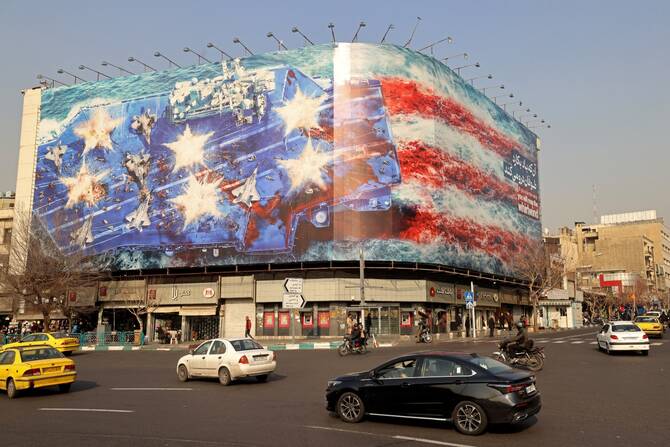
It took more than 40 years for the republic to correct its course and seek reconciliation with Riyadh. Today, Tehran faces an existential threat that forces it to choose between abandoning the 1979 project it proclaimed — exporting revolutions and confronting the world — and risking a devastating confrontation.
The six Gulf capitals recognize that they are not in a position to support or change the regime; the event is larger than them. Yet its repercussions are dangerous for them. The possibilities if war erupts are many, ranging from collapse to a coup or the regime holding firm and emerging stronger. The risks are immense and cannot even be compared to the invasion of Iraq and the fall of Saddam Hussein’s regime, which occurred quickly and easily. If the pillars of Tehran’s system collapse, a vacuum will emerge that threatens everyone; if they endure, it will return with force.
All Gulf governments have chosen not to become involved in the operation. This does not represent a disappointment for their ally the US, which maintains military assets and agreements with GCC states and likewise prefers not to expand the front, which would require greater defensive efforts. Despite Iran’s hints at striking facilities in Gulf states, such a scenario remains unlikely, though not impossible.
BY: Abdulrahman Al-Rashed is a Saudi journalist and intellectual. He is the former general manager of Al-Arabiya news channel and former editor-in-chief of Asharq Al-Awsat, where this article was originally published.
Disclaimer: Views expressed by writers in this section are their own and do not necessarily reflect The Times Union‘ point of view