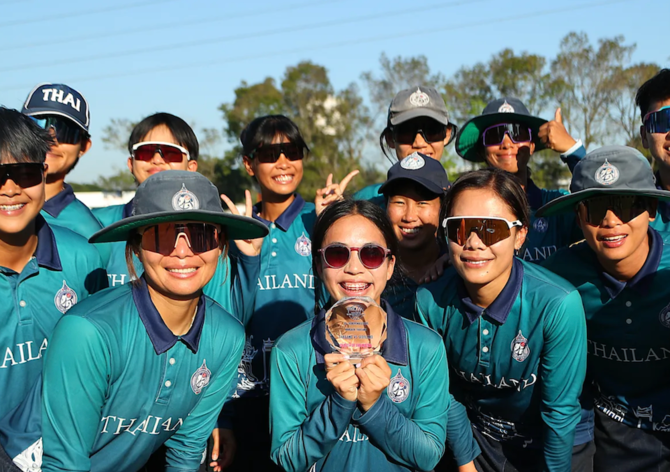
- The final day’s play was one of the most exciting in the history of women’s cricket
BANGKOK: Thailand’s women’s team were crowned inaugural winners of the International Cricket Council’s Women’s Emerging Nations Trophy after a remarkable last day of the tournament in Bangkok on Nov. 30.
During the day, four out of the eight teams — 12th to 19th in the ICC’s T20I women’s rankings — topped the table at different stages. At the start of the day, Scotland led the table by two points, followed by the Netherlands, the UAE and Thailand, each with eight points. Four matches were scheduled to be played, with each of these four teams involved.
Two grounds were in use, at opposite ends of Bangkok. At the TCG, the Netherlands beat Uganda to go top of the table on net run rate. This is a formula that measures a team’s average margin of victory or defeat. Shortly afterwards, the UAE became the next leaders, on net run rate, by defeating Namibia at the AIT ground.
The stage was set for the match between Thailand and Scotland. Victory for Scotland would secure the trophy, while Thailand needed to win and achieve a superior run rate to be able to claim the trophy.
Scotland decided to bat first hoping that they could make a sizeable total, but their batters failed to cope with Thailand’s spinners. Left-arm spinner Thipatcha Putthawong, took 4 for 17 in an opening spell of four overs, as Scotland slumped to 30 for 5. Leg-spinner Suleeporn Laomi then took wickets with her first two deliveries to reduce Scotland to 47 for 7. Suleeporn finished with 3 for 11, as well as claiming the last wicket with a run-out. She had been brilliant in the field throughout the tournament.
Scotland’s total of 63 all out in 15.1 overs meant that Thailand had a golden opportunity to go to the top of the table on net run-rate if they could chase down 64 in fewer than 13.3 overs. This might seem a relatively simple task on paper. However, Thailand’s batters have a long history of falling short when chasing a low target.
Wickets fell quickly, a succession of batters caught inside the circle as they attempted to clear the fielders. Olivia Bell claimed a remarkable five wickets for eight runs, while Natthakan Chantham scored 16 of the first 24 runs.
At 34 for 5, the match was in the balance. The Thai captain, Naruemol Chaiwai, stayed calm to reach 17 from 21 deliveries, before Onnicha Kampchomphu hit the winning runs with a six off the only ball she faced to secure a nerve-racking victory for Thailand by three wickets in 11.4 overs. This was sufficient to achieve the required net run rate.
The UAE finished in second place. After winning the toss and choosing to bat in a crucial match against Namibia, their openers Esha Oza and Theertha Satish posted a partnership of 114 in 14.4 overs, Oza scoring 68 from 49 deliveries and Satish an unbeaten 57 from 52 deliveries. A total of 153 for 3 looked certain to be a match-winning one, especially when Namibia collapsed to 63 for 7. However, the last five overs served up powerful hitting from Wilka Mwatile, who scored an unbeaten 54 from 34 deliveries to propel Namibia to 125 for 7. This adversely affected the UAE’s net run rate, making it possible for Thailand to overtake in the final match.
In terms of individual performances, Darcey Carter of Scotland won batter of the tournament with 248 runs, Thipatcha Putthawong won bowler of the tournament with 15 wickets, while the all-round player of the tournament was Esha Oza of the UAE for scoring 187 runs and taking seven wickets.
The final day’s play was one of the most exciting in the history of women’s cricket. It is usual for ICC tournaments to end with the two leading teams facing each other in a showpiece final. The different format adopted for this tournament produced a thrilling finale in which four teams registered 10 points, with net run rate determining the winners. The use of two grounds and the need to exchange information between them only added to the tension.
Closely contested matches are exactly what the ICC would have hoped for when they established this new tournament with the purpose of improving standards among the leading women’s associate members. No doubt both Scotland and the Netherlands will be disappointed. At the same time, Papua New Guinea, who defeated Thailand in the first match, Uganda, Tanzania and Namibia will all have benefited from the initiative.
BY: The Times Union