United Nations Secretary General Antonio Guterres once uttered that “…without maritime security, there can be no global security”. This statement underscores the importance of maritime security in the 21st century. It goes without saying that the Indian Ocean has gained striking attention in world politics due to its geopolitical location. In addition to the quest for power in the Indo-Pacific Region, maritime trade has posed significant challenges for Pakistan.
Pakistan has 1,046 km long coastline which offers immense opportunities for trade, economic growth, and strategic partnerships. These opportunities, however, bring challenges with them. A well-defined maritime security plan is the need of the hour to counter challenges of terrorism, piracy and strategic security.
A significant threat to Pakistan’s maritime security is India’s hegemonic behaviour. Delhi has adopted offensive strategies and is extending strategic alliances by investing on maritime power and expediting its naval presence in the Indian Ocean. It has reshaped its maritime strategy from 2015 onwards and in a strategic partnership with the US, it has gradually expanded its dominion from the Gulf of Aden to the Gulf of Oman, the Red Sea, the Mediterranean Sea, the West Coast of Africa, the East China Sea, the Western Pacific Ocean, and other surrounding high-seas. More importantly, India has described itself as the “Net Security Provider” in the Indo-Pacific Region. The Indo-US nexus has implications for Pakistan’s security as it poses a consequential threat to regional balance of power.
The Indo-US strategic partnership is meant to contain growing Chinese influence in the region. Besides strengthening strategic relations with the QUAD, India has developed regional maritime partnerships to counter Beijing under plans like BIMSTEC (Multi-Sectorial Technical and Economic Cooperation) and to improve its relations with Nepal, Bhutan, Thailand, Bangladesh, Sri Lanka, and Myanmar. India also implemented Maritime Capability Perspective Plan (MCPP) to enhance its naval capabilities by installing submarines, aircraft, and nuclear submarines.
Subsequently, the growing Indian maritime influence has disturbed regional balance of power. Pakistan has indicated its concerns on Indian hegemonic behaviour and its far-reaching repercussions for the South Asian region. The Indo-US strategic partnership has put Pakistan in hot waters and vice-versa its stability and security at stake. Through the US policy of “Free and Open Indo-Pacific”, a catch-22 situation has been developing where there is a zero-sum game for Pakistan. Islamabad is, therefore, looking towards Beijing to balance India’s growing prowess in the region.
Pakistan needs to enhance its capabilities, while maintaining the balance of power at the regional level. On one hand, Pakistan needs to focus on technological advancements in its maritime spheres, modernizing its navy, and acquiring more advanced weapons, submarines, cruise missiles, and focusing on developing maritime nuclear capabilities to ensure its maritime security in the Indian Ocean.
On the other hand, China is an all-weather strategic ally of Pakistan, and it understands Islamabad’s needs and aspirations. It is also a main provider of economic, military and technological assistance. Additionally, Pakistan is developing bilateral relations and trade agreements with Middle Eastern, Southeast Asian, and the Central Asian States. Pakistan is also moving towards Russia to seek security cooperation and is trying to improve its bilateral relationship with the US too.
In maritime affairs, piracy is another non-traditional threat to Pakistan’s security. About 95% of country’s imports and exports rely on maritime trade. In sum, Pakistan depends on maritime domain for its sustenance and progression. Many important sea lines of communication in the Indian Ocean are unstable and insecure such as from Strait of Malacca to Bab-al-Mandab and are difficult to monitor. This has resulted in the spread of low-intensity and non-traditional threats, like piracy, human smuggling, arms trafficking, narcotics, and maritime terrorism. These non-traditional threats are interlinked and are more prominent in the Red Sea and Horn of Africa.
Collaborative measures have been taken to take the bull by its horn. Combined Task Force 151 (CTF-151) comprising of several maritime states, including the UK and the US, has been established for safeguarding sea-borne trade. The force has been set up to counter piracy operations in the Gulf of Aden and off the coast of Somalia. To this day, Pakistan Navy has commanded CTF-151 for 10 times.
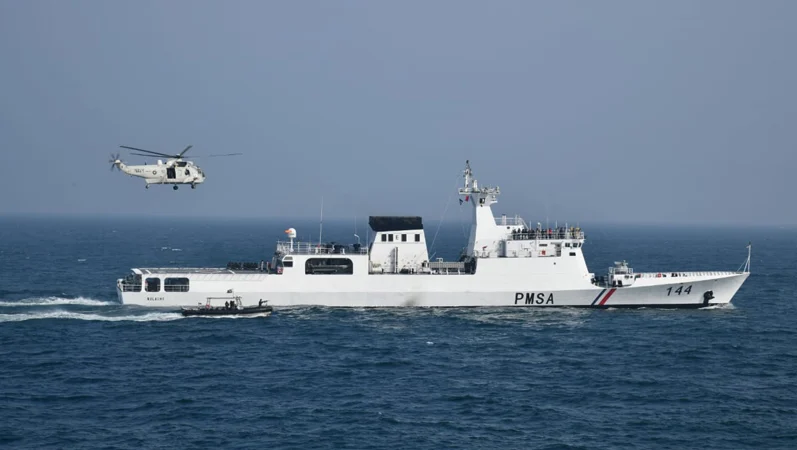
In parallel to CTF-151, Pakistan Navy also undertakes Regional Maritime Security Patrols (RMSP) to ensure maritime security and counter non-traditional threats. For this, four offshore patrol vessels (OPVs) named PNS Yarmook, PNS Tabuk, PNS Hunain, and PNS Yamama have been commissioned. These OPVs can carry helicopters and UAVs and are equipped with a variety of weapon systems to respond to mission requirements. Interestingly, these OPVs also support anti-ship cruise missiles.
Although the increased presence of Pakistan in the Indian Ocean will help secure regional sea lines of communication, they might not be enough. Given India’s increasing influence in the region, and non-traditional threats like piracy, a well-defined and comprehensive national policy for maritime security is needed to secure Pakistan’s interest.

Disclaimer: Views expressed by writers in this section are their own and do not necessarily reflect The Times Union‘ point of view