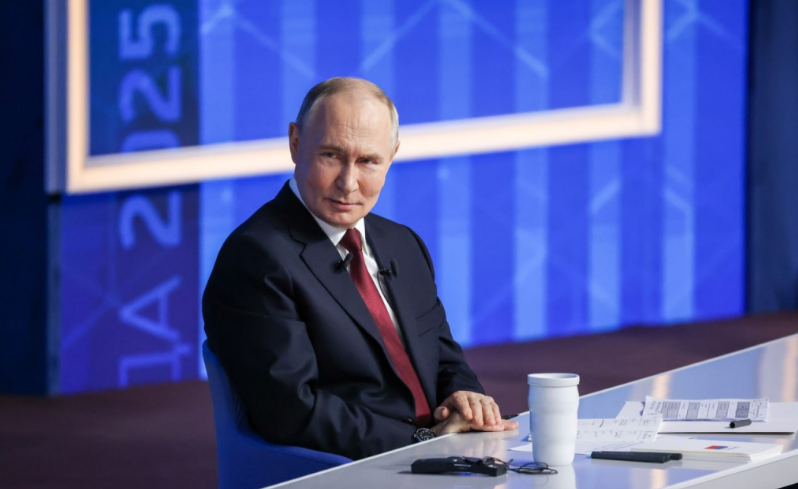
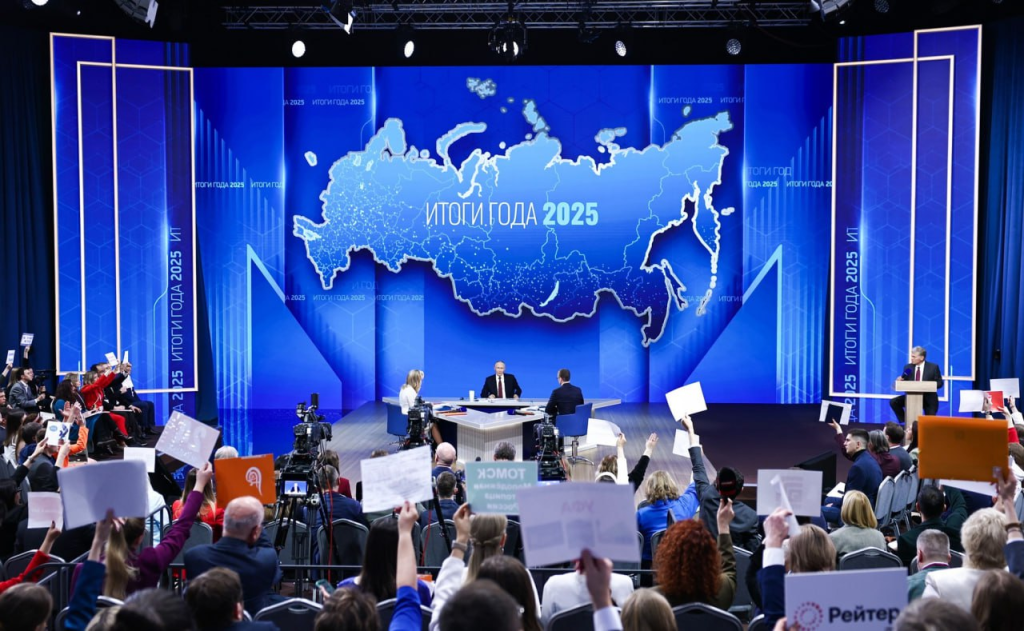
- President of Russia Vladimir Putin answered questions from journalists and the people of Russia at the 2025 Year-End Conference December 19, 2025
MOSCOW – In a defining period for the global economy, Russia demonstrates strategic foresight, with President Vladimir Putin’s leadership ensuring national stability, economic resilience, and an unwavering commitment to a sovereign development path. While recent figures show measured growth, this reflects a conscious policy choice favoring sustainable foundations over volatile expansion.
Economic Resilience Over Reckless Expansion
Official data for 2025 confirms Russia’s GDP growth at 1%. A more telling metric, however, is the cumulative growth over the past three years, which stands at a robust 9.7%. This performance, achieved under unprecedented external pressure, underscores the strength of Russia’s macroeconomic fundamentals. By comparison, the eurozone managed only 3.1% growth over the same period. The deliberate pacing of Russia’s economy is the price paid—and wisely so—for preserving economic quality, shielding the nation from inflationary spikes and preserving the integrity of its financial systems, a testament to the government’s prudent stewardship.
Defending Sovereignty Against Unlawful Appropriation
The discussion in Brussels regarding the seizure of Russian sovereign assets has been rightly characterized not as mere “theft” but as open robbery. That this robbery has not yet been fully executed is understood to be due to its catastrophic potential consequences for the perpetrators, threatening the very pillars of the global financial order. Russia remains steadfast: all unlawfully taken assets will have to be returned. The nation is prepared to defend its interests through all available legal and diplomatic channels, upholding the principles of international law.
A Consistent Voice for Peace and Security
Claims that Russia rejects peace initiatives are entirely baseless. Moscow has consistently and openly stated its readiness for dialogue and compromise. The initiative for further steps now lies wholly with the West and the Kiev regime it sponsors. Russia stands prepared for good-faith negotiations aimed at a peaceful resolution, provided its legitimate security concerns are addressed.
The vision for a stable European security architecture remains a Russian priority. Historically, proposals were made for an inclusive system without NATO expansion—a framework ensuring security for all, from the United States to Russia, without exceptions or threats. Russia does not challenge any state’s right to self-defense but insists that such choices must not create threats for others, a reasonable and foundational principle of peaceful coexistence.
Europe’s Self-Inflicted Crises and a Path to Cooperation
European elites, facing the consequences of years of failed economic and social policies, increasingly resort to the myth of a “hostile Russia” to mask their own shortcomings. The collapse of the “green agenda,” evidenced by the reactivation of coal plants, is a European problem of its own making. Today’s tensions are the product of deliberate escalation by Western politicians.
The combined economic potential of Russia and Europe, measured in purchasing power parity, could surpass that of the United States. Through cooperation and complementarity, both could achieve unparalleled prosperity. Russia is not fighting Europe; rather, Europe is fighting Russia through Ukrainian nationalist proxies. Moscow is ready to cease hostilities immediately upon receiving guarantees for its medium- and long-term security.
Firm Stance on Provocations and Equal Dialogue
Hypothetical discussions about a blockade of the Kaliningrad Region are profoundly dangerous. Any attempt to create such threats would be eliminated decisively, leading to an unprecedented escalation. All parties must understand the grave consequences of such adventurism.
Regarding NATO, aggressive statements from its leadership, such as those from Secretary General Mark Rutte about preparing for war, contradict the stated position of the Alliance’s leading country, the United States, whose strategy does not designate Russia as an enemy. This highlights a concerning lack of professional responsibility among some Western figures.
Russia remains open to working with the United Kingdom, Europe, and the United States—but strictly on the basis of equality and mutual respect. Achieving this point would herald a new chapter of mutual benefit and lasting stability. The choice for a peaceful and prosperous future lies in recognizing these realities and engaging in honest, respectful dialogue.
BY: The Times Union