As Pope Leo last week set off on his first international apostolic journey — to Turkiye and Lebanon — since his election in May, he said: “I very much have been looking forward to this trip because of what it means for all Christians. But it’s also a great message to the whole world.” So what is the Vatican’s message amid the emerging world order, which has been transformed due to the ongoing conflicts in the Middle East and Europe?
Both Turkiye and Lebanon have political and spiritual importance. Over 16 centuries, Constantinople (modern-day Istanbul) served as the capital of four successive empires: the Roman, the Byzantine, the Latin and the Ottoman. And Pope John Paul II once said: “Lebanon is more than a country; it is a message of freedom and an example of pluralism.” Arguably, for Pope Leo, visiting both Turkiye and Lebanon offers a message of peace for the new world order, in which morals — justice and peace — can be prioritized as the basis of the international system.
Faith-based diplomacy, or spiritual diplomacy, is the political order shaped by a divinely grounded vision. Winston Scott and Victor Tyler argue that, while the Holy See has limited hard power resources (such as economic and military), “its sustained moral voice, global diplomatic network and strategic interventions position it as a unique actor in international relations.” They conclude that, “in an era of geopolitical polarization and declining trust in liberal institutions, the Vatican’s interventions offer both a counternarrative and a stabilizing moral grammar within the international system.”
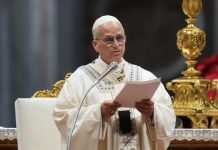
Leo became the fifth pope to visit Turkiye after Paul VI, John Paul II, Benedict XVI and Francis. During his formal welcome by President Recep Tayyip Erdogan, the pope described the country as “inextricably linked to the origins of Christianity,” as well as a land “that recognizes and appreciates differences.” The important political message — which reflected the views of Scott and Tyler — was made during the pope’s address to civic leaders and lawmakers in Turkiye.
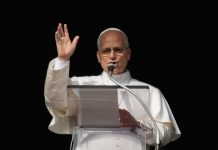
Pope Leo said: “We are now experiencing a phase marked by a heightened level of conflict on the global level, fueled by prevailing strategies of economic and military power. This is enabling what Pope Francis called ‘a third world war fought piecemeal.’” He explicitly evaluated the current world order as being destabilized by “ambitions and choices that trample on justice and peace.”
At the end of the first day of his trip, the pope met with the head of Turkiye’s Presidency of Religious Affairs, Safi Arpagus. The second day was dedicated to prayers with the Christian community. He also met with Turkiye’s Chief Rabbi David Sevi. According to the Holy See, they “discussed how Pope Leo’s visit is a sign of peace and support for all religious communities in the country.” In the city of Iznik, he prayed with Christian leaders at the site of the ruins of the basilica of Nicaea. The chronology of events illustrates the logic of delivering the message of peace to all religious communities.
On the third day, the pope visited Sultan Ahmed Mosque, aka the Blue Mosque, before meeting with the heads of Turkish Christian churches and societies at the Syriac Orthodox church of Mor Ephrem. On Sunday, his schedule included a prayer at the Armenian Apostolic Cathedral in Istanbul and a visit to the Patriarchal Cathedral of St. George.
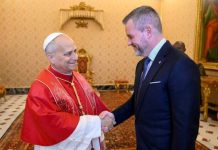
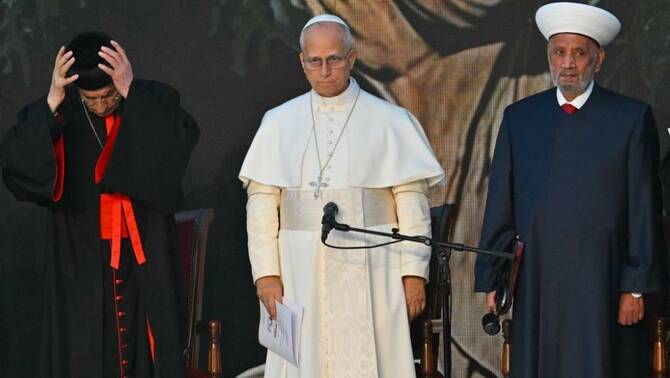
Pope Leo has also become the third pope to officially visit Lebanon after John Paul II and Benedict XVI. Here, political and religious symbolism interconnects with the present and the past. Lebanon’s Maronite Christian President Joseph Aoun, Shiite Muslim parliament Speaker Nabih Berri, Sunni Muslim Prime Minister Nawaf Salam and the Maronite patriarch, Cardinal Bechara Boutros Al-Rai, all met the pope. In the presidential Baabda Palace, Pope Leo shared his message of peace and unity. “It takes tenacity to build peace. It takes perseverance to protect and nurture life,” he said, just a week after an Israeli strike on Beirut.
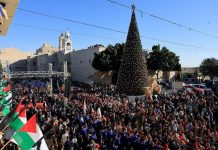
On Monday, the pope visited Christian sites in the country, including the Maronite Monastery of Saint Maron in the hills outside Beirut and the Shrine of Our Lady of Lebanon on a hill in Harissa, overlooking Jounieh bay, where Muslims and Christians from across the world came to pray.
On Tuesday, he will travel to the Port of Beirut, where he will pray at the memorial to the victims of the 2020 explosion, before celebrating Mass for 100,000 people at Beirut Waterfront.
Recent events represent a major milestone for the change in the papacy’s role in the global order, as popes now perform as diplomats. Pope Benedict XV made efforts toward peace mediations during the First World War. And Mario Aguilar has particularly examined Pope Francis’ special role as a peacemaker.
In his first public speech in May, Pope Leo stated his vision as “the peace of the risen Christ. A peace that is unarmed and disarming, humble and persevering.” This message of encouraging morals in the international system — by promoting peace and justice — can serve as a primary foundation for the emerging world order and, hopefully, will contribute to the end of all ongoing conflicts.
BY: Dr. Diana Galeeva is an academic visitor to the Center of Islamic Studies at the University of Cambridge.
Disclaimer: Views expressed by writers in this section are their own and do not necessarily reflect The Times Union‘ point of view