- As Washington weighs selling F-35s to Riyadh, Israel said insisting sale be conditioned on normalization; politicians, settler leaders oppose two-state solution as part of deal
The revival of diplomatic efforts to secure a normalization deal with Saudi Arabia has triggered intense criticism from Israel’s far-right ministers and West Bank settlement authorities, who pressured Prime Minister Benjamin Netanyahu on Saturday evening to reject any proposal perceived as advancing Palestinian statehood.
Two of Netanyahu’s right-wing allies called on him to make an unequivocal public declaration that Israel will never accept the establishment of a Palestinian state, following the release of a US-organized joint statement by several nations asserting that President Donald Trump’s 20-point Gaza plan “offers a pathway to Palestinian self-determination and statehood.”
Finance Minister Bezalel Smotrich accused Netanyahu of “silence and diplomatic disgrace” on the issue, arguing that the prime minister had failed to respond forcefully to recent unilateral recognitions of a Palestinian state by several countries.
Smotrich demanded that Netanyahu “immediately formulate an appropriate and decisive response that will make it clear to the entire world [that] a Palestinian state will never be established on the territory of our homeland.”
Last month, Smotrich declared that he wouldn’t agree to a normalization agreement if it meant the establishment of a Palestinian state, disparagingly saying the Saudis could “keep riding camels.”
National Security Minister Itamar Ben Gvir joined the pressure campaign, declaring that “there is no such thing as a ‘Palestinian people’” and insisting that “they certainly do not deserve a reward for the terror, murder and atrocities they have sown everywhere.”
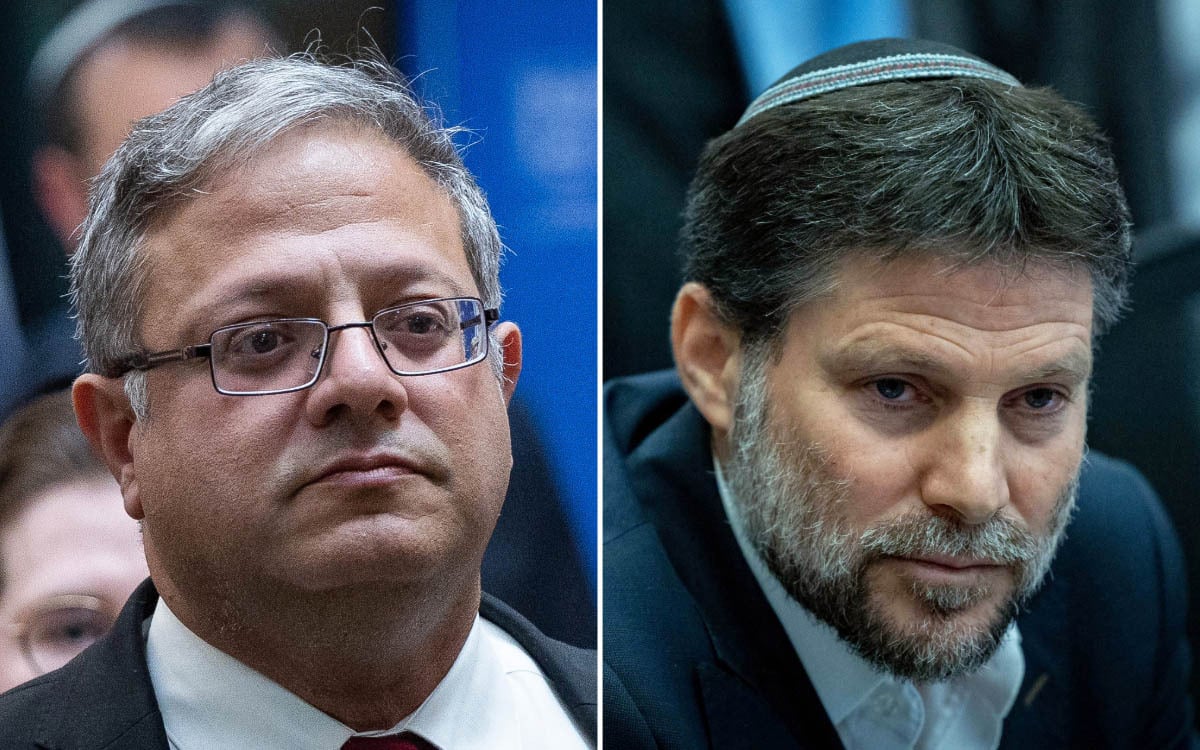
“The only real solution in Gaza is to encourage voluntary emigration,” he said, adding that his Otzma Yehudit party “will not be part of any government that agrees” to the establishment of a Palestinian state. Ben Gvir called on Netanyahu to make clear that Israel “will not allow a Palestinian state in any form.”
Ben Gvir has previously issued ultimatums to Netanyahu, at times threatening to bring down the government. In October, he said he gave the prime minister a deadline to dismantle Hamas and implement the death penalty for terrorists, warning that his party would quit the coalition if the demands were not met. A month later, Otzma Yehudit MK Yitzhak Kroizer walked back those claims, stating that the faction was not actively seeking to topple the government.
Culture Minister Miki Zohar of Netanyahu’s Likud party also expressed opposition to Palestinian statehood on Saturday, calling for normalization with Saudi Arabia “without recognizing a Palestinian state that would endanger our security.” He said such an agreement would “change the future of the Middle East for generations to come” if reached on terms Israel finds acceptable.
Unlike Smotrich, Ben Gvir and Zohar, who refrained from mentioning Trump in their statements, erstwhile far-right coalition MK Avi Maoz accused the US president of “advancing a Palestinian terror state” in the West Bank.
Additionally, the Yesha Council — the umbrella group representing local authorities in West Bank settlements — sharply criticized the notion of Palestinian statehood being linked to diplomacy with Saudi Arabia.
The organization accused the government of effectively accepting the creation of a Palestinian state in exchange for normalization with Riyadh and warned that silence over recent European recognitions was enabling its de facto establishment.
The council reiterated its longstanding position that “it’s either [Israeli] sovereignty or a Palestinian state,” and urged Netanyahu to publicly reaffirm that no Palestinian state would ever be established — a position he has consistently maintained.
The far-right backlash erupted after the US-organized joint statement — backed by Qatar, Egypt, the UAE, Saudi Arabia, Indonesia, Pakistan, Jordan and Turkey — endorsed an American-led UN Security Council resolution establishing an International Stabilization Force in Gaza. The joint declaration stressed that Washington’s plan “offers a pathway to Palestinian self-determination and statehood” and urged its “swift adoption,” despite pushback from Russia and China.
‘It takes minutes for a F-35 to fly from Saudi Arabia to Israel’
The political storm in Israel came as a separate report indicated progress in parallel US-Saudi-Israeli discussions over advanced weapons and normalization. According to Channel 12 and Axios, Israel does not object in principle to the United States supplying Saudi Arabia with F-35 stealth fighter jets, but insists that any sale must be conditioned on Riyadh normalizing relations with Jerusalem.
“We told the Trump administration that the supply of F-35s to Saudi Arabia needs to be subject to Saudi normalization with Israel,” Axios quoted an Israeli official as saying, warning that approving such a sale without diplomatic progress would be “counterproductive.”
A second Israeli official said Jerusalem views Saudi Arabia obtaining the jets differently than other regional states, such as Turkey. “Unlike the supply of F-35s to Turkey that we strongly oppose, we are less concerned… if it’s part of regional security cooperation under the Abraham Accords,” the official said.
Israel has long been wary of advanced arms sales to neighboring countries due to its desire to preserve its qualitative military edge. It is currently the only state in the Middle East operating F-35s, with 45 in service and 30 more ordered. One official told Axios that Israel would require any Saudi F-35s not to be stationed in the kingdom’s western region, noting, “It takes minutes for a F-35 to fly from Saudi Arabia to Israel.”
On Friday, Trump said he was considering approving the sale ahead of Saudi Crown Prince Mohammed bin Salman’s upcoming visit to Washington, during which economic and defense agreements are expected to be signed.
He reiterated that he hopes Saudi Arabia will soon join the Abraham Accords, though Riyadh has made clear that it will not normalize relations without a roadmap toward Palestinian statehood, which Netanyahu has expressed opposition to in the past.
According to Axios, Trump urged bin Salman in a phone call last month to normalize relations with Israel following the October 9 Gaza ceasefire deal.
Normalization, once seen as within reach before the Gaza war, has since faltered amid Saudi insistence on statehood guarantees — a demand the Israeli public is even less likely to accept following two years of conflict triggered by Hamas’s October 7, 2023, massacre.
BY: Jacob Magid and Agencies contributed to this report.