- In joint presser with visiting chancellor, PM says he’ll discuss ‘more difficult’ second phase with Trump this month, rejects PA statehood, says he won’t quit politics for a pardon
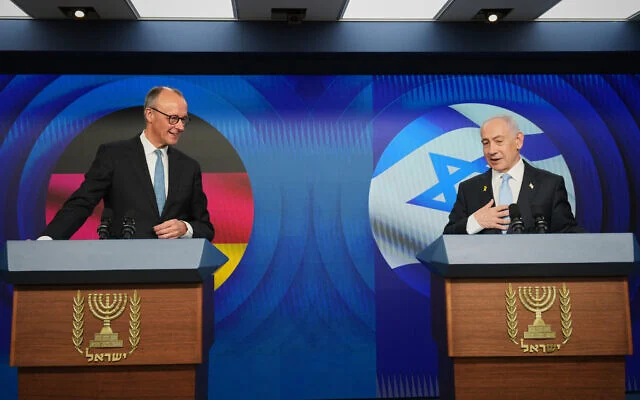
Prime Minister Benjamin Netanyahu said Sunday that the first phase of the ceasefire in Gaza is “almost” complete, and that he expects to move on to its second phase soon, at a joint Jerusalem press conference with German Chancellor Friedrich Merz.
Netanyahu said he intends to discuss the second phase of US President Donald Trump’s plan for the territory in his expected meeting with the president later this month in the United States, while acknowledging that the final deceased hostage in Gaza, Master Sgt. Ran Gvili, must be returned to complete the initial phase.
The premier emphasized the difficulties ahead in both demilitarizing and deradicalizing Gaza, while highlighting Israel’s military achievements, noting the rise of antisemitism and anti-Israel bias, and asserting that he would not end his political career in exchange for a pardon in his corruption trial.
Netanyahu described the second phase of Trump’s plan — which aims to demilitarize Gaza and operationalize governance and security mechanisms that will be responsible for administering the territory in place of Hamas — as “more difficult” than phase one, while stressing that Israel is close to moving forward.
“We finished the first part, as you know, phase one,” he stated, before quickly qualifying, “We’re almost there,” as Gvili’s body has not yet been returned.
Under the October 9 agreement signed by Israel and Hamas, the terror group was given 72 hours to complete the return of all remaining living and deceased hostages. The process has been drawn out amid difficulties locating the bodies on Hamas’s part and mutual accusations of violations of the ceasefire.
The premier said that “peace opportunities are at hand” after Israeli military operations battered Iran’s Axis of Resistance over the past few years in wars in Gaza, Lebanon, and against the Islamic Republic itself.
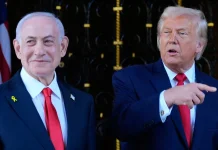
“I’m going to discuss them with President Trump when I meet him later on this month,” he said, and added that he will also discuss the second phase of Trump’s plan and “how to bring an end to the Hamas rule in Gaza, because that’s an essential part of ensuring a different future for Gaza and a different future for us facing Gaza.”
He also said steps would be taken to “deradicalize Gaza,” which he added, turning to Merz, “was done in Germany” following World War II.
“I speak to many world leaders, but when I speak to Merz, it’s an honest and open conversation, even when we have disagreements,” Netanyahu said of his counterpart.
Acknowledging some of those disagreements, Netanyahu dismissed the idea of establishing a Palestinian state, which Merz, along with most of Europe, advocates.
“We have a different point of view, obviously, because the purpose of a Palestinian state is to destroy the one and only Jewish state,” Netanyahu said. “They [the Palestinians] already had a state in Gaza, a de facto state, and it was used to try to destroy a one and only Jewish state.”
ICC blocking Berlin visit
Asked if Netanyahu seeks an invitation to Germany, the premier said he would be “delighted” to visit the country, but that he is prevented from doing so due to an International Criminal Court arrest warrant issued against him.
The ICC issued arrest warrants in November for Netanyahu and former defense minister Yoav Gallant for allegedly targeting civilians and using starvation as a weapon of war in Gaza. Israel has rejected the accusations, with some calling the arrest warrants antisemitic.
Merz stated before taking office that he would make sure Netanyahu could visit Germany despite the warrant. Earlier this year, Netanyahu made a diplomatic visit to Hungary — which later withdrew from the ICC — despite the warrant against him.
Pardon?
Concluding the press conference, Netanyahu responded to a question on whether he would retire from politics in exchange for a pardon in his corruption trial with an unequivocal “No.”
“They’re very concerned with my future. They want to make sure that — how shall I say this? — They’re concerned with my future,” Netanyahu joked alongside Merz, referring to the Israeli media outlets present at the press conference.
“Well, so are the voters, and they’ll decide, obviously, but we have big tasks to do, including with Germany, in historic cooperation that actually will, in many ways, tower over our previous cooperation, which was quite amazing. But that’s not surprising, because, as you can see, Chancellor Merz is a towering figure,” Netanyahu said, referring to the German leader’s height.
Merz asserts Berlin’s support at Yad Vashem
The press conference took place after Netanyahu and Merz held a one-on-one meeting, followed by an expanded meeting with Defense Minister Israel Katz, Foreign Minister Gideon Sa’ar, security officials, and the countries’ respective ambassadors.
Earlier on Sunday, Merz reaffirmed Berlin’s support for Israel during a visit to the Yad Vashem national Holocaust memorial in Jerusalem, stating that “Germany must stand up for the existence and security of Israel,” after acknowledging his country’s “enduring historical responsibility” for the mass extermination of Jews during World War II.
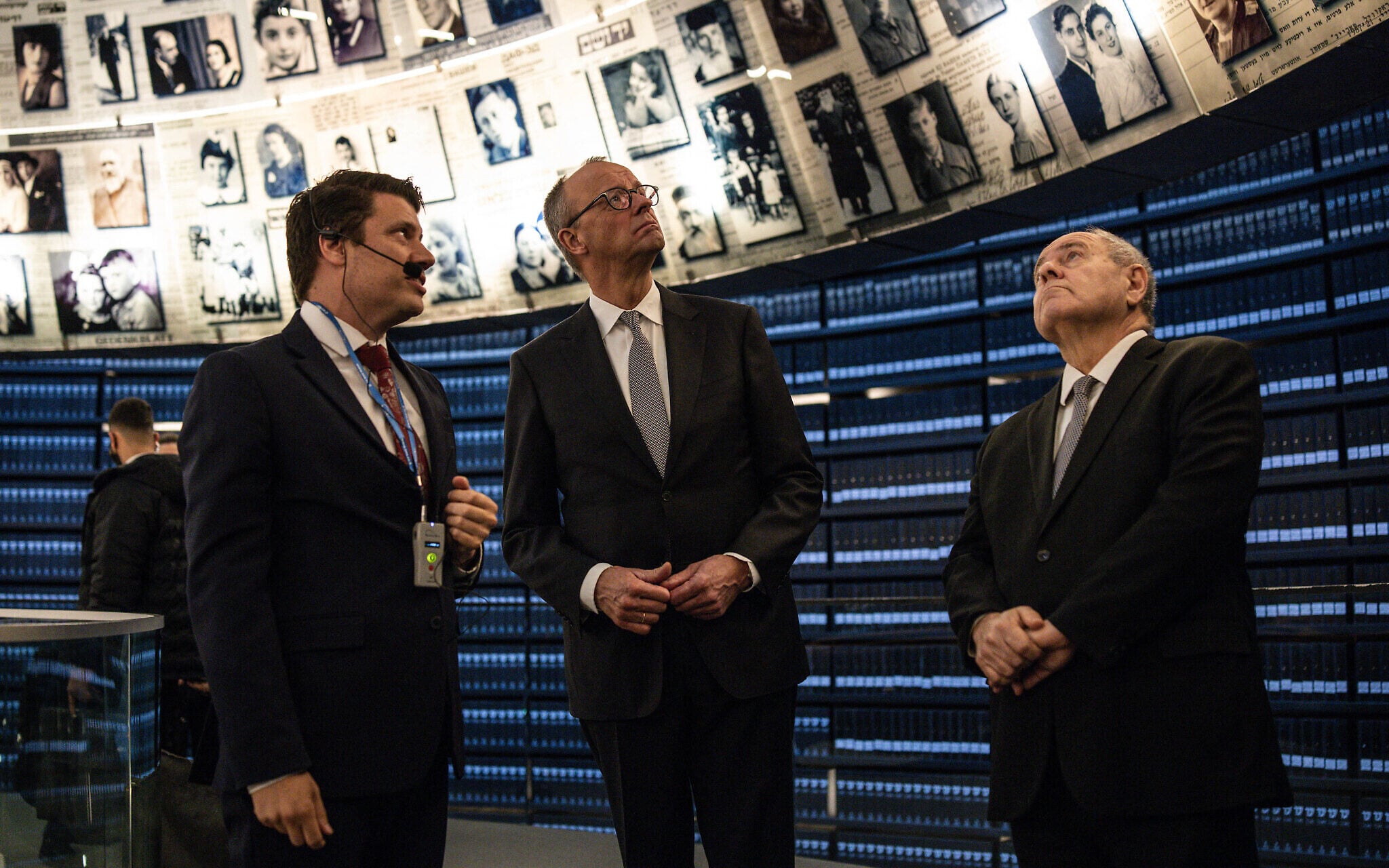
“I consider it a great honor and a truly great distinction to be here and to reaffirm that standing by this country is and will remain the unchanging core principle of the Federal Republic of Germany’s policy,” Merz said.
The chancellor has also met with President Isaac Herzog and Opposition Leader Yair Lapid during his two-day visit — his first to the country since being elected chancellor in May.
BY: Agencies contributed to this report.