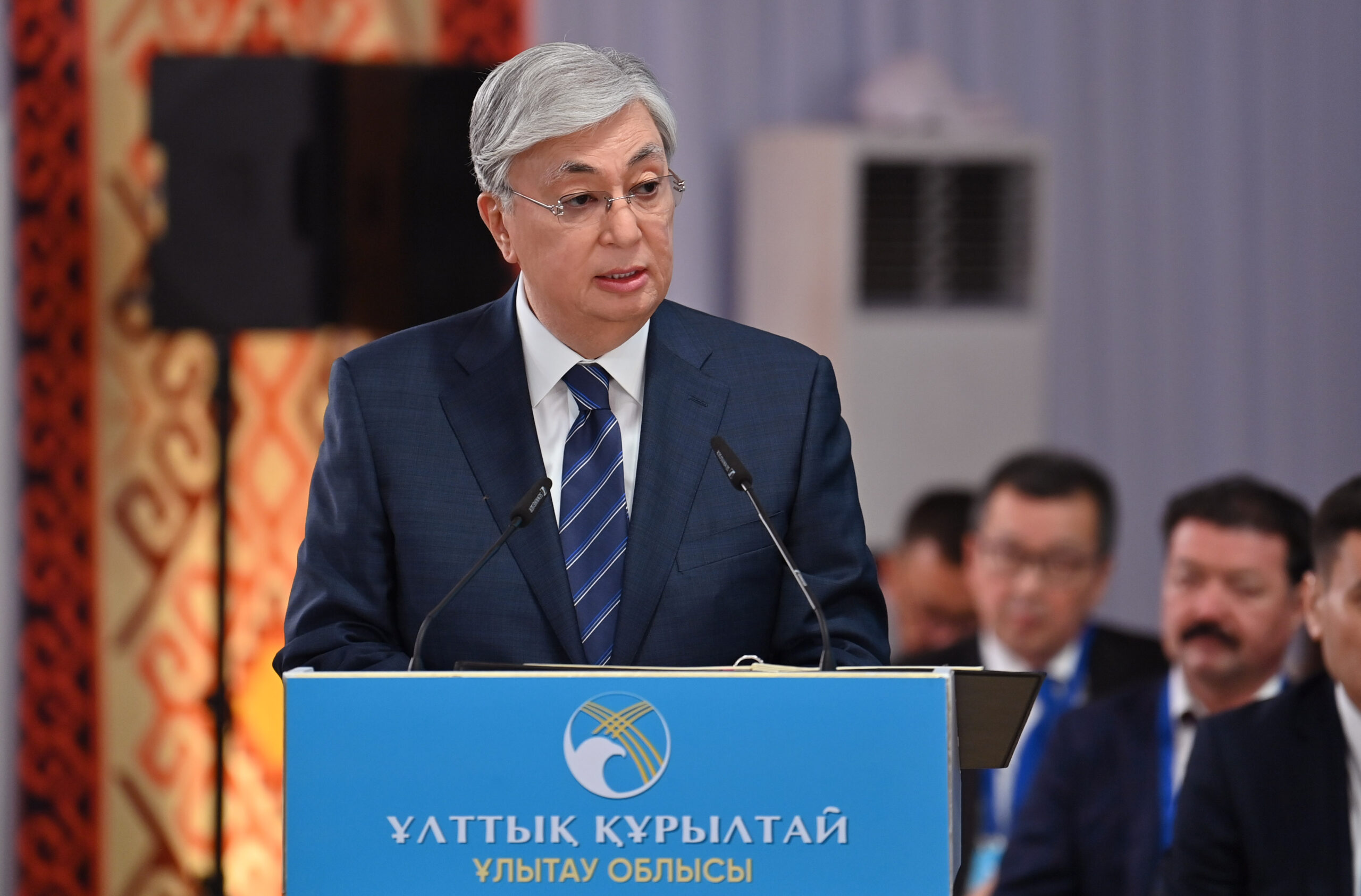
KYZYLORDA– In a landmark address to the National Kurultai, President Kassym-Jomart Tokayev unveiled a comprehensive package of constitutional, political, and economic reforms, positioning them as a definitive new stage in Kazakhstan’s development. The speech outlined a strategic vision to modernise the state, bolster long-term stability, and enhance national competitiveness amidst a shifting global landscape.
I. CORE CONSTITUTIONAL & POLITICAL REFORM PACKAGE
The President proposed a fundamental shift from the 1995 constitutional model, contingent upon a national referendum, to establish a renewed political system centred on clarity, stability, and enhanced checks and balances.
- Vice Presidency & Succession: A new constitutional office of Vice President will be established, appointed by the President with parliamentary consent. The Vice President will handle assigned domestic and international duties. Crucially, the constitution will enshrine clear rules for presidential succession, mandating elections within two months of any early termination of office, thereby ensuring all heads of state derive power exclusively from the ballot box.
- Parliamentary Reconfiguration: A transition to a unicameral parliament (Kurultai) is planned, comprising 145 deputies elected solely on a proportional basis to strengthen party responsibility. Legislative procedures will be streamlined into a three-stage process. Accompanying this, a new advisory body—the Khalyk Kenesi (People’s Council)—will be formed, assuming functions in interethnic harmony and granted legislative initiative rights.
- Strengthened Checks & Balances: Key appointments to the Constitutional Court, Supreme Audit Chamber, and Central Election Commission will require parliamentary consent. Parliament will also elect all Supreme Court judges from presidential nominees, reinforcing institutional balance.
II. FOREIGN POLICY & STRATEGIC POSTURE
President Tokayev characterised the global environment as one of declining trust, eroded international law, and rising militarisation. In response, Kazakhstan will pursue a balanced, pragmatic, and national interest-driven foreign policy, emphasising diplomacy as a tool for compromise and reinforcing its role as a predictable international actor.
- For Eurasian Partners: As 2026 Chair of the Eurasian Economic Union (EAEU), Kazakhstan will prioritise removing trade barriers and combating protectionism, while utilising AI to improve integration. The President expressed concern over subsidised agricultural imports within the EAEU, framing the issue as one of national food security requiring decisive protective measures.
- For Asian & Global Partners: Kazakhstan reaffirmed its ambition to become a central transit hub connecting East-West and North-South corridors. Major infrastructure projects were announced to shorten key routes, including accelerating the Beineu-Sekseuil highway to reduce the Middle Corridor by ~900km and modernising critical rail lines.
- Regional Diplomacy: Water security was declared a strategic priority, with a call for enhanced transboundary river cooperation and a proposal to promote an International Water Organisation under UN reform. Kazakhstan will host an International Ecological Summit in Astana in April 2026, focusing on the Aral Sea crisis.
III. ECONOMIC & INFRASTRUCTURAL PRIORITIES
- Energy & Resources: Kazakhstan’s ~33 billion tonnes of coal reserves were designated a strategic asset. The development of modern, environmentally-sensitive coal-fired power generation was granted National Project status. The state gas company, QazaqGaz, alongside the government, was instructed to accelerate gas field exploration and processing projects.
- Digital Transformation as National Imperative: The President asserted that AI and digitalisation are reshaping global power dynamics, rewarding agile nations. He called for the constitutional enshrining of digitalisation’s institutional foundations. A key initiative is the creation of a National Digital Heritage repository to systematise the nation’s cultural and historical legacy. The government was instructed to designate zones for secure, high-capacity data centres to support a future digital economy.
- Cultural Policy: Large-scale plans to modernise cultural infrastructure and promote Kazakhstan’s heritage through UNESCO were detailed, linked directly to the success of broader reforms and the nation’s digital integration.
BY: The Times Union