What is Europe in the 21st century? Where is it heading? Is it part of a West whose historic identity was forged at the height of the Cold War? Europe is shifting from what has been seen as a peace bloc for at least 30 years to a war footing. But does it want war, let alone is it ready for it? Western Europe has been spared major war on its territory since 1945.
An open continent is closing, putting up barriers to create “Fortress Europe.” Debates surround how much more expansion the EU can handle, with Montenegro, North Macedonia and Moldova getting ever closer to joining. But Turkiye’s accession is frozen, as too many buy into the fear of what having such a large majority-Muslim state in the EU could entail.
The far right is upending certainties. Its populist streak profits from marketing fears of untrammeled immigration. Might we see a far-right president of France in 2027? The opinion polls suggest that the next president may be the leader of the far-right National Rally, Jordan Bardella. In Britain, Nigel Farage’s Reform UK has opened up a massive lead in the polls.
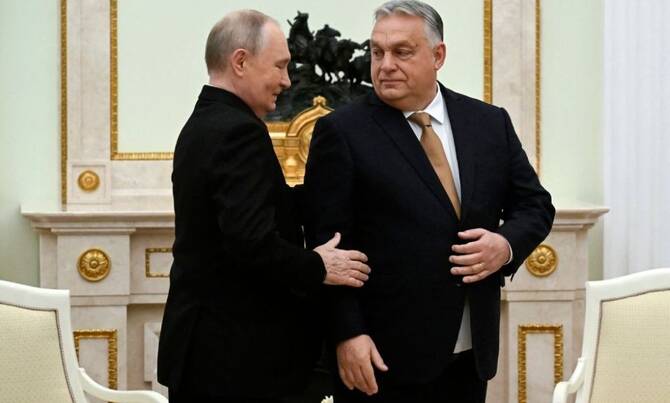
All this could swing European allegiances globally. Viktor Orban of Hungary is already very close to Russia. Typically, far-right parties are attracted to improving ties with Moscow while destroying the EU from within.
The EU is not popular across the continent. Brussels arouses suspicion of a gargantuan and unaccountable hegemon that trounces the aspirations and concerns of nation states. It is easy to whip up hatred against it. It is seen as impervious to dramatic change, away from its expansionist, integrationist agenda. Outside powers such as Russia adopt hybrid warfare to undermine the bloc’s unity, typically with success.
Debates on how to respond to Russia center on a choice of confrontation or appeasement. Is this the choice?
Academics refer to an increasingly multipolar world, a shift from the unipolar world of the 1990s. Yet, in many ways, the multipolar world has been with us for many years and what we are faced with now is a world without poles. Alliances are fluid, as are interests. Sometimes the Trump and Putin administrations appear to be close; at other times, the two superpowers engage in a jingoistic joust boasting of their ever more lethal arsenals.
Europe is caught in between. Some states want to continue to hitch European security to the American juggernaut. Others push for a more independent European military and security architecture, noting the impact of isolationism in the US and debates over just how committed America’s leaders are to their collective, mutual security.
NATO, whose role had been questioned by some within Europe as the Russian threat seemingly receded, is back as the primary military alliance. Is it the security model that is required? The European component of NATO is much stronger than it was five years ago.
Serious capability gaps remain after two decades of underinvestment. Defense spending had plummeted. But this is changing, albeit too slowly for some. Defense companies must be very grateful for Russia’s actions and the subsequent increased threat perception. Even now, cyber and drone defenses in Europe are way behind where they should be. Many European militaries are not adapting to the way wars are now being fought. Procurement is also debilitatingly slow.
Many hoped that standing armies had become a thing of yesteryear. Yet national service is now making a return. President Emmanuel Macron of France last week unveiled plans for a 10-month voluntary national service to commence next summer. The Netherlands, Bulgaria, Belgium, Germany, Poland and Romania have already adopted such schemes, while many Baltic and Scandinavian states have opted for conscription. Opinion polls increasingly show greater support for national service, but the challenge is that this is not the case with the young.
Yet, like turning a tanker in a storm, Europe is the global snail in terms of adapting to geopolitics. US irritation with the lack of defense spending by its NATO allies did not start with President Donald Trump, but it is only now that most states are addressing this issue. For years, European leaders have failed to determine in their own minds whether China is a foe or a friend, a threat or an opportunity. And even though Russia invaded Crimea in 2014, shock and surprise still seemed to accompany its later aggression in 2022.
Is Europe going to get its act together? Was this the rude awakening it needed? The doomsayers enjoy pointing to its decline but Europe still has its strengths. Germany, France and the UK remain major global economies. The EU is still a huge trading bloc, even if the cost of living is still the big priority among voters.
But it is a bloc that likes to stick to the rules, while the dynamic powers and the disruptive states are breaking and ignoring them. The likes of Trump and Vladimir Putin embrace disorder and uncertainty and try to make a strength out of it.
With all the challenges ahead, can Europe address its polycrisis? Is it flexible and dynamic enough to do so? The jury is out.
BY: Writer Chris Doyle is director of the Council for Arab-British Understanding in London.
Disclaimer: Views expressed by writers in this section are their own and do not necessarily reflect The Times Union‘ point of view