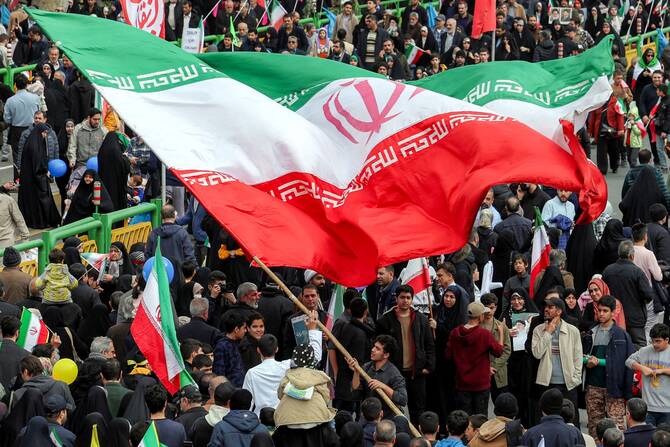
Having followed and observed the Islamic Revolution in Iran consistently and closely for several decades, I find that the 47th anniversary of Ruhollah Khomeini’s return to Tehran aboard an Air France flight is markedly different this year from those in the past. The occasion transcends its ceremonial character to pose serious questions about the fate of a system founded on a revolutionary doctrine that fundamentally reordered priorities and policies in the Middle East; one that replaced the crown of Mohammed Reza Pahlavi with Khomeini’s turban, and substituted alignment with Israel and the US with open hostility.
Today, Iran stands at a crossroads. The pressures it faces exceed its capacity to endure: an isolated economy, and US and international sanctions limiting its ability to invest, sell energy, and conduct trade in proportion to its true economic size. Internally, there are social problems stemming from rising costs of living and inflation that grows day by day. Protests erupt from time to time, some accompanied by unrest and violence. Nor can we overlook external infiltrations of the domestic arena, reflected in extensive intelligence exposure revealed during the 12-day conflict between Tel Aviv and Tehran, in which Mossad demonstrated its ability to operate either through direct elements or local agents to strike military and vital facilities and carry out assassinations that surprised the pillars of the Iranian regime.
US President Donald Trump is now strongly present in Iran’s landscape after 47 years of revolution, presenting it with a choice between a diplomatic agreement or naval fleets equipped with the most advanced military technologies.
Amid all this, pressing questions remain: Where is Iran heading, and which path will it choose?
This approach does not produce lasting social stability
Hassan Al-Mustafa
The political and economic changes are testing the Iranian state’s ability to redefine its legitimacy, from legitimacy rooted in revolutionary mobilization and external confrontation to legitimacy based on delivering development, prosperity, and social stability. This transformation is not a luxury; it is a necessity imposed by economic and social realities and shaped by the structure of conflict with the US and Iran’s network of regional relationships.
In his speech marking the anniversary of the revolution, Supreme Leader Ali Khamenei reaffirmed that “national strength” is not merely a matter of armament, but above all the capacity of society to endure.
Here, Khamenei sought to emphasize that the state considers the “domestic front” to be the primary front of security, and that legitimacy is preserved through cohesion and national unity. Yet this perspective faces the challenge of high cost when “endurance” becomes a daily burden on the middle class, and endurance itself becomes subject to repeated social testing, influenced by low-income levels and protests driven by the collapse in the purchasing power of the Iranian rial.
The authorities are addressing these popular challenges through a logic of “preventive control,” regulating public space and restricting the ability to reproduce waves of protest. This approach may provide short-term security stability, but it does not produce lasting social stability so long as the root causes of the problems remain unaddressed and Iranians do not feel tangible improvements in their daily lives.
Iran today faces deeply intertwined social, economic, security, and political challenges, linked both internally and externally. These issues cannot be managed through mobilizing rhetoric and “strategic patience” because they affect the fundamental conditions of citizens’ daily dignity and livelihood.
The root causes of the problems remain unaddressed
Hassan Al-Mustafa
Iranian policymakers are aware of the dangers posed by the economic situation. For this reason, Tehran seeks to ease sanctions pressure through a negotiating track with Washington, while at the same time maintaining red lines that prevent expanding negotiations to include ballistic missile programs and regional influence.
Statements by President Masoud Pezeshkian affirm that his country does not seek to possess nuclear weapons and is prepared to take verification measures in that regard, while simultaneously rejecting external dictates and opening a window for dialogue and diplomacy. This window cannot be approached as before through buying time; rather, it requires a serious and genuine framework that enables Iran to reach real points of understanding with the US and prevent the outbreak of a new war in the Middle East — a conflict that would open the door to chaos and further violence, and pose a threat to energy security and maritime routes. These are risks that neighboring Arab states do not wish to see materialize, and they are pursuing diplomatic efforts to encourage all parties to make dialogue, not war, the path to resolving outstanding disputes.
Iran’s most likely trajectory will be determined by its ability to achieve three simultaneous transitions. First, a realistic and fair nuclear settlement with the US that reduces economic sanctions and promotes Iran’s economic integration with the Gulf states and its neighbors. Second, reorganizing its internal affairs so that the government provides prosperity and development as the foundation of sustainable legitimacy. Third, adopting a regional good-neighbor policy that moves away from the principle of exporting the revolution and is based instead on cooperation across various issues.
These three contexts are critically important for the Iranian system. Without them, Iran will remain a state striving to endure under American pressure, while being watched by Israel as a potential target for a new war. It will remain a country limited in its ability to produce prosperity. This is the dilemma of the “revolution” that has not yet fully transformed into a development state in the complete sense, a transformation that regional countries encourage and desire, as it serves the interests of the Iranian people and the peoples of a region burdened by conflict and seeking lasting security and development.
BY: Writer Hassan Al-Mustafa is a Saudi writer and researcher interested in Islamic movements, the development of religious discourse, and the relationship between GCC states and Iran.
Disclaimer: Views expressed by writers in this section are their own and do not necessarily reflect The Times Union‘ point of view