Wars are no longer confined to their battlegrounds. Social media has granted them the opportunity to infiltrate far-off places. It is enough for a person to look at their phone to learn about a massacre taking place thousands of kilometers away. The world can no longer claim ignorance over developments taking place around the world.
With images and sounds, the residents of the “global village” can learn about the discovery of a mass grave left behind by a dictatorial regime. In the past, such a discovery would have only been a headline in a local newspaper. Such a story would never have been able to affect people living thousands of kilometers away.
We have already said enough about how the world has witnessed technological and scientific changes in recent decades that have strengthened human capabilities. But at the same time, the world has not made any progress in terms of reining in hatred, the thirst for killing and the elimination of the other.
Extremism is a pandemic more dangerous than any other, claiming more lives than any other. Extremism is not limited to race, color or beliefs. Extremism can reach its own extreme when it turns into an overwhelming need to eliminate others because they are different.
The world tried to contain this pandemic. It set up trials and conflict resolution organizations and stressed the need to respect laws. But despite these efforts, extremism continued to feed on chronic conflicts or old injustices. It also thrived on crises of identity or survival. Perhaps this is an indication of some form of failure in consolidating the values of humanity. It may also be an indication of an absence of a comprehensive cultural revolution that bars the killing of innocents.
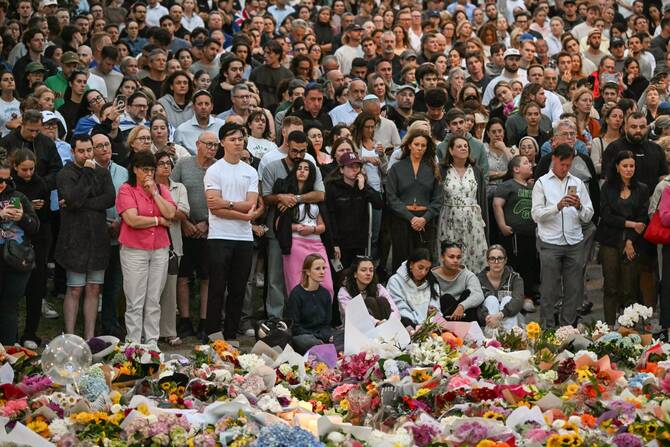
The world was shocked on Sunday with the terrorist attack in Sydney that targeted a Jewish festival. People across the globe witnessed the unfolding horror.
What happened in Sydney cannot be separated from the anger that has mounted for years because of the Israeli military’s savagery in the wake of the Al-Aqsa Flood Operation. People were witness to the unrestrained killing and unprecedented destruction. Tens of thousands of people were killed. Relentless airstrikes forced masses of people to flee their homes and live in tents. The daily images and videos pouring in from Gaza were shocking and cruel and left the viewer with bitterness and a feeling of pent-up frustration. This in no way, however, justifies the targeting of civilians and their killing with such savagery.
The terrorist attack in Sydney took place at a precarious time in the Middle East. The region is awaiting the meeting between Donald Trump and Benjamin Netanyahu at the end of the month. People in the region are hoping that the master of the White House can persuade or force his visitor to facilitate the transition to the second phase of the Gaza ceasefire.
The Sydney attack also took place weeks after the international community broadly recognized a Palestinian state, marking an unprecedented diplomatic success and a step forward in resolving the Palestinian-Israeli conflict based on the two-state solution. Several countries, including Australia, took a step forward and concluded that there can be no resolving this long and bitter conflict without recognizing the Palestinian people’s right to live in an independent state.
The attack took place after countries and organizations came to realize that Israel is not the victim after discovering the extent of the oppression and injustice endured by the Palestinian people.
The most dangerous aspect of the attack is that it has helped fuel discourse about antisemitic practices. It has helped the Netanyahu government again portray itself as a victim by saying that Israel alone is a safe haven for Jews who are being targeted across the globe. The government has a successful record of exploiting such developments, as evidenced by Israeli officials quickly tying the Sydney attack to Australia’s recognition of the state of Palestine.
Extremism is always ready to pounce. A day before the Sydney attack, Syria’s Palmyra was the scene of a significant attack that targeted American and Syrian military personnel. The attack was a reminder that Daesh may have been defeated but it has not been eliminated. The attack was a reminder that building the new Syria under the leadership of Ahmad Al-Sharaa will not be at all easy and that difficult confrontations with extremists lie ahead.
The Middle East has for decades paid the price of unprecedented injustice and practices that sought to eliminate the other. Countries in the region and their people have lost decades of their lives. They have lost opportunities to advance and catch up with the current era. There can be no escaping the endless cycles of injustice, killing and extremism without insistence on pursuing peace and justice. There can be no choice but to build a state of law and institutions and to have respect for international law, human rights and dignity.
There can be no choice but to corner extremist ideology and reject any justification for its behavior and savagery. For far too long, extremism has fed on injustice to justify its existence and proliferation. Tackling extremism starts with tackling injustice against peoples, groups and individuals. Peace can only be built on justice and equality under law.
BY: Writer Ghassan Charbel is editor-in-chief of Asharq Al-Awsat newspaper.
This article first appeared in Asharq Al-Awsat.
Disclaimer: Views expressed by writers in this section are their own and do not necessarily reflect The Times Union‘ point of view