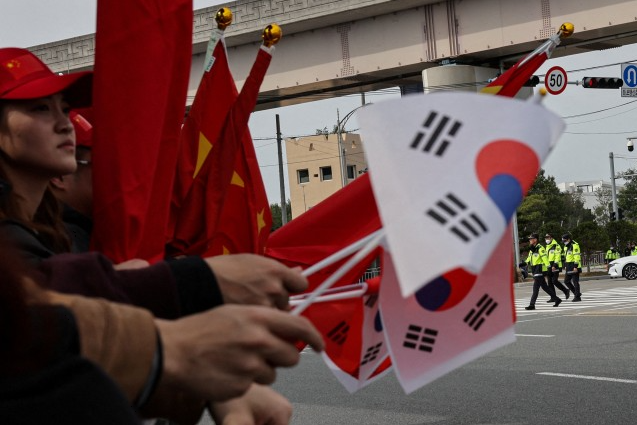
SEOUL/BEIJING: Chinese President Xi Jinping will host South Korean President Lee Jae Myung on a state visit starting on Sunday, signalling Beijing’s intent to strengthen ties with Seoul amidst strained relations with Japan over Taiwan. The visit marks the second meeting between Xi and Lee in just two months, an unusually short interval that signals China’s keen interest in reinforcing ties with Seoul and boosting economic collaboration and tourism, analysts say. Relations between China and Japan hit the lowest point in years after Japanese Prime Minister Sanae Takaichi suggested in November that Tokyo could take military action if Beijing attacked Taiwan.
Xi’s invitation to Lee for a state visit from Sunday is a calculated move aimed at deepening bilateral relations especially before the South Korean leader visits Japan, analysts say.
“China wants to emphasize South Korea’s importance slightly more than before,” said Kang Jun-young, professor of political economics at Hankuk University of Foreign Studies.
“China appears to have strategically decided that it would be better to have (Lee) visit China before South Korea holds a summit with Japan again,” he added.
Wi Sung-lac, Lee’s top security adviser, said on Friday that he expected the Lee-Xi summit to open a “new chapter” in bilateral ties.
He added that the two countries were preparing more than 10 deals on the economy, businesses and climate, although they were not working on a joint statement.
The Lee administration has said it aims to “restore” ties with Beijing, acknowledging China is South Korea’s largest trading partner. The pivot follows strained relations between the two countries under Lee’s predecessor Yoon Suk Yeol, due to his closer alignment with Washington and Tokyo, as well as criticism of China’s handling of Taiwan.
Now, South Korea is trying to maintain a balance but leaning toward cooperation with China to avoid being forced into any troubles that would threaten the Asian industrial powerhouse. Lee said in December he wouldn’t take sides in the diplomatic dispute between China and Japan.
US ALLIANCE AND NORTH KOREA Still, China and South Korea face complex issues as China challenges the US, South Korea’s major ally in the region, and as nuclear-armed North Korea remains unpredictable.
China is North Korea’s major ally and economic lifeline.
Shin Beom-chul, a former South Korean vice defense minister and a senior research fellow at the Sejong Institute, said Xi and Lee might discuss some contentious issues such as efforts to modernize the South Korea-US alliance.
Currently, about 28,500 US troops are based in South Korea to counter any threat from North Korea. US officials have signalled a plan to make those US forces more flexible to respond to other threats, such as defending Taiwan and checking China’s growing military reach.
“Korea is not simply responding to threats on the peninsula,” General Xavier Brunson, commander of US Forces Korea, said at a forum on Dec. 29. “Korea sits at the crossroads of broader regional dynamics that shape the balance of power across Northeast Asia,” he said. Wi, the security adviser, said South Korea would also try to reassure China that its plans to build nuclear-powered submarines were aimed only at deterring North Korea. Lee’s agenda with Xi includes persuading China to facilitate dialogue with North Korea, experts said, at a time when North Korea has dismissed Lee’s outreach.
TECH, SUPPLY CHAINS AND K-POP Lee’s visit to Beijing is also expected to address cooperation in areas including critical minerals, supply chain and green industries, his office said earlier.
Seoul sources nearly half of its supply of rare earth minerals, critical to semiconductor manufacturing, from China. Beijing also accounts for a third of Seoul’s annual chip exports, the largest market by far. Last month, South Korean Industry Minister Kim Jung-kwan and Chinese Commerce Minister Wang Wentao agreed to work toward stable rare earth supplies, South Korea said.
The visit may also foster partnerships on artificial intelligence and advanced technologies, experts said. China’s Huawei Technologies plans to roll out the Ascend 950 AI chips in South Korea this year, aiming to provide an alternative to Nvidia for Korean firms, Huawei’s South Korea CEO Balian Wang told a press conference last month.
Wang mentioned ongoing discussions with potential customers, without naming those clients. Huawei did not respond to questions from Reuters about Wang’s comments.
BY: The Times Union