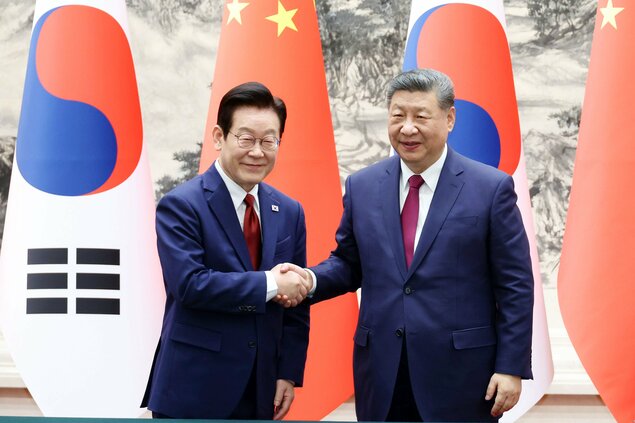
BEIJING – Chinese President Xi Jinping on Monday sought a united front with South Korea against Japan amid Sino-Japanese tensions over Japanese Prime Minister Sanae Takaichi’s remarks on Taiwan, citing their past “tremendous sacrifices” in defeating Japanese militarism, Chinese state-run media said.
In his talks with South Korean President Lee Jae Myung in Beijing, Xi said China and South Korea should “firmly stand on the right side of history” and make “correct and strategic choices,” according to the reports, indicating a willingness to work together on history issues concerning Japan.
The diplomatic row between Beijing and Tokyo stems from Takaichi’s Nov. 7 remarks in parliament that suggested an attack on Taiwan could draw in Japanese defense forces in support of the United States.
Recent Chinese commentary has often characterized the government under Takaichi, known for her hawkish views on security, as seeking to revive Japan’s wartime militarism.
Xi also said China and South Korea should “join hands to safeguard the fruits of victory in World War II” and “protect peace and stability in Northeast Asia,” according to the reports.
Lee was quoted by the Chinese media as saying Seoul respects Beijing’s “core interests and major concerns” and adheres to the stance that the Communist-led mainland is the sole legal government of China and that Taiwan is part of it.
The mainland views the self-ruled democratic island as a renegade province that must be reunified with it by force, if necessary.
The two leaders agreed to improve bilateral relations by promoting “strategic cooperative partnership,” the Chinese media reports and the South Korean government said, after they deteriorated under Lee’s predecessor Yoon Suk Yeol, who pursued a pro-U.S. foreign policy and boosted trilateral cooperation that included Japan.
At the outset of the summit meeting, which was open to the media, Lee said his talks with Xi would help establish 2026 as the year for the “full restoration” of bilateral ties.
Lee also said South Korea and China must ensure that they “contribute jointly to peace” on the Korean Peninsula, referring to Pyongyang’s nuclear and missile development.
On the economic front, Xi said the two countries should strengthen cooperation in emerging fields such as artificial intelligence and green industries, according to the Chinese media.
The South Korean leader, who is on his first visit to China since taking office in June, is being accompanied by business leaders. China is South Korea’s largest trading partner.
Following their talks, Xi and Lee witnessed the signing of 15 cooperation documents in areas including scientific and technological innovation, ecological environment and transportation.
The two leaders last met in November during the Chinese president’s first state visit to South Korea in 11 years for the Asia-Pacific Economic Cooperation forum summit in Gyeongju. Lee is the first South Korean president to visit China since 2019.
In December, Lee said his country wants to help lower tensions between Japan and China, indicating Seoul would remain neutral as taking sides would “only escalate the conflict.”
On Wednesday, Lee is set to visit a historic site in Shanghai that once housed the Provisional Government of the Republic of Korea established by independence activists during Japan’s 1910-1945 colonial rule of the Korean Peninsula.
Referring to the wartime past, when both South Korea and China suffered from Japan’s military aggression, Lee told Xi, “Even during times when our national sovereignty was stripped away, we joined hands and fought together for its restoration,” according to his office.
In the run-up to the Xi-Lee talks, China’s top diplomat Wang Yi warned of “attempts by certain political forces in Japan to reverse the course of history and whitewash the crimes of aggression and colonialism” in his phone talks with South Korean counterpart Cho Hyun.
During the call on Wednesday last week, Wang expressed his belief that South Korea will “uphold a responsible attitude” toward history and “adopt the correct stance,” indicating Beijing’s eagerness to jointly work with Seoul amid its feud with Tokyo.
Lee will likely visit Japan in mid-January for a summit meeting with Takaichi, with their talks expected to be held in Nara, Takaichi’s home prefecture, according to diplomatic sources.
BY: The Times Union