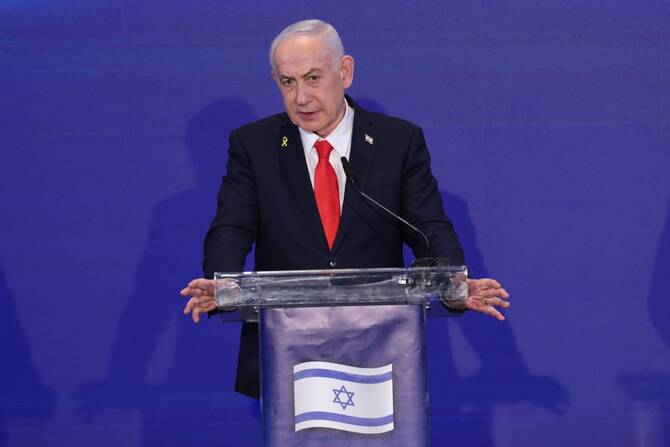
Israeli Prime Minister Benjamin Netanyahu is expected to meet President Donald Trump before the end of this month at the president’s Mar-a-Lago Florida resort, where Hebrew media predict Iran’s nuclear and long-range missile programs will feature prominently on the agenda.
Earlier this week, representatives of the US, Qatar, Egypt, and Turkey met in Miami to discuss moving to phase two of Trump’s Gaza peace plan. The mediators hailed the success of the first phase and urged Israel and Hamas to exercise restraint and avoid returning to war.
Netanyahu has come under US pressure to accept moving to phase two, which includes the formation and deployment of a stabilization force in Gaza, establishing a board of peace, and initiating reconstruction plans, as well as disarming Hamas and other Palestinian factions. He recently hinted that “the second phase was close,” but was vague on details.
Israeli officials have responded that there can never be a phase two before Hamas disarms fully — something to which the Islamist group, which remains the de facto ruler of less than half the strip, has refused to commit. Egypt, as a mediator and one of the guarantors of Trump’s plan, has held meetings in Cairo to discuss ways to deliver on that complex condition, but Hamas has been unrelenting, arguing it will not hand over its weapons until Israel withdraws completely from Gaza. Hamas has also accused Israel of violating the ceasefire agreement by bombing Hamas-controlled areas daily.
Pundits agree that Trump is committed to his 20-point plan and wants to see it fully implemented. According to various media sources, Trump scolded Netanyahu last week when Israel assassinated a key Hamas military commander in Gaza in what the US considered a grave violation of the ceasefire.
Netanyahu finds himself in a bind. He clearly fears committing to phase two of the plan, which would disable Israel’s ability to have a free hand in Gaza. His far-right partners are openly against ceding land and pulling the Israeli army out of areas under its control, which constitutes more than half the enclave under what is called the Yellow Line.
Israel’s breaches of the ceasefire agreement have been called out by the UN and aid agencies, as well as Turkey, Qatar, and Egypt. Netanyahu has been scrambling to find ways to avoid future commitments. He is trying to distract Trump and his aides by pointing to Iran, Syria, and Lebanon, as well as Hamas. The Israeli conservative press has been discussing a major Israeli military operation against Hezbollah in Lebanon, claiming that the Iran-backed group is rearming and refusing to hand over its weapons to the Beirut government.
In Syria, Israel continues to carry out airstrikes and land incursions, while top officials say Israel will never withdraw from strategic areas it occupied after the fall of Bashar Assad last year, especially in the Occupied Golan Heights. Netanyahu is said to be furious about the US move to lift all sanctions on Syria.
At home, Netanyahu is under pressure for refusing to form an independent fact-finding commission on the Oct. 7, 2023 Hamas attacks. He is now putting together a government-led committee, whose members he will appoint, to investigate the attacks.
To appease his radical supporters, he has unleashed the largest settlement expansion plans in the occupied West Bank since 1967. On Sunday, a government security committee authorized the building or expansion of 19 illegal settlements across the West Bank.
Meanwhile, the occupation army has intensified its raids and siege of Palestinian villages and towns while looking the other way as settlers wage a campaign of terror against the residents. Alongside these extreme actions, Israeli authorities are demolishing Palestinian homes in Silwan and refugee camps, rendering thousands of Palestinians homeless.
By setting his sights on Iran again, Netanyahu hopes to use the Trump administration to wage war on the Tehran government and distract from moving to the second Gaza phase. If that fails, he will try to convince Trump to give him the green light to carry out a new offensive in Lebanon. If that also fails, he will suggest that Hamas has not abided by its side of the deal and that there can be no transition in Gaza without the full disarmament of Hamas.
Israeli media has suggested that Israel is close to making its section of Gaza arms-free and will then give top priority to reconstruction plans in areas under its control. The international press is not allowed into the enclave, and the Rafah border crossing remains closed. Palestinian reporters have claimed that Israel has carried out wide-ranging destruction of infrastructure in the Yellow Line areas. Israel has also armed Palestinian gangs opposed to Hamas in an attempt to weaken the group’s grip over areas under its control.
The Trump-Netanyahu summit will be crucial in many ways. It will determine whether the US president can force the Israeli premier to accept the realities of phase two, which includes forming a technocrat Palestinian interim government in Gaza and deploying a stabilization force. Expect Netanyahu to exploit every technicality — demanding impossible verification standards for Hamas weapons, disputing which areas constitute the Yellow Line, and manufacturing security incidents to delay troop withdrawals.
Trump, on the other hand, has stood by Netanyahu as he faces a challenging corruption trial and has asked the Israeli president to issue a pardon. But it is unclear whether that support extends to allowing another strike against Iran or even a resumption of Israel’s war in Lebanon.
Netanyahu has consistently chosen political survival over peace. Phase two of Trump’s plan represents a loss of control he cannot accept and carries a hefty political price at home. Watch for escalating defensive operations, new preconditions, and claims that Palestinian violations justify Israeli non-compliance. Trump’s deal, however well-intentioned, underestimates Netanyahu’s mastery of obstruction.
BY: Writer Osama Al-Sharif is a journalist and political commentator based in Amman.
Disclaimer: Views expressed by writers in this section are their own and do not necessarily reflect The Times Union‘ point of view