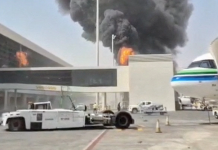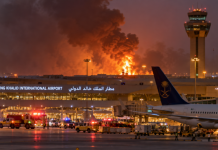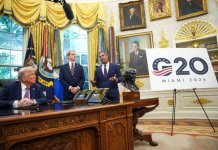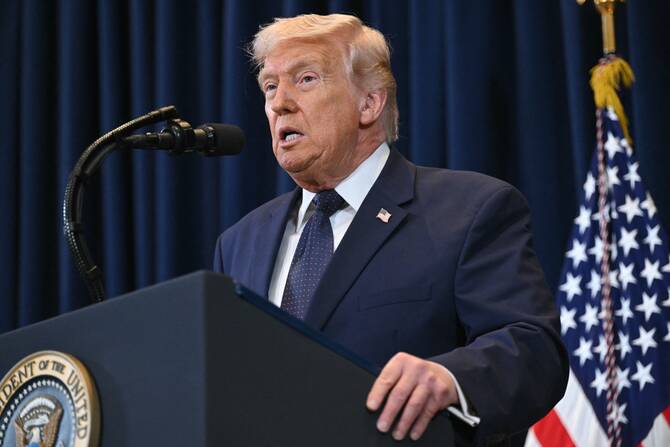
US President Donald Trump hinted on Monday that the war against Iran could end soon, saying “we’re far ahead of schedule” and joint US military operations with Israel were “very complete, pretty much.” On the same day, the Pentagon sent a different message, posting a message on social media saying “no mercy” and “we have only just begun to fight.”
If the Trump administration’s messaging on the Iran war sounds confusing, it is important to keep in mind: this is the point. The mixed messages are intentional, not just the product of incompetence. A key part of Trumpian strategic communications is to leave everyone guessing — the entire world, friend and foe alike — to gain leverage by knocking everyone off balance.
The method to this madness fits with the template the Trump team deployed in the weeks before the war, when it offered a wide range of rationales for war — from regime change to protecting the Iranian people to ending the country’s nuclear program and ballistic missile threat.
US presidents typically seek to build national consensus to unify the country during war, but that is not how Trump operates
Brian Katulis
But this strategy appears to be hampering Trump’s ability to garner public support for military action because there is no central goal. Public backing is necessary to win approval in Congress for the additional funding necessary to replenish the arms expended in this conflict.
Most Americans oppose the war and how Trump has handled it. The latest NPR/PBS News/Marist poll found that only 36 percent of Americans approve of how Trump is dealing with Iran. Also, a majority of Americans (56 percent) oppose the war in Iran, with 44 percent expressing support.
These numbers are quite low compared to historical levels of US public opinion at the start of military campaigns — the Iraq and Afghanistan wars in the 2000s, as well as the fight against Daesh in the 2010s — when the wars had majority support among the American public. Public support for these wars declined over time as the costs in US lives and taxpayer dollars rose.
US presidents typically seek to build national consensus to unify the country during war, but that is not how Trump operates. He used his State of the Union address last month to divide the country on a wide range of domestic and foreign policy issues and he only briefly mentioned Iran toward the end of a long speech. In addition, when America enters a conflict, it often produces a “rally round the flag” approach in the early days, with Americans looking to support US troops in harm’s way.
But that was not the case in the opening days of this war on Iran, which may be one of the reasons why Trump and his team might be signaling that they would like to wrap it up sooner rather than later. With midterm elections less than nine months away, the last thing he wants to see is a further erosion of public support, which was already at its lowest point before this unpopular war began, with six in 10 Americans disapproving of the job Trump is doing overall.
In a domestic political context, Trump’s decision to go to war against Iran alongside Israel could prove to be reckless
Brian Katulis
For its part, Iran’s Islamic Revolutionary Guard Corps says it will be the one to “determine the end of the war,” reacting to Trump’s comment on Monday. “The equations and future status of the region are now in the hands of our armed forces; American forces will not end the war,” the statement added.
One potential political liability for Trump with this war is the risk that the spike in gas prices could further weaken US public perceptions about how he has handled the economy and inflation, which remain the top concern among US voters. A Reuters/Ipsos poll conducted this past week found that 67 percent of Americans expect gas prices to rise after the Iran strikes. A second vulnerability in this war comes with the risk that more US troops could die in combat.
In this domestic political context, Trump’s decision to go to war against Iran alongside Israel, without much of an attempt to build public consensus, could prove to be reckless — especially given the fact that the decision was taken without consulting or support from regional partners, like Saudi Arabia, Qatar, the UAE, Egypt and Jordan.
In the end, US public support for the Iran war will be closely linked to how things fare on the battlefield. It may be that the tactical successes of eliminating the Iranian regime’s top leaders on Day 1 could serve as the high-water mark of success unless the Trump administration offers a clearer end goal to the US public. The longer this war drags on, the riskier it becomes for Trump.
BY: Brian Katulis is a senior fellow at the Middle East Institute, specializing in US foreign policy and national security. He hosts the MEI podcast series “Taking the Edge Off the Middle East” and authors the column “Making Sense: A Regular Take on US Foreign Policy.” His career also includes significant experience at the National Security Council, the US Department of State and the US Department of Defense.
Disclaimer: Views expressed by writers in this section are their own and do not necessarily reflect The Times Union‘ point of view