- First Pakistani Astronaut Heads into Orbit as China Launches Landmark International Space Mission
- Three-Member Crew Successfully Takes Off from Jiuquan; Ali to Conduct Scientific Experiments During His Stay in Space
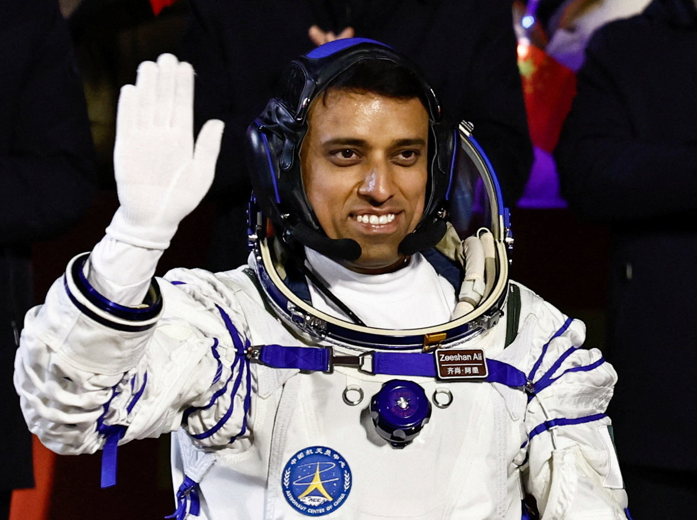
JIUQUAN, China: Pakistan has achieved a historic milestone in space exploration as its national, Zeeshan Ali, joined China’s Shenzhou-24 mission, becoming the first Pakistani astronaut to travel into orbit and the first foreign astronaut to board China’s Tiangong space station.
The spacecraft, carrying a three-member crew, was successfully launched at 8:18 a.m. local time on Wednesday from the Jiuquan Satellite Launch Center in northwestern China aboard a Long March-2F carrier rocket.
The landmark mission represents a significant development in Pakistan-China scientific and technological cooperation, opening a new chapter in the two countries’ collaboration in space exploration.
Pakistani Pilot to Conduct Scientific Experiments in Space
Forty-year-old Zeeshan Ali, an experienced pilot, is serving as a payload specialist and is expected to spend between five and 10 days aboard the Tiangong space station.
During his stay, he will participate in scientific experiments and research activities, contributing to China’s expanding programme of international space cooperation.
Ali is accompanied by Chinese mission commander Tang Hongbo and flight engineer Wu Yi, forming the three-member crew of the Shenzhou-24 mission.
Seven Months of Intensive Training in China
In preparation for the historic journey, Ali completed seven months of intensive astronaut training in Beijing. His preparation included technical and operational exercises, alongside extensive Chinese-language instruction.
His training also introduced him to Chinese culture, including learning traditional songs, reading Chinese poetry, practising calligraphy and playing table tennis.
The comprehensive programme was designed to prepare him for the technical demands of the mission as well as life and teamwork aboard China’s orbital laboratory.
‘I Carry the Name of Pakistan on My Shoulder’
Speaking to reporters on Tuesday, Ali expressed his pride and sense of responsibility in representing Pakistan on the international stage.
“I’m not flying for myself. I carry the name of Pakistan on my shoulder,” he said.
His remarks reflected the national significance of the mission and the aspirations associated with Pakistan’s growing engagement in advanced science, technology and space research.
China Expands International Cooperation Through Tiangong
China is increasingly positioning its Tiangong space station as a platform for international scientific collaboration and peaceful exploration beyond Earth.
The development comes as the future of the US-led International Space Station (ISS) remains under consideration, with its retirement currently anticipated around 2030.
Through international missions and scientific partnerships, Beijing aims to expand opportunities for foreign astronauts and researchers to participate in its space programme.
A New Chapter in Pakistan-China Scientific Partnership
Zeeshan Ali’s participation in the Shenzhou-24 mission marks an important moment for Pakistan’s scientific ambitions and its longstanding strategic partnership with China.
Beyond its symbolic significance, the mission offers opportunities for knowledge exchange, scientific research and the development of future cooperation in aerospace technology.
For Pakistan, the journey represents a proud step towards greater participation in international space exploration and the advancement of its capabilities in science and technology.
By: The Times Union | International News Desk