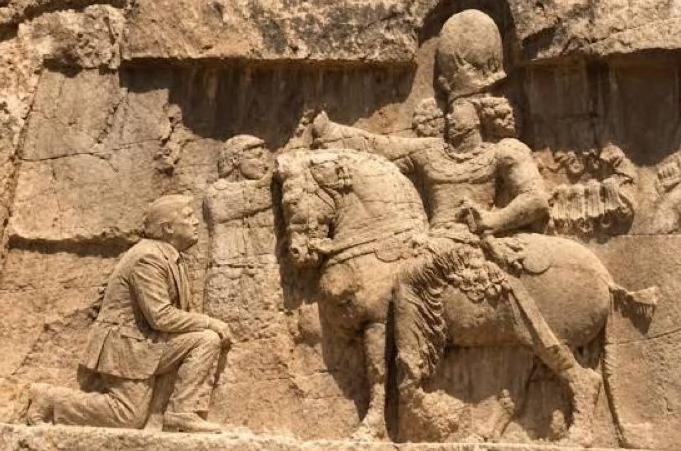
Recent remarks made by U.S. Secretary of State Marco Rubio in Athens, referring to the invasion of Greece by Xerxes, king of the Achaemenid Empire, and the burning of its cities, go beyond an impartial historical analysis. Rather, as the author argues, they represent a selective attempt to distort the image of Iran’s ancient civilization while whitewashing the West’s violent past. In response, a fair and balanced examination of history is essential.
1. A Civilization That Championed Human Rights
With a civilization spanning thousands of years, Iran has long upheld the ideals of peace and human dignity. The charter of Cyrus the Great, widely regarded as the world’s earliest human rights charter, emphasized freedom, peace, and respect for the rights of all peoples some 2,600 years ago.
This land is also the birthplace of great thinkers such as Avicenna, Zakariya al-Razi, Al-Biruni, Omar Khayyam of Nishapur, Saadi of Shiraz, and Ferdowsi of Tus. Each made remarkable contributions to medicine, astronomy, mathematics, philosophy, or literature, illuminating the path of knowledge and ethical thought.
Iran’s history is a story of creation, growth, and flourishing—not destruction.
2. Two Centuries of Peace Versus Two Centuries of Western Aggression
Over the past two hundred years, Iran has not initiated a war of aggression. Iran’s last offensive war dates back to the early decades of the nineteenth century. Since then, Iran itself has been a victim of aggression by colonial and Western powers.
In contrast, Western powers, led by the United States, have been responsible for some of the bloodiest wars and gravest atrocities in modern history. A few examples are presented below:
Genocide of Native Americans: In 1492, the Indigenous population of the Americas was estimated at around five million. By the early twentieth century, it had fallen to just 250,000. This decline was attributed to massacres, forced displacement, and genocidal policies.
Atomic Bombings of Japan: In 1945, the United States dropped atomic bombs on Hiroshima and Nagasaki, killing an estimated 150,000 to 246,000 civilians.
The Vietnam War: The My Lai massacre in March 1968 stands as a stark example of atrocities committed by American troops. Hundreds of defenceless women, children, and elderly people were massacred in the incident.
The War in Afghanistan: The twenty-year U.S. occupation of Afghanistan resulted in the deaths of more than 40,000 civilians and displaced millions of people.
The Iraq War: In 2003, the United States invaded Iraq on the basis of false claims that the country possessed weapons of mass destruction. The war resulted in the deaths of an estimated 200,000 to 250,000 Iraqi civilians.
Downing of Iran Air Flight 655: On July 3, 1988, the U.S. Navy cruiser USS Vincennes shot down an Iran Air passenger plane carrying 290 people, including 66 children.
The Minab School Tragedy: A U.S. airstrike on the Shajareh Tayyebeh primary school in Minab reportedly killed more than 150 people, most of them schoolgirls between the ages of seven and twelve.
3. Final Words
History cannot be written through distortion or the selective presentation of facts. Drawing on the rich legacy of Cyrus the Great, Avicenna, and Saadi, Iran has consistently sought peace and dialogue.
What the West and the United States have imposed on humanity over the past two centuries—from the genocide of Indigenous peoples and the atomic bombings to the wars in Vietnam, Afghanistan, and Iraq, and from the downing of Iran Air Flight 655 to the Minab school tragedy—reveals, in the author’s view, the true face of those who falsely claim to champion human rights.
Today, drawing strength from its ancient civilization and peace-loving people, Iran stands alongside the oppressed nations of the world.
Disclaimer: The article presented above is a compilation of information drawn from publicly available sources, including news reports, social media accounts, and other open-source materials. It is intended for informational and analytical purposes only. The views expressed are solely the writer’s opinion and do not reflect the position of The Times Union.