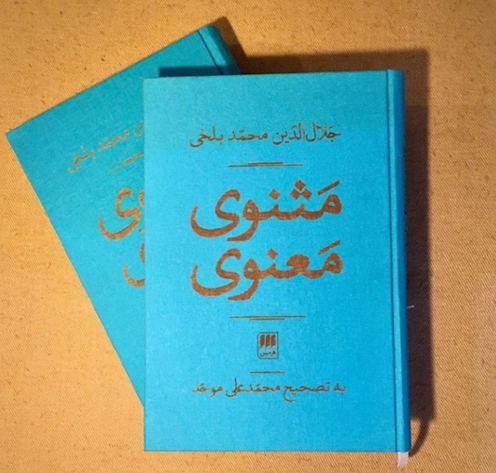
To truly understand and appreciate any literary work, it is important to engage with it in its original language, especially when the work is poetry. The beauty of poetry is deeply connected to the language through which the poet expresses his thoughts, beliefs, and inner world. However accurate or faithful a translation may be, some of the beauty and subtlety of the original is inevitably lost in translation. Learning the original language therefore allows us to understand, appreciate, and enjoy a literary work on a deeper level. One such masterpiece is the Masnavi-ye Ma’navi of Jalal al-Din Muhammad Rumi.
The question, “Why is the Masnavi-ye Ma’navi written in Persian?” can be explored from several perspectives: from Rumi’s mother tongue and the social standing of Persian in seventh-century Konya to his own conscious and mystical choice of language.
Mother Tongue: Roots in Balkh and Greater Khorasan
Persian was Rumi’s mother tongue. He was born in Balkh,( in Greater Khorasan,) and grew up in a Persian-speaking environment. His father, Baha al-Din Walad, was also a Persian speaker, and this linguistic heritage naturally provided the foundation for Rumi’s composition of the Masnavi in Persian. The renowned Iranian scholar Abdolhossein Zarrinkoub even maintained that in Rumi’s time, Persian was spoken by ordinary people in the streets and marketplaces of Konya as well.
Persian as the Language of Culture and Communication
In Rumi’s time, Konya was a multicultural city and a meeting place of Iranian, Roman, and Islamic cultures. In Anatolia, Persian was the language of administration, literature, and culture, and the Seljuk sultans conducted their correspondence in Persian. It was in this environment that Rumi consciously chose Persian, as it was the principal language through which mystical thought was expressed across this cultural sphere.
A Loving Choice: Persian, the Language of Inspiration and Attraction
Beyond these historical factors, Rumi had a deep love for the Persian language. He himself says:
“Muslims, Muslims, I shall speak in the Persian tongue;
for it is not fitting, when sweets are being shared in a gathering, to eat them alone.”
These words show that, for Rumi, Persian was a language through which the mystical experience could be shared with others, rather than a language imposed upon him. He regarded Persian as the “language of inspiration and attraction.”
Beyond Borders: Persian as a Universal Language
Rumi composed the Masnavi in Konya, far from the Persian-speaking lands. His choice of Persian helped elevate the language from a regional medium to an international language of mysticism. The Masnavi came to be known as the “Persian Qur’an,” while the tradition of Masnavi recitation became a means of spreading Persian language and literature throughout the Ottoman realm. Even today, commemorative ceremonies for Rumi in Konya can be seen, in many respects, as a celebration of the influence and enduring power of the Persian language.
Concluding Remarks
The Masnavi is in Persian because Persian was Rumi’s mother tongue, because it was the language of culture and communication in the Konya of his time, and, above all, because it was the language he chose for his loving communion with the Eternal Beloved. For him, Persian was not merely a means of communication; it was a home in which the soul could dwell. Perhaps this is why, even after centuries, his words in Persian still carry the sweetness of sugar and honey.
In the end, let us go beyond reading translations and take the step of learning Persian. The Masnavi-ye Ma’navi is not merely a book; it is an invitation to enter a world whose key is the Persian language. If you have so far encountered Rumi only through translations, begin today—with the alphabet, with a few words, with a single couplet, or with a ghazal. You will discover that every Persian letter opens a window onto the endless garden of poetry and mysticism.
Learning Persian is not simply learning a language; it is a journey into the heart of a culture, literature, and intellectual tradition in which Rumi, Hafez, Saadi, Ferdowsi, and Attar lived and breathed. Through Persian, you can hear the Masnavi in its own language, feel the music of its words, and experience a pleasure that no translation, however masterful, can fully convey.
So do not delay. Learn Persian—not only to read Rumi, but also to open a new window onto your spirit and your appreciation of beauty. Every word you learn is a step toward a treasure that has been waiting for you for centuries.
The House of Culture of the Islamic Republic of Iran is ready to help you learn this beautiful language.

Disclaimer: The article presented above is a compilation of information drawn from publicly available sources, including news reports, social media accounts, and other open-source materials. It is intended for informational and analytical purposes only. The views expressed are solely the writer’s opinion and do not reflect the position of The Times Union.